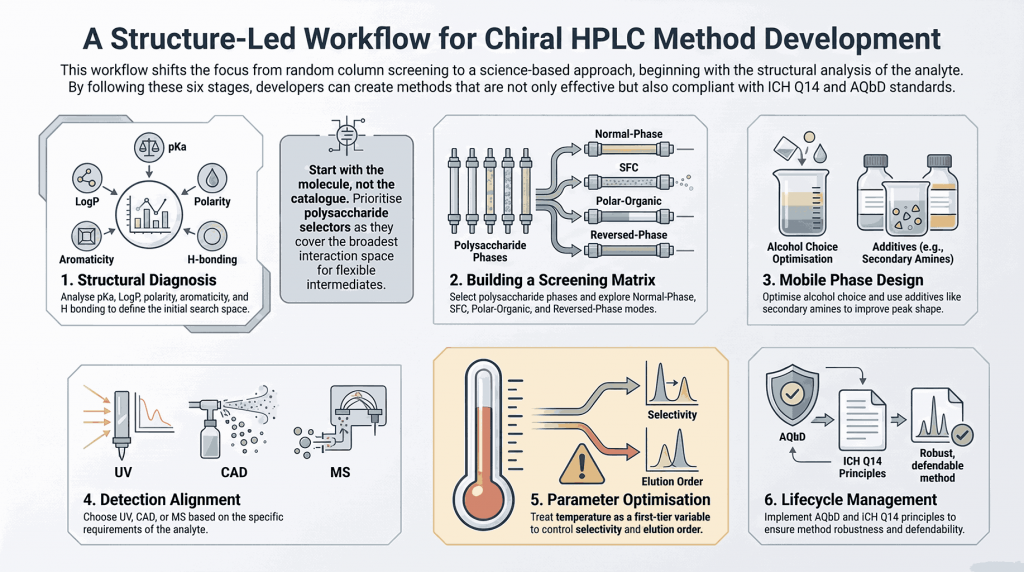
From a structural diagnosis of the analyte to a defendable, robust, lifecycle-ready method
Start with the molecule, not the column catalogue
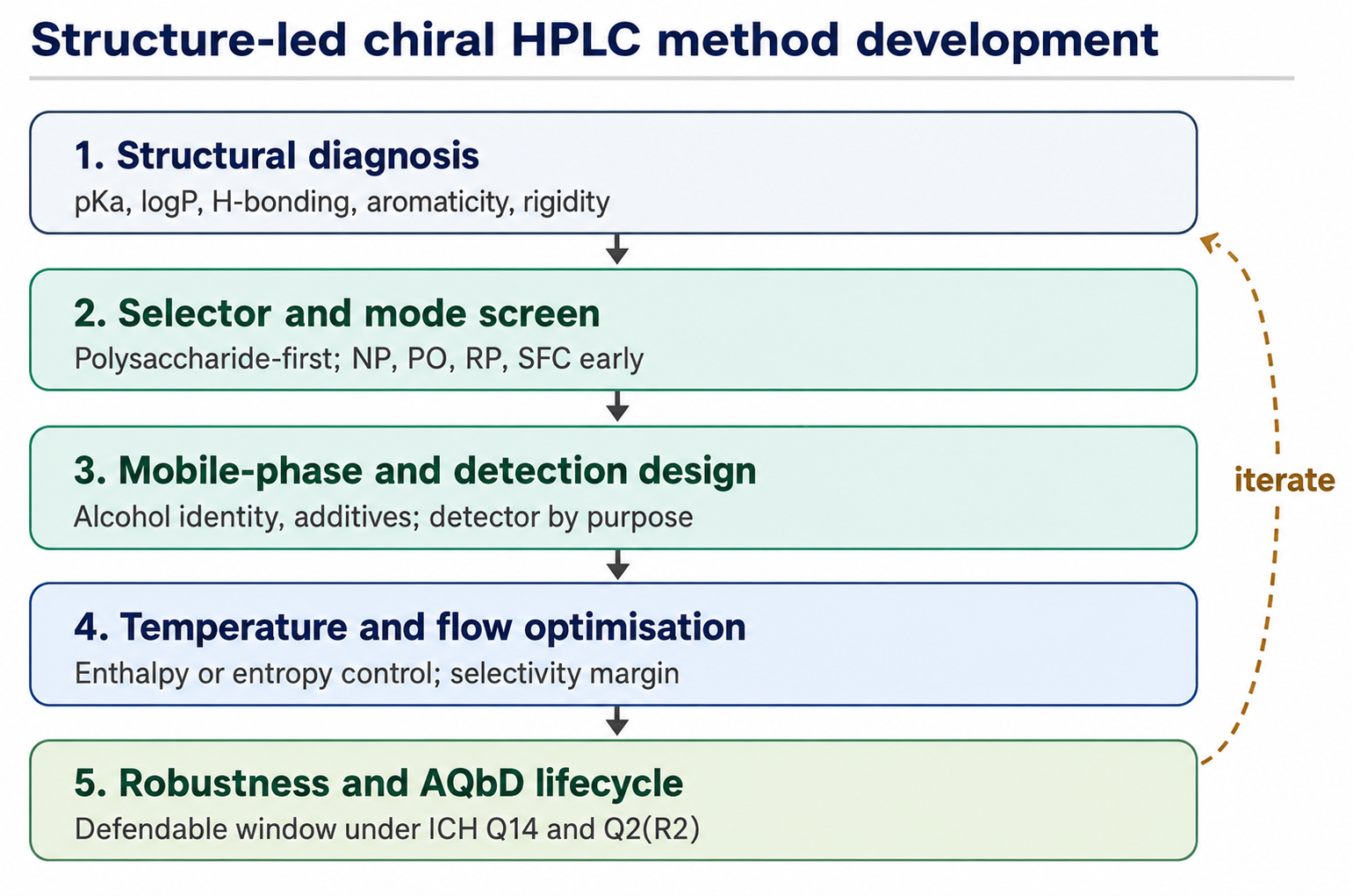
A credible chiral method does not begin with random column screening. It begins with a short structural diagnosis of the analyte and the likely impurity set. The pKa values indicate whether the analyte is neutral, cationic, anionic, or zwitterionic in the modes under consideration. LogP and overall polarity indicate whether solubility favours hydrocarbon-rich, polar-organic, aqueous, or SFC conditions. Aromaticity, hydrogen-bond donors and acceptors, conformational flexibility, halogenation, and steric bulk all influence which recognition motifs are likely to matter on a CSP. ICH Q14 treats this prior knowledge as a legitimate and important input to procedure development and lifecycle management. [1]
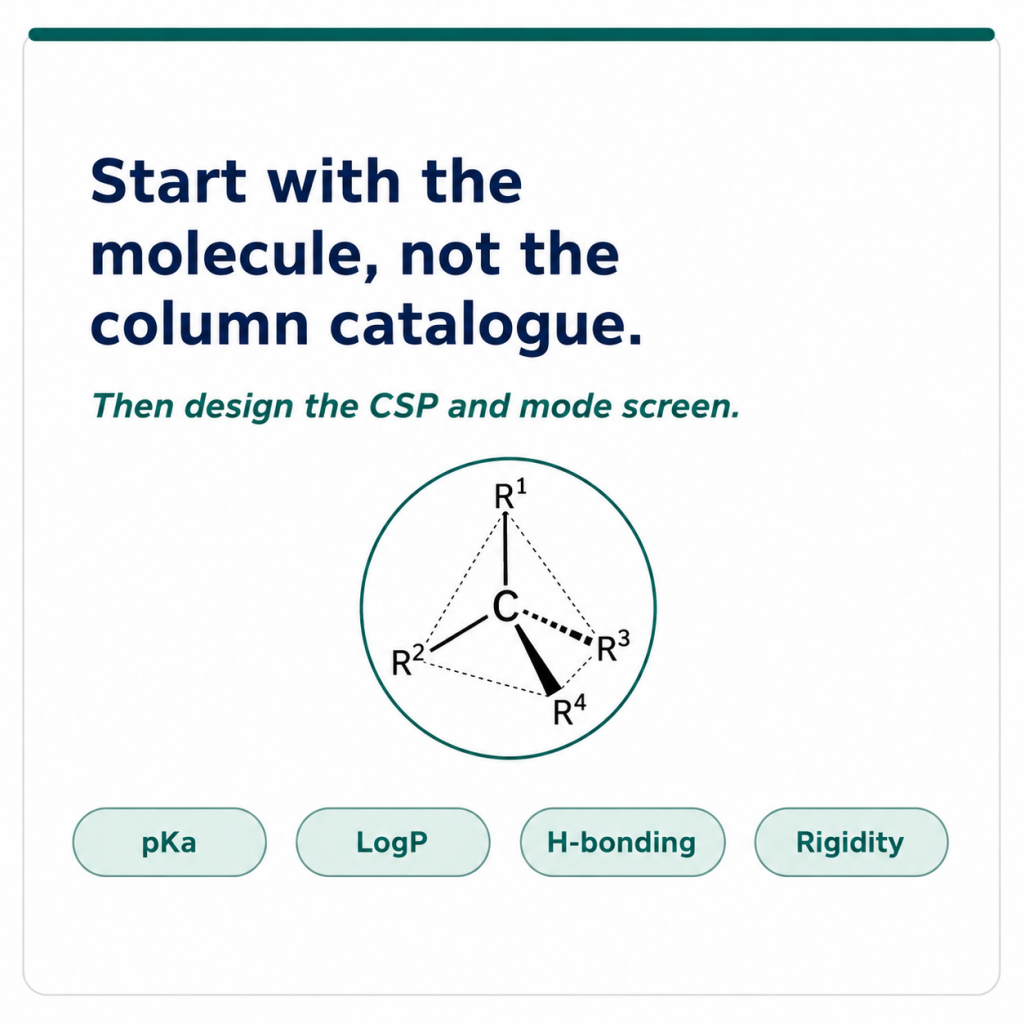
That structural read does not predict the winner with certainty, but it improves the first-pass screen. Highly basic amines respond differently to macrocyclic glycopeptide, crown-ether, or polysaccharide phases than neutral aromatic heterocycles do. Amino-acid-like compounds may fit niche selectors well. Conformationally flexible aromatic intermediates and APIs are usually best assessed first on polysaccharide selectors because those phases cover a broad interaction space, and recent reviews still place them at the centre of practical method development. [2,3,4]
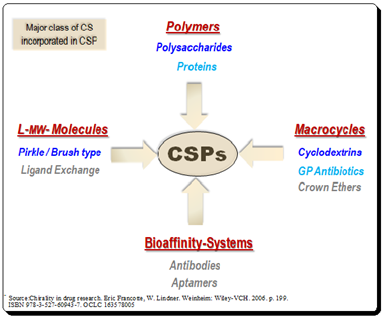
Build a screening matrix that is broad enough to learn from
The efficient way to screen is to vary both selector and mode in a controlled way. Pharmaceutical chiral screening has evolved from ad hoc scouting to structured selector libraries and abbreviated mode panels, and the industrial need for faster, higher-throughput screens has grown as sample loads and molecular diversity increased. [5,6]
For small-molecule work, a practical starting panel often includes several polysaccharide phases representing both amylose and cellulose chemistries, together with a limited set of conditions covering normal-phase, polar-organic, and reversed-phase modes. If SFC is available it should be considered early rather than kept as a rescue technique, because its selectivity can be complementary and its productivity superior. Macrocyclic glycopeptide or cyclodextrin phases can be added when polarity, functionality, or prior experience suggests a fit. [2,7,8]
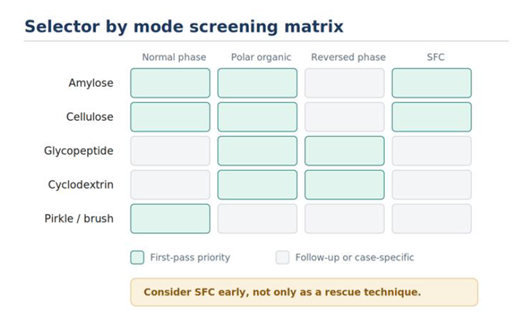
Established practice favours structured screening. Current best practice narrows the selector library using prior knowledge, then explores a deliberately chosen mode matrix rather than a single solvent family. Emerging practice adds automated column switching, response ranking, and software-assisted optimisation to shorten the screen without claiming that the chemistry has become fully predictable. Computer-assisted optimisation illustrates both the potential and the limit: software can reduce the experimental burden, but only after a sensible initial search space has been defined. [5,6,9]
Why polysaccharide phases dominate the first pass
Polysaccharide CSPs dominate because they are unusually versatile. Amylose and cellulose derivatives provide broad enantioselectivity across structurally diverse APIs, intermediates, metabolites, and related impurities. Their dominance is reinforced by loadability, multimodal solvent compatibility, and a strong bridge from analytical to preparative work. [2,3,4] Read more @ <https://chiralpedia.com/blog/polysaccharide-based-csps/>.
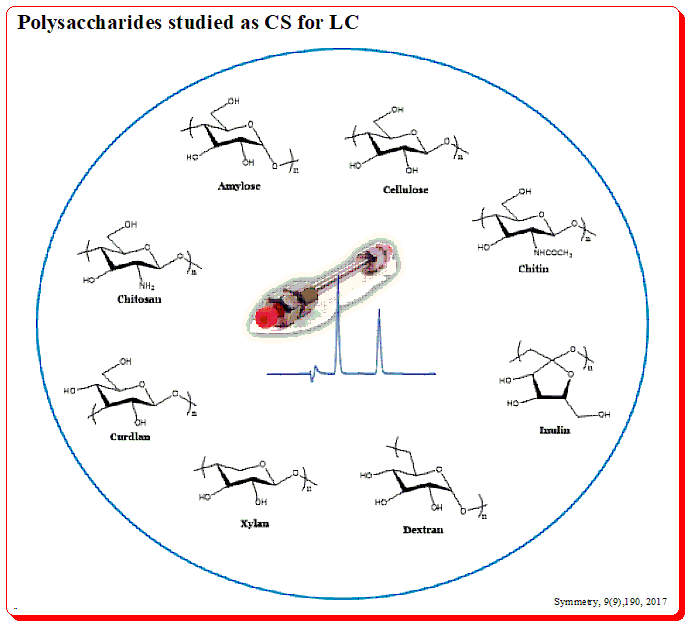
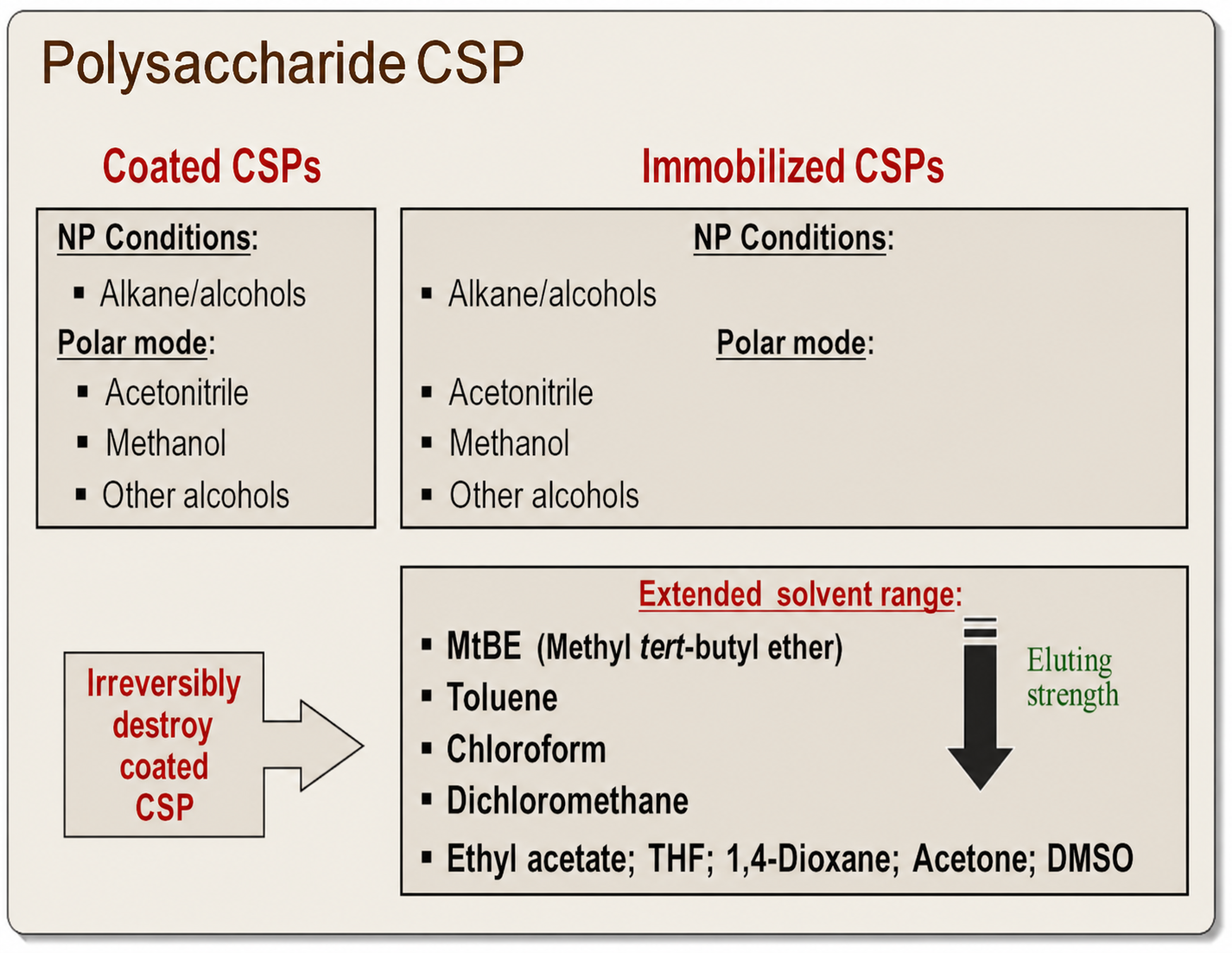
The coated-versus-immobilised distinction matters operationally, and it is defined here once for the whole series. Coated phases often give excellent selectivity but are solvent-limited. Immobilised phases trade some interpretive simplicity for much wider solvent compatibility, which can be decisive when the sample requires tetrahydrofuran, methyl tert-butyl ether, chlorinated solvents, strong alcohols, or unusual scouting mixtures. Immobilisation expanded the accessible solvent space and strengthened the role of polysaccharide phases in both HPLC and SFC. [2,10]
Mobile phase design is where most good screens become useful methods
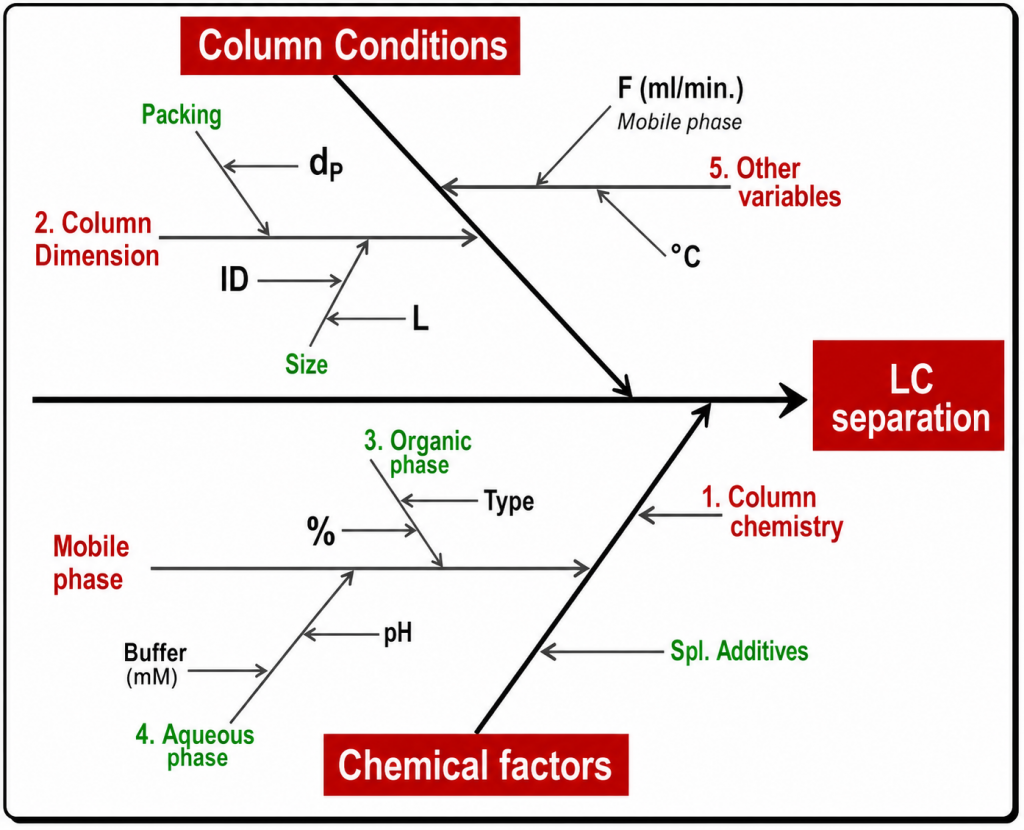
Once a promising selector is found, mobile-phase design converts separation into a working procedure. In normal-phase or SFC-like contexts, hydrocarbon plus alcohol systems provide the basic language, with hexane or heptane plus ethanol, methanol, or isopropanol remaining common. In polar-organic mode, methanol, ethanol, acetonitrile, or their mixtures often give faster equilibration and better detector compatibility. Reversed-phase conditions become attractive when the matrix is aqueous, when direct LC-MS support is needed, or when formulation and stability samples are hard to dissolve in nonpolar media. [2,4]
Alcohol choice changes more than retention. Methanol, ethanol, and isopropanol alter hydrogen-bonding competition, solvating power, viscosity, and access to selector cavities or grooves. Changing the alcohol can reverse elution order, recover lost selectivity, or rescue peak shape, which is why small solvent swaps are often more valuable than large composition changes during optimisation. The same logic applies to acetonitrile in polar-organic mode, where differences in proticity and donor-acceptor behaviour can materially affect chiral discrimination. [2,4]
Acidic and basic additives are sometimes essential for ionisable analytes. They can suppress unwanted silanol interactions, adjust analyte ionisation, and improve symmetry or even selectivity. The effect is analyte- and selector-dependent, sometimes large and sometimes negligible. The operational caution is equally important: nonvolatile or strongly retained additives can create memory effects, complicate LC-MS, and make preparative solvent removal less convenient. [9,11,12]
Detection should follow the analytical question
UV or PDA detection remains the default for most pharmaceutical chiral methods because many APIs and related substances have adequate chromophores and the detectors are simple, robust, and linear. When UV response is poor or the mobile phase contains UV-active modifiers, alternatives become useful. Evaporative light-scattering and charged-aerosol detection suit non-UV-active compounds, with charged-aerosol detection particularly useful in poor-UV pharmaceutical workflows. Mass spectrometric detection matters when sensitivity, peak identity, impurity confirmation, or hyphenated preparative workflows are in play. Optical-rotation or circular-dichroism detection is specialised rather than routine, but valuable when direct chiroptical information is needed. [13,14,15,16]
The practical rule is to keep the detector aligned with purpose. For release and stability control, the simplest validated detector that meets the analytical target is usually correct. For trace impurity assignment or isolation support, orthogonal confirmation by LC-MS is often justified even when the validated quantitative method uses UV. For nonchromophoric analytes, forcing a UV method creates unnecessary fragility, and a charged-aerosol or light-scattering workflow may be better from the start. [2,13,14]
Case Study 1:
A basic API that tails and reverses: solvent-swap and temperature logic
Problem. A conformationally flexible basic API (a secondary amine, moderate logP) resolves partially on an amylose tris(3,5-dimethylphenylcarbamate) column in hexane/ethanol, but both peaks tail badly and resolution is below the value needed for a stability-indicating impurity method.
Approach. Rather than lengthen the column, the mechanism is addressed. A small amount of a volatile amine additive (for example diethylamine) is added to suppress silanol and ion-exchange tailing; the alcohol is then swapped from ethanol to isopropanol to change hydrogen-bonding competition; and temperature is dropped from 30 to 15 degrees C to exploit the enthalpy term.
Decision logic. The additive fixes peak shape; the alcohol swap recovers selectivity and, in this illustrative case, reverses elution order so the minor enantiomer elutes first, which is preferable for trace quantitation on the tail of the main peak; the temperature drop widens the selectivity margin without a large run-time penalty.
Outcome / learning. Baseline resolution adequate for a quantitation-limit-level impurity method is reached without changing the selector. The lesson: on a chiral method, identity of the solvent and the temperature usually teach more than percentage tuning or column length.
Temperature, flow, and mode choices are not afterthoughts
Temperature is one of the most underused variables in chiral optimisation. Because chiral recognition depends on small differences in enthalpy and entropy between transient diastereomeric interactions, temperature can change retention, selectivity, and even elution order, and an isoenantioselective temperature can exist at which selectivity vanishes. It is worth treating temperature as a first-tier parameter once the screen has identified a viable selector-mode pair. [17]
Flow rate mainly affects efficiency and throughput rather than intrinsic selectivity, but the practical effect on resolution can still be significant on larger-particle columns or when extra-column dispersion is not negligible. Isocratic operation remains more common than gradient operation in traditional chiral assays because reproducibility and scale-up are easier when the system is held steady, but gradients are increasingly useful in simultaneous chiral-achiral methods and in complex impurity profiling where chemoselective resolution is also required. [18]
Troubleshooting by mechanism rather than habit
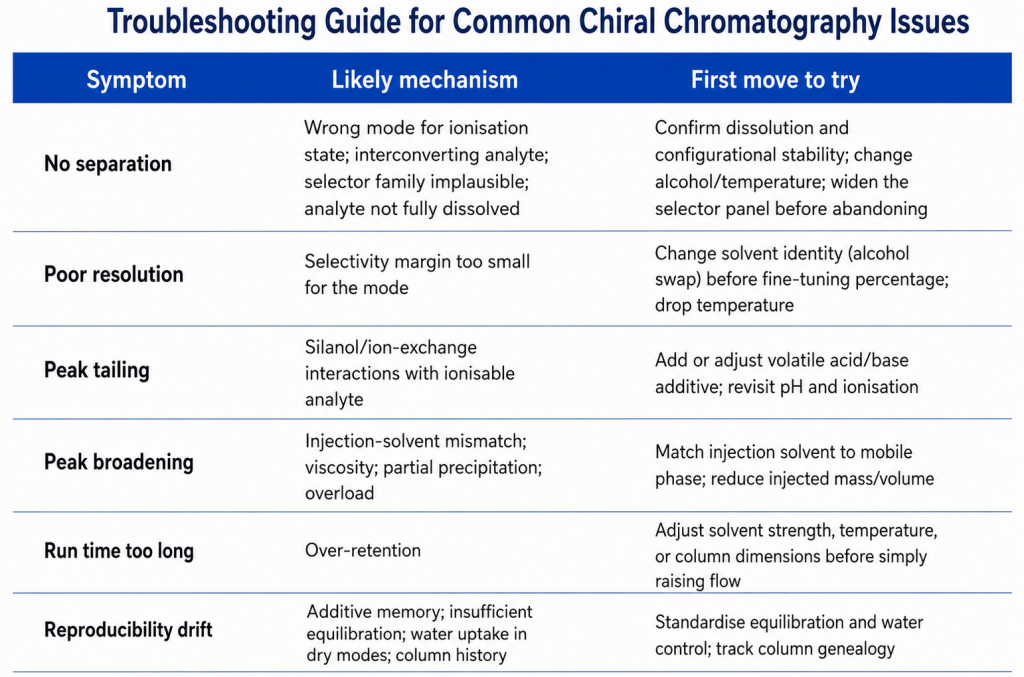
When a method misbehaves, the fastest route to a fix is to ask what the mechanism is telling you rather than reaching reflexively for a longer column or a higher flow. The quick-reference table below maps the common symptoms to their likely mechanistic causes and the first move to try. [2,5,9]. The Table below presents – Mechanism-first troubleshooting for chiral HPLC.
Optimisation under AQbD and lifecycle control
ICH Q14 and Q2(R2) changed the language in which good method development is defended. Q14 formalises science- and risk-based development, allows either a minimal or an enhanced approach, and places the analytical target profile at the centre of the workflow. Q2(R2) then asks that validation demonstrate the procedure is fit for its intended purpose. Together they support a lifecycle model rather than a one-time validation event. [1,19]
For a chiral assay or impurity method, an enhanced (AQbD) workflow is especially useful because the parameter space is interactive: column chemistry, alcohol type, modifier percentage, temperature, and additive can all interact. Design of experiments therefore has genuine value here rather than being a decorative statistical exercise. Q2(R2) explicitly encourages design of experiments for studying intermediate-precision effects, and Q14 supports enhanced approaches that establish procedure understanding, analytical procedure ranges, or a method operable design region when justified. [1,19,20]
The practical outcome is straightforward. By the time the method is declared developed, the team should know what controls resolution, what changes are benign, what causes failure, and what robustness window is defendable. That broader technology picture, including immobilised selectors, SFC, automation, modelling, and greener development, is the subject of Episode 3.
References
1. International Council for Harmonisation. Q14 Analytical Procedure Development. Geneva: ICH; 2023. Available from: https://database.ich.org/sites/default/files/ICH_Q14_Guideline_2023_1116.pdf
2. Chankvetadze B. Recent trends in preparation, investigation and application of polysaccharide-based chiral stationary phases for separation of enantiomers in high-performance liquid chromatography. TrAC Trends Anal Chem. 2020;122:115709. https://doi.org/10.1016/j.trac.2019.115709
3. Teixeira J, Tiritan ME, Pinto MMM, Fernandes C. Chiral stationary phases for liquid chromatography: recent developments. Molecules. 2019;24(5):865. https://doi.org/10.3390/molecules24050865
4. Liu H, et al. Recent advances in chiral liquid chromatography stationary phases and applications for pharmaceutical analysis. J Chromatogr A. 2023.
5. Tarafder A, Miller L. Chiral chromatography method screening strategies: past, present and future. J Chromatogr A. 2021;1638:461878. https://doi.org/10.1016/j.chroma.2021.461878
6. De Luca C, et al. Recent developments in the high-throughput separation of biologically active chiral compounds via high performance liquid chromatography. 2024.
7. Desfontaine V, Guillarme D, Francotte E, Novakova L. Supercritical fluid chromatography in pharmaceutical analysis. J Pharm Biomed Anal. 2015;113:56-71. https://doi.org/10.1016/j.jpba.2015.03.007
8. Berkecz R, Tanacs D, Peter A, Ilisz I. Enantioselective liquid chromatographic separations using macrocyclic glycopeptide-based chiral selectors. Molecules. 2021;26(11):3380. https://doi.org/10.3390/molecules26113380
9. Ferencz E, et al. Possibilities and limitations of computer-assisted chiral HPLC method development. Sci Rep. 2024;14. https://doi.org/10.1038/s41598-024-78415-1
10. Ibrahim AE, et al. Recent advances in chiral selectors immobilization and chiral mobile phase additives in liquid chromatographic enantioseparations. J Chromatogr A. 2023.
11. Stringham RW. Chiral separation of amines in subcritical fluid chromatography using polysaccharide stationary phases and acidic additives. J Chromatogr A. 2005;1070(1-2):163-170. https://doi.org/10.1016/j.chroma.2005.02.044
12. Yun KY, et al. Effect of amine mobile-phase additives on chiral subcritical fluid chromatography of amines on polysaccharide CSPs. J Chromatogr A. 2004.
13. Zhang T, et al. Use of an evaporative light scattering detector in the detection of enantiomeric resolution on chiral stationary phases by HPLC. 2006.
14. Bu X, et al. Chiral analysis of poor UV-absorbing pharmaceuticals by SFC with charged aerosol detection. 2016.
15. Kott L. An evaluation of four commercial HPLC chiral detectors. 2007.
16. Lloyd DK. Polarimetric detection in high-performance liquid chromatography. 1989.
17. Lammerhofer M. Chiral recognition by enantioselective liquid chromatography: mechanisms and modern chiral stationary phases. J Chromatogr A. 2010;1217(6):814-856. https://doi.org/10.1016/j.chroma.2009.10.022
18. Papp LA, et al. Comprehensive review on the use of chiral stationary phases in single-column simultaneous chiral-achiral HPLC separation methods. Molecules. 2024. https://doi.org/10.3390/molecules29020446
19. International Council for Harmonisation. Q2(R2) Validation of Analytical Procedures. Geneva: ICH; 2023. Available from: https://database.ich.org/sites/default/files/ICH_Q2%28R2%29_Guideline_2023_1130.pdf
20. Tome T, Casar A, Obreza A. Development and optimization of liquid chromatography analytical methods by using AQbD principles. Org Process Res Dev. 2019;23(9):1784-1802. https://doi.org/10.1021/acs.oprd.9b00238
Further Reading
- Measuring quality of chromatogram – Tools 1.0
- Measuring quality of chromatogram- Tools 2.0
- Measuring quality of chromatogram- Tools 3.0
- Controlling selectivity-Solvent role-1.0
- Controlling selectivity-Solvent role-2.0
- Controlling selectivity-Additional factors-1.0 – pH
- Controlling selectivity-Additional factors-2.0 – temperature