How chiral methods and isolated standards are justified in a dossier, and a calibrated view of the future
The regulatory position on stereochemical purity
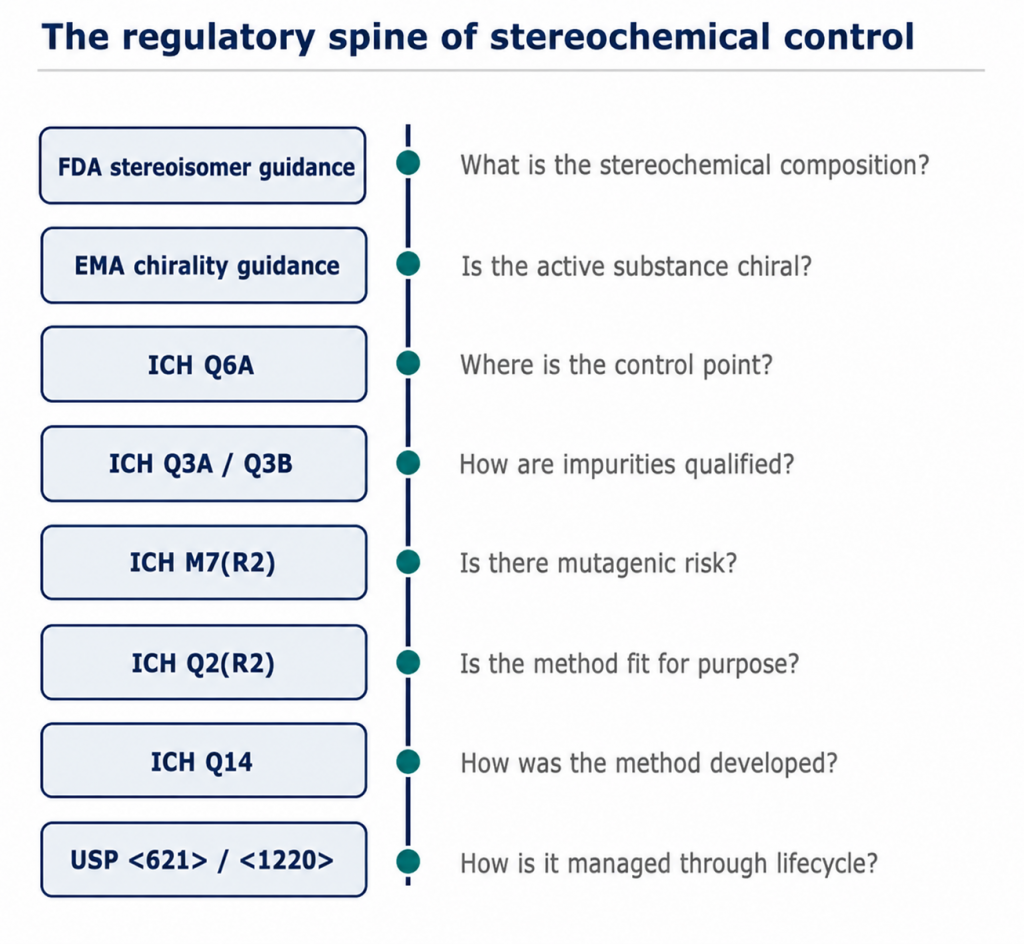
Regulators have treated stereochemistry as a quality and development issue for decades, and the core position has been stable even as the vocabulary evolved. FDA’s 1992 stereoisomer guidance requires that the stereoisomeric composition of a chiral drug be known, that stereochemically appropriate analytical methods be available early enough to interpret pharmacokinetic and toxicological findings, and that final specifications assure identity, quality, purity, and strength from a stereochemical viewpoint. EMA’s chirality guidance similarly expects explicit study of chiral active substances during development. [1,2]
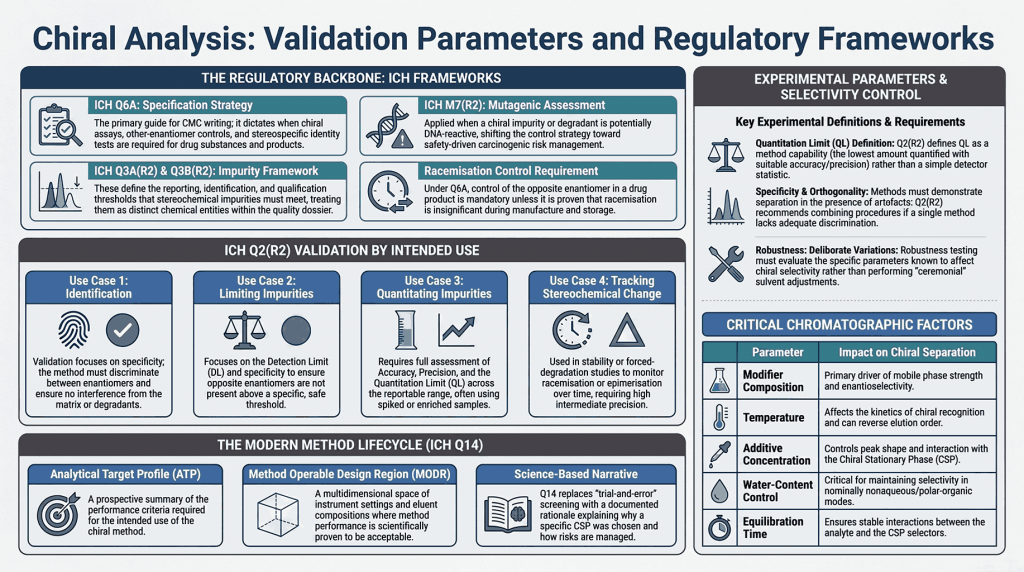
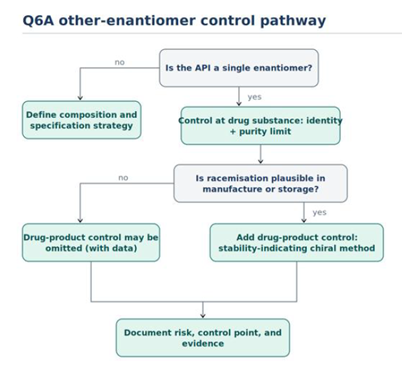
ICH Q6A is especially relevant for CMC writing because it states, in practical terms, when chiral assay, other-enantiomer control, and stereospecific identity testing may be needed for drug substances and products. It also states that control of the other enantiomer in a drug product is necessary unless racemisation is shown to be insignificant during manufacture and storage. That single sentence governs a large amount of day-to-day stereochemical control strategy in dossiers. [3]
ICH Q3A(R2) and Q3B(R2) provide the general impurity framework into which stereochemical impurities must fit. They are not chirality-specific, but they define expectations for reporting, identifying, controlling, and qualifying impurities. A stereochemical impurity above relevant thresholds, or otherwise important, enters this framework like any other impurity, with stereochemically informed analytical requirements. ICH M7(R2) becomes relevant when a chiral impurity or degradant is also potentially DNA-reactive, at which point the chiral-purity conversation intersects with a safety-driven control strategy aimed at negligible carcinogenic risk. [4,5,6]
What validation means for a chiral method under ICH Q2(R2)
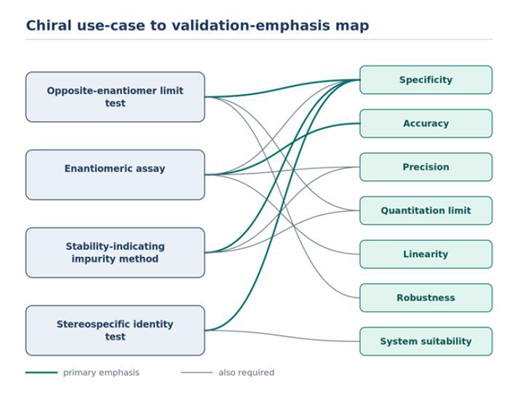
Q2(R2) reframes validation around suitability for intended purpose. For a chiral method the validation package must match the use, and the four common chiral use-cases pull on different parameters. Validation effort follows intended purpose: the same chiral separation is validated differently depending on whether it limits, quantifies, identifies, or tracks stereochemical change.
For chiral methods, specificity or selectivity is often the decisive parameter. It is not enough to show separation of two enantiomer peaks in a neat racemate; the method should demonstrate that the target analyte can be identified or quantitated in the presence of related substances, degradants, matrices, or sample-preparation artefacts. Q2(R2) allows specificity to be supported by absence of interference or by orthogonal comparison, and recommends a combination of procedures where one alone cannot provide adequate discrimination, which is highly relevant for chiral impurity work in complex matrices. [7]
Accuracy and precision should be established across the reportable range under regular test conditions, including matrix and sample preparation where relevant. For opposite-enantiomer methods at low levels, spiked or enriched samples are often unavoidable, and Q2(R2) permits artificially prepared samples where authentic homogeneous samples are unavailable. Repeatability and intermediate precision should reflect actual use conditions, and Q2(R2) now actively encourages design of experiments for studying variability factors. [7]
Quantitation limit deserves emphasis for chiral impurity methods because Q2(R2) defines it as the lowest amount that can be quantified with suitable precision and accuracy, particularly for impurities and degradation products. It is a method capability, not a detector statistic, and must be demonstrated in the actual method context. Robustness should not be a ceremonial two-percent solvent exercise; Q2(R2) asks that deliberate variations in procedure parameters be evaluated, which for chiral methods should include the parameters known from development to affect selectivity, such as modifier composition, temperature, additive concentration, and sometimes equilibration or water-content control in nominally nonaqueous modes. [7] The table below makes that mapping explicit before the parameters are discussed individually.
Q14, lifecycle management, and analytical control strategy
Q14 moves chiral method development away from a “screen until something works” culture toward a defendable, science-based narrative. It allows a minimal or an enhanced approach but expects the analyst to define the intended purpose, draw on product and process understanding, use risk management, and, where appropriate, formalise performance criteria in an analytical target profile. It also provides a basis for analytical procedure ranges, a method operable design region, and structured post-approval change management when development knowledge is strong enough. [8]
This is particularly useful for chiral methods because lifecycle questions are common. A method may need to migrate from discovery-scale hardware to commercial QC hardware, from one detector to another, from a normal-phase-like system to a polar-organic one, or from a dedicated chiral method to a combined chiral-achiral impurity method. Under Q14 logic those changes are easier to manage when the original development established what really controls performance and what parameter movement is scientifically benign. USP lifecycle thinking points the same way: general chapter <621> covers chromatographic procedures and system suitability, while chapter <1220> introduces a broader analytical-procedure lifecycle approach. [8,9,10]
Practical applications across development and commercial control
Chiral methods are applied across the full development chain. In API development they support route scouting, asymmetric-step control, salt selection, crystallisation understanding, and release of single-enantiomer drug substances. In process chemistry they help identify whether an undesired stereoisomer is generated in a specific step or carried through from an upstream intermediate. In starting-material and intermediate control they can prevent the final API method from carrying the entire burden of stereochemical assurance, an approach Q6A recognises where justified. [3]
In generic development, chiral control may be needed both to match the reference product’s stereochemical specification and to show that formulation or manufacturing does not induce racemisation. In stability and forced-degradation studies, chiral methods determine whether stereochemical integrity is preserved or whether degradation introduces an opposite enantiomer, an epimer, or a related stereochemical degradant, and FDA guidance expects stability protocols to assess stereochemical integrity until conversion is shown not to occur. In cleaning and carryover studies, chiral methods become relevant when a process handles single-enantiomer materials and opposite-enantiomer contamination would be meaningful. In reference-standard preparation, preparative chiral chromatography may be necessary to isolate the standard used for qualification or response-factor work. [1,3]
How to present chiral methods in a dossier
A good chiral section does not merely include a chromatogram and a validation table. It explains why chiral control is needed, identifies the specific stereochemical risk, states what is measured and why, and shows how the method fits the broader process and product understanding. If the method controls the opposite enantiomer of a single-enantiomer API, the dossier should state whether racemisation risk exists in synthesis, formulation, and storage, and whether control is applied at drug-substance, intermediate, or drug-product stages. Q6A provides the backbone for this discussion. [3]
Under Q14, the most persuasive dossiers also show development knowledge: why the selected CSP was chosen, which parameters were shown to affect selectivity, what robustness window the data support, and, if an enhanced approach is used, what the analytical target profile, key performance criteria, and operating ranges are. Those are not bureaucratic extras; they are the material from which post-approval flexibility is built. [8]
The literature landscape from early chiral HPLC to the present
The literature arc is clear. Early pharmaceutical chiral chromatography was shaped by mechanistic ideas such as the three-point interaction model and by the emergence of practical CSP families. Successive reviews show the field moving from selector discovery, to mechanistic interpretation, to platform screening, to the present emphasis on integrated workflows that combine enantioselectivity, chemoselectivity, automation, and sustainability. [11,12,13,14]
At the same time, regulatory literature and approval-trend analyses show that chirality has remained strategically important in marketed medicines. The 2013-to-2022 approval review demonstrates that the subject is not a residue from the 1990s; it remains part of current drug-development reality. [15]
Future direction, with the right level of caution
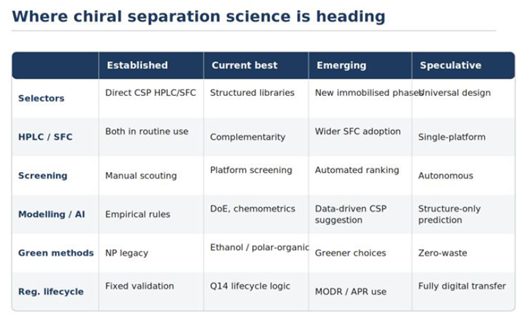
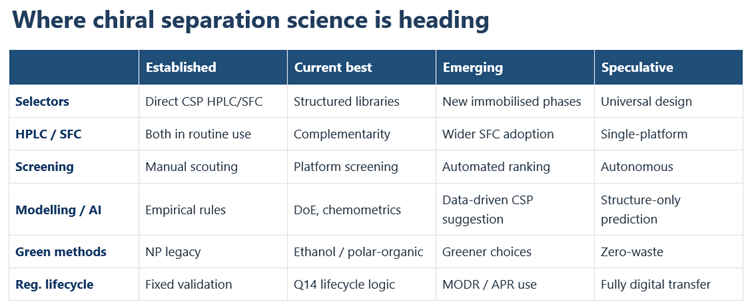
Established scientific practice will continue to rely on direct CSP-based HPLC and SFC for most pharmaceutical enantiomeric separations. Current best practice is moving toward broader yet more structured selector libraries, lifecycle-based development under Q14 and Q2(R2), and early consideration of analytical-to-preparative transfer, greener solvents, and orthogonal confirmation. [7,8]
Emerging technology includes better immobilised selector libraries, faster automated screening, simultaneous chiral-achiral methods, richer use of design of experiments and chemometrics, and data-driven ranking or retention-prediction tools, including structure-based CSP prediction, that reduce experimental burden while remaining coupled to experimental verification. Speculative future direction includes robust structure-only prediction of the best CSP and solvent system across highly diverse chemotypes, universal digital twins for chiral method transfer, and routine mechanistic prediction of chiral impurity formation from route design alone. The field is moving toward these ambitions but is not there yet, because chiral recognition remains too context-dependent for that level of certainty. [16,17,18]
The balanced conclusion is uncomplicated. Chiral HPLC remains scientifically demanding because it exploits subtle stereochemical energy differences. It remains practically important because those differences continue to matter in drug quality and patient risk. And it remains regulatory-relevant because agencies still expect stereochemical composition and stereochemical impurities to be understood and controlled with the same seriousness as any other quality attribute. That is why chiral chromatography is still a specialist discipline, not a historical curiosity.
References
1. U.S. Food and Drug Administration. Development of New Stereoisomeric Drugs. Rockville (MD): FDA; 1992. Available from: https://www.fda.gov/regulatory-information/search-fda-guidance-documents/development-new-stereoisomeric-drugs
2. European Medicines Agency (CPMP). Investigation of Chiral Active Substances. London: EMA; adopted 1993, effective 1994. Ref. 3CC29a.
3. International Council for Harmonisation. Q6A Specifications: Test Procedures and Acceptance Criteria for New Drug Substances and New Drug Products: Chemical Substances. Geneva: ICH; 1999. Available from: https://database.ich.org/sites/default/files/Q6A%20Guideline.pdf
4. International Council for Harmonisation. Q3A(R2) Impurities in New Drug Substances. Geneva: ICH; 2006. Available from: https://database.ich.org/sites/default/files/Q3A%28R2%29%20Guideline.pdf
5. International Council for Harmonisation. Q3B(R2) Impurities in New Drug Products. Geneva: ICH; 2006.
6. International Council for Harmonisation. M7(R2) Assessment and Control of DNA Reactive (Mutagenic) Impurities in Pharmaceuticals to Limit Potential Carcinogenic Risk. Geneva: ICH; 2023. Available from: https://database.ich.org/sites/default/files/ICH_M7%28R2%29_Guideline_Step4_2023_0216_0.pdf
7. International Council for Harmonisation. Q2(R2) Validation of Analytical Procedures. Geneva: ICH; 2023. Available from: https://database.ich.org/sites/default/files/ICH_Q2%28R2%29_Guideline_2023_1130.pdf
8. International Council for Harmonisation. Q14 Analytical Procedure Development. Geneva: ICH; 2023. Available from: https://database.ich.org/sites/default/files/ICH_Q14_Guideline_2023_1116.pdf
9. United States Pharmacopeia. General Chapter <621> Chromatography. Rockville (MD): USP.
10. United States Pharmacopeia. General Chapter <1220> Analytical Procedure Life Cycle. Rockville (MD): USP; 2022.
11. Yashima E. Polysaccharide-based chiral stationary phases for high-performance liquid chromatographic enantioseparation. J Chromatogr A. 2001;906(1-2):105-125. https://doi.org/10.1016/S0021-9673(00)00501-X
12. Lammerhofer M. Chiral recognition by enantioselective liquid chromatography: mechanisms and modern chiral stationary phases. J Chromatogr A. 2010;1217(6):814-856. https://doi.org/10.1016/j.chroma.2009.10.022
13. Teixeira J, Tiritan ME, Pinto MMM, Fernandes C. Chiral stationary phases for liquid chromatography: recent developments. Molecules. 2019;24(5):865. https://doi.org/10.3390/molecules24050865
14. Chankvetadze B. Recent trends in preparation, investigation and application of polysaccharide-based chiral stationary phases for separation of enantiomers in high-performance liquid chromatography. TrAC Trends Anal Chem. 2020;122:115709. https://doi.org/10.1016/j.trac.2019.115709
15. McVicker RU, O’Boyle NM. Chirality of new drug approvals (2013-2022): trends and perspectives. J Med Chem. 2024;67(4):2305-2320. https://doi.org/10.1021/acs.jmedchem.3c02239
16. Ali I, Messali M, Gogolashvili A, Sekkoum K. Chiral Chromatography and Artificial Intelligence Integration in Enantiomers Separation. Chirality. 2025 Dec;37(12):e70066. doi: 10.1002/chir.70066
17. Pieter De Gauquier, , Kenno Vanommeslaeghe, , Yvan Vander Heyden, , Debby Mangelings. Modelling approaches for chiral chromatography on polysaccharide-based and macrocyclic antibiotic chiral selectors: A review. Analytica Chimica Acta, 2021. 10.1016/j.aca.2021.338861
18. Hong Y, Welch CJ, Piras P, Tang H. Enhanced Structure-Based Prediction of Chiral Stationary Phases for Chromatographic Enantioseparation from 3D Molecular Conformations. Anal Chem. 2024 Feb 13;96(6):2351-2359. doi: 10.1021/acs.analchem.3c04028. doi: 10.1021/acs.analchem.3c04028
Further Reading