? Nature’s Handedness, Agriculture’s Inspiration.
Introduction
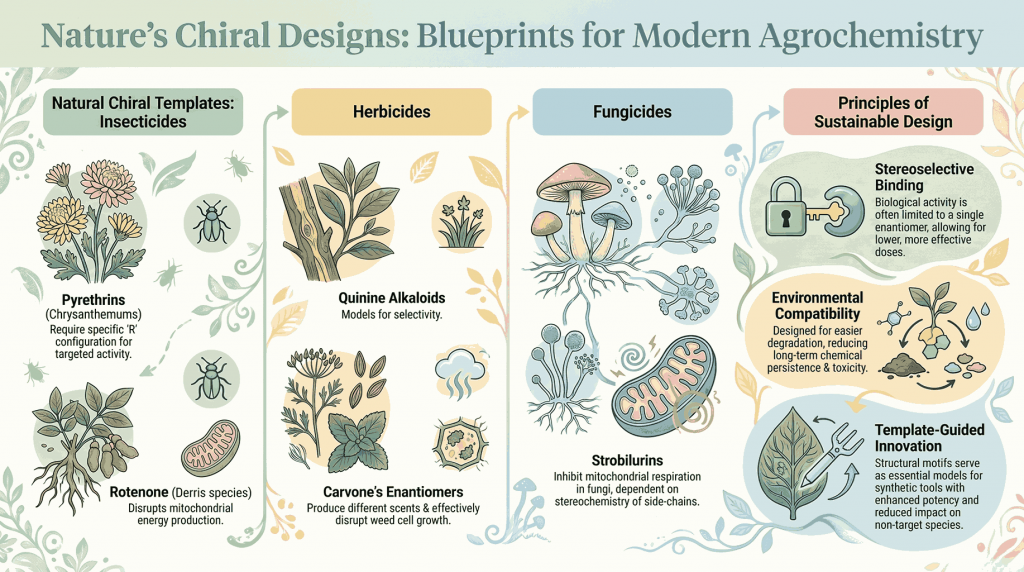
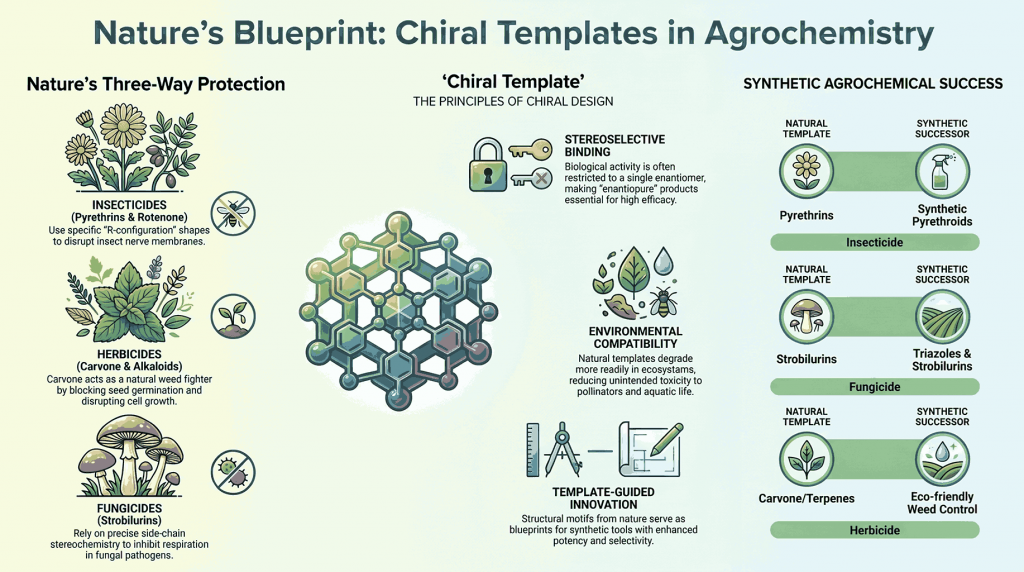
Nature is the ultimate chemist, and chirality is one of its most powerful design principles. Many of the most effective agrochemicals are inspired by or derived directly from natural compounds, which are overwhelmingly chiral. These natural products serve as templates for synthetic agrochemistry, guiding the development of pesticides, herbicides, and fungicides with specific stereochemical features. In this episode, we examine the role of chirality in natural agrochemical compounds, discuss how stereochemistry drives their activity, and explore how these natural templates inform the design of modern synthetic agrochemicals.
Chirality in Plant-Derived Insecticides
Pyrethrins
Pyrethrins, derived from Chrysanthemum cinerariifolium, are classic examples of natural chiral insecticides. They contain multiple stereogenic centers, and their insecticidal activity depends heavily on stereochemistry. The natural isomers show rapid knockdown effects on insects by targeting sodium channels in nerve membranes.
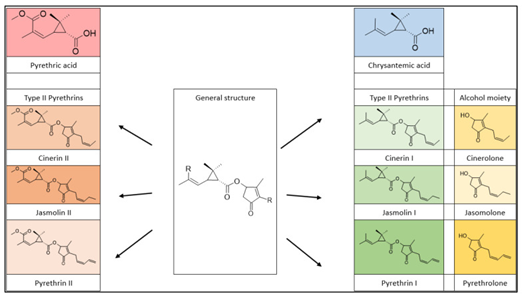
Synthetic pyrethroids were modeled on these natural templates, but not all stereoisomers are equally effective. Enantioselectivity explains why only certain stereoisomers contribute to insecticidal action, while others may persist environmentally with lower efficacy.
Pyrethroids have three asymmetric carbon atoms and can have as many as eight possible stereoisomers. The presence of two chiral centers in the cyclopropane ring of chrysanthemic acids produces two pairs of diastereomers, which are designated cis and trans based on the orientation of the C-l and C-3 substitutions in relation to the plane of the cyclopropane ring. But only those with the R configuration at the cyclopropane C-l are insecticidally active.
Rotenone
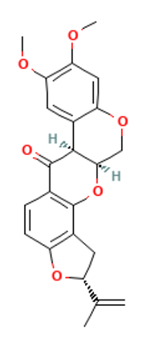
Rotenone, extracted from Derris and Lonchocarpus species, is another chiral insecticidal natural product. It is a naturally occurring isoflavonoid featuring a complex, rigid five-ring structure with three distinct chiral centers. Its stereochemistry influences its binding to mitochondrial NADH dehydrogenase, which disrupts energy production in insects and fish (Casida, 1973). Though less widely used today due to toxicity concerns, rotenone remains an instructive case in the stereoselective design of agrochemicals.
Chirality in Plant-Derived Herbicides
Alkaloids as Templates
Several alkaloids produced by plants exhibit herbicidal properties, with chirality contributing to their selective activity. For instance, quinine and related alkaloids display stereochemical constraints that affect their biological interactions. These structural motifs have been studied as models for designing synthetic herbicides with improved selectivity (Williams, 1996).
Essential Oils and Terpenes
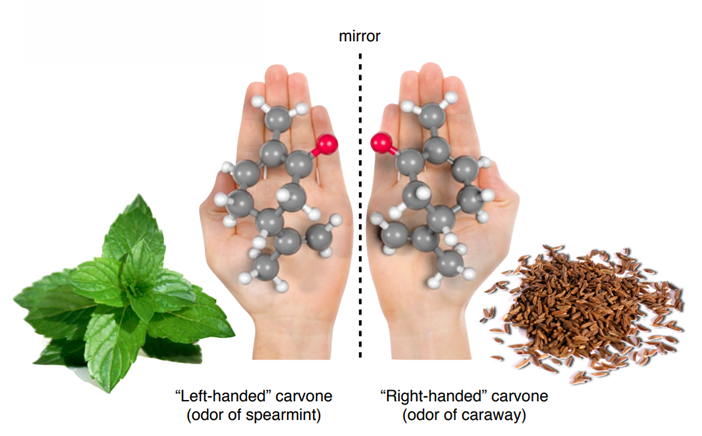
Terpenes such as carvone illustrate how chirality affects biological function. The chiral molecule carvone exists as two enantiomers: The R-(-)-enantiomer of carvone smells like spearmint, while the S-(+)-enantiomer smells like caraway, highlighting stereoselectivity in receptor interactions. Certain terpenes also show herbicidal or allelopathic effects, making them attractive natural templates for eco-friendly weed control (Dayan et al., 2009).
? (-)-Carvone: Nature’s Gentle Weed Fighter Carvone, a natural compound found in spearmint and dill essential oils, is gaining attention as a safe, eco-friendly alternative to harsh synthetic herbicides. Instead of polluting the environment, it quietly stops weeds in their tracks—disrupting their cell growth, blocking seed germination, and preventing seedlings from developing. The result? Cleaner fields, healthier ecosystems, and a greener way to manage weeds.
Chirality in Natural Fungicides
Natural products such as strobilurins, originally isolated from Strobilurus tenacellus, are chiral fungicides that inhibit mitochondrial respiration. The stereochemistry of the side chains is essential for their high potency against fungal pathogens (Bartlett et al., 2002). These discoveries directly inspired the development of synthetic strobilurin fungicides, now a cornerstone of global crop protection.
Lessons for Synthetic Agrochemistry
Natural chiral compounds illustrate key principles that synthetic chemists use when designing modern agrochemicals:
- Stereoselective Binding — Biological activity is often confined to a single enantiomer, reinforcing the value of developing enantiopure products.
- Environmental Compatibility — Natural compounds degrade more readily, but stereochemistry still affects persistence and toxicity in ecosystems.
- Template-Guided Design — Structural motifs from natural products serve as models for new chiral agrochemicals with enhanced potency and selectivity.
The success of synthetic pyrethroids, triazoles, and strobilurins demonstrates how stereochemical lessons from natural products shape modern crop protection chemistry.
Sustainability and Eco-Friendly Solutions
As agriculture faces pressure to reduce chemical inputs and environmental impacts, natural chiral products inspire greener solutions. Biopesticides based on enantiopure natural molecules or their derivatives align with integrated pest management (IPM) and sustainable agriculture goals (Dayan et al., 2009).
Chirality plays a role not only in designing potent products but also in minimizing unintended toxicity to pollinators, aquatic species, and humans. Using nature’s chiral templates helps bridge traditional crop protection with eco-conscious innovation.
Conclusion
Natural products highlight the central role of chirality in agrochemistry. Pyrethrins, rotenone, carvone, terpenes, and strobilurins exemplify how stereochemistry drives biological interactions in insects, weeds, and fungi. Synthetic agrochemicals continue to borrow from these chiral templates, refining them into more potent and selective tools.
In the next episode, we will explore how chirality influences the environmental impact of agrochemicals, with a focus on degradation, persistence, and ecological consequences.
References
Bartlett D.W., Clough J.M., Godwin J.R., Hall A.A., Hamer M., Parr-Dobrzanski B. (2002). The strobilurin fungicides. Pest Manag Sci. 58(7): 649–662.
Pierluigi Caboni, Todd B. Sherer, Nanjing Zhang, Georgia Taylor, Hye Me Na, J. Timothy Greenamyre, John E. Casida (2004). Rotenone, Deguelin, Their Metabolites, and the Rat Model of Parkinson’s Disease. Chem. Res. Toxicol. 17, 11, 1540–1548. https://doi.org/10.1021/tx049867r
Crosby D.G. (1995). Environmental fate of pesticides: stereochemistry as a factor in transformation and degradation. Pure Appl Chem. 67(3): 407–412.
Dayan FE, Cantrell CL, Duke SO. Natural products in crop protection. Bioorg Med Chem. 2009 Jun 15;17(12):4022-34. doi: 10.1016/j.bmc.2009.01.046.
Garrison, A. W. (2011). An introduction to pesticide chirality and the consequences of stereoselectivity. In H. Ohkawa, H. Miyagawa, & P. W. Lee (Eds.), Chiral pesticides: Stereoselectivity and its consequences (ACS Symposium Series, Vol. 1085, pp. 1–7). American Chemical Society. https://doi.org/10.1021/bk-2011-1085.ch001
Williams A. (1996). Opportunities for chiral agrochemicals. Pestic Sci. 46(1): 3–9.
Hodoșan C, Gîrd CE, Ghica MV, Dinu-Pîrvu CE, Nistor L, Bărbuică IS, Marin ȘC, Mihalache A, Popa L. Pyrethrins and Pyrethroids: A Comprehensive Review of Natural Occurring Compounds and Their Synthetic Derivatives. Plants (Basel). 2023 Nov 29;12(23):4022. doi: 10.3390/plants12234022.
Schleier, J. J., III, & Peterson, R. K. D. (2011). Pyrethrins and pyrethroid insecticides. In O. Lopez & J. Fernandez-Bolanos (Eds.), Green trends in insect control (pp. 94–131). Royal Society of Chemistry. https://doi.org/10.1039/BK9781849731492-00094
Liu W, Gan J, Schlenk D, Jury WA. Enantioselectivity in environmental safety of current chiral insecticides. Proc Natl Acad Sci U S A. 2005 Jan 18;102(3):701-6. doi: 10.1073/pnas.0408847102.
From garden to gas chambers: the bioactive power of (-)-carvone against weeds, 2024. https://www.eurekalert.org/news-releases/1055684
Krajewska A, Azeez G, Ebadollahi A, Kalemba D, Synowiec A. Carvone-Rich Essential Oils and Their Agrobiological Interactions: A Review. Molecules. 2026 Feb 7;31(4):579. doi: 10.3390/molecules31040579.
Damião Pergentino De Sousa, Franklin Ferreira De Farias nóbrega, Reinaldo Nóbrega De Almeida. (2007). Influence of the chirality of (R)-(−)- and (S)-(+)-carvone in the central nervous system: A comparative study. Chirality, 19, 4, 264-268. https://doi.org/10.1002/chir.20379
Further Reading – Following blog articles and references therein