#chirality

Episode 4: Fungicides and Stereochemistry

🌱When Molecular Handedness Determines Fungal Control for a More Sustainable Future. 🍄 Introduction Fungal infections cause devastating losses in agriculture, threatening global food security. Fungicides are therefore essential tools in crop protection. Many fungicides are chiral, and their enantiomers can differ significantly in fungicidal potency, environmental behavior, and toxicity to non-target organisms. The stereochemistry of …

Episode 4: Fungicides and Stereochemistry Read More »

Episode 3: Herbicides and the Role of Chirality

🌱 Herbicides Have Two Faces — Chirality Decides Their Impact.” 🧬 Introduction Herbicides are among the most widely used agrochemicals worldwide. They are applied to protect crops from weed competition, ensuring higher yields and food security. A significant number of herbicides are chiral, and their enantiomers often show large differences in biological activity, environmental fate, …

Episode 3: Herbicides and the Role of Chirality Read More »

Episode 2: Stereoselectivity and Biological Activity in Pesticides

🧬🌱 “When Mirror Images Decide Between Protection and Toxicity.” Introduction Pesticides are essential tools in modern agriculture, protecting crops from insects, weeds, and pathogens. Many of these compounds are chiral, meaning they exist as two or more non-superimposable mirror-image forms called enantiomers. Enantiomers often exhibit very different biological activities, toxicities, and environmental behaviors. Understanding these …

Episode 2: Stereoselectivity and Biological Activity in Pesticides Read More »

Episode 1: Introduction to Chirality in Agrochemicals

What happens when 𝒄𝒉𝒊𝒓𝒂𝒍𝒊𝒕𝒚 𝒎𝒆𝒆𝒕𝒔 𝒄𝒓𝒐𝒑 𝒔𝒄𝒊𝒆𝒏𝒄𝒆? Introduction Chirality, the property of a molecule that makes it non-superimposable on its mirror image, is a crucial consideration in agrochemistry. Agrochemicals such as pesticides, herbicides, and fungicides often contain one or more stereogenic centers. The two enantiomers of a chiral molecule can behave very differently in biological …

Episode 1: Introduction to Chirality in Agrochemicals Read More »

Germanium 🧬: Beyond Carbon — A Chiralpedia Guide to a New Dimension of Chirality

Demonstrates that chirality extends beyond carbon into heavier elements Introduction: Beyond Carbon-Centered Chirality Chirality is one of the most fundamental concepts in chemistry, typically introduced through tetrahedral carbon atoms bearing four different substituents. However, chirality is not limited to carbon—it extends across the periodic table. Germanium, a Group 14 element positioned below silicon, presents a …

Germanium 🧬: Beyond Carbon — A Chiralpedia Guide to a New Dimension of Chirality Read More »

X-ray Reveals the Truth. R/S Makes It Speak.

Why stereochemistry is not just about seeing molecules—but learning how to describe them In modern chemistry, we have powerful tools like X-ray crystallography that can reveal the exact three-dimensional structure of a molecule with remarkable precision. So it raises a compelling question: If we already know what a molecule truly looks like in 3D… why …

X-ray Reveals the Truth. R/S Makes It Speak. Read More »

Case Study Through the Chiralpedia Lens: tert-Butanesulfinamide — The Sulfur-Centered Chiral Tool That Changed Drug Synthesis

A Quiet Revolution in Asymmetric Synthesis tert-Butanesulfinamide, widely known as Ellman’s sulfinamide, is one of the most influential chiral auxiliaries in modern asymmetric synthesis. Developed in the 1990s by the laboratory of Jonathan Ellman, this sulfur-centered chiral reagent revolutionized the stereoselective construction of amines—key structural motifs in pharmaceuticals and agrochemicals. Its configurationally stable stereogenic sulfur …

Case Study Through the Chiralpedia Lens: tert-Butanesulfinamide — The Sulfur-Centered Chiral Tool That Changed Drug Synthesis Read More »

🚨🪞Mirror Life: When Chirality Flips, Does Biology Unravel?🧬🌍

The Mirror We Build Defines the World We Keep; Decoding the Science, the Risks, and the Responsibility Synopsis: Mirror Life: When Chemistry Meets Philosophy Recently, Scientific American published two striking pieces that push chemistry into almost philosophical territory: Both ask a radical question: what if we rebuilt life itself using mirror‑image molecules? For decades, chirality—the …

🚨🪞Mirror Life: When Chirality Flips, Does Biology Unravel?🧬🌍 Read More »

🪞Why the Language of Chirality Must Evolve: When Molecules Speak in 3D and Models Listen in 2D🤖

A chiral perspective on how we describe, teach, and encode molecular handedness in the age of artificial intelligence Prelude Chiral molecules are not flat drawings on paper (2D). They live in space (3D). They twist, reflect, and occupy three dimensions in ways that decide how they bind to receptors, how they are metabolized, and ultimately …

🪞Why the Language of Chirality Must Evolve: When Molecules Speak in 3D and Models Listen in 2D🤖 Read More »

Teaching Machines to See in 3D: The Chiral Blind Spot in AI-Driven Drug Discovery

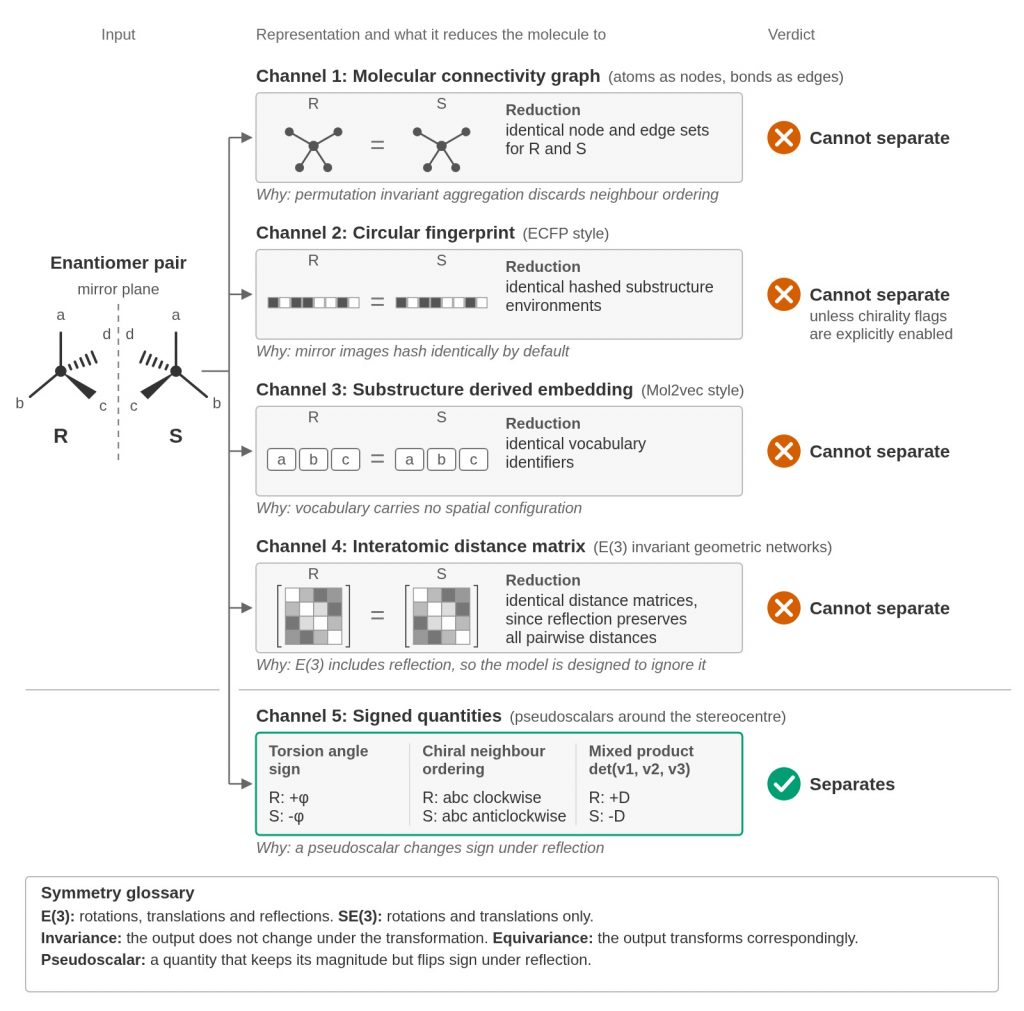
Can an AI truly understand a molecule if it cannot tell left from right? Artificial intelligence now shapes the earliest and most consequential stages of drug discovery, from virtual screening and ADMET prediction to generative molecular design. Yet many of these systems operate in an effectively achiral digital environment, where molecules are represented as flat …

Teaching Machines to See in 3D: The Chiral Blind Spot in AI-Driven Drug Discovery Read More »