Valliappan Kannappan

Episode 3: Herbicides and the Role of Chirality

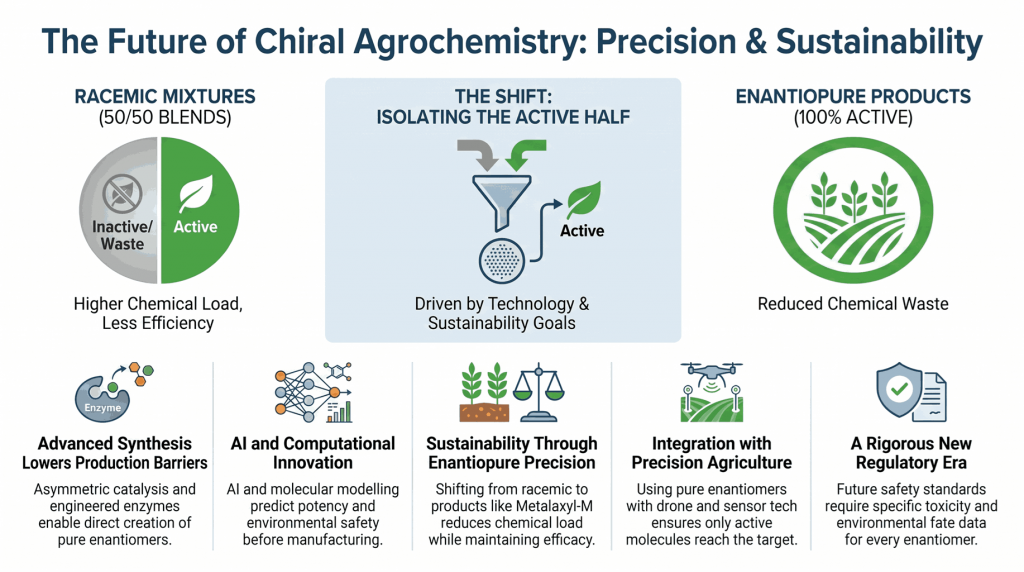
🌱 Herbicides Have Two Faces — Chirality Decides Their Impact.” 🧬 Introduction Herbicides are among the most widely used agrochemicals worldwide. They are applied to protect crops from weed competition, ensuring higher yields and food security. A significant number of herbicides are chiral, and their enantiomers often show large differences in biological activity, environmental fate, and toxicity. The role of chirality in herbicides is particularly important because these compounds are applied across millions of hectares, …

Episode 3: Herbicides and the Role of Chirality Read More »

Episode 2: Stereoselectivity and Biological Activity in Pesticides

🧬🌱 “When Mirror Images Decide Between Protection and Toxicity.” Introduction Pesticides are essential tools in modern agriculture, protecting crops from insects, weeds, and pathogens. Many of these compounds are chiral, meaning they exist as two or more non-superimposable mirror-image forms called enantiomers. Enantiomers often exhibit very different biological activities, toxicities, and environmental behaviors. Understanding these stereochemical differences is critical to designing pesticides that are both effective and safe. Enantioselectivity in pesticides arises because the molecular …

Episode 2: Stereoselectivity and Biological Activity in Pesticides Read More »

Episode 1: Introduction to Chirality in Agrochemicals

What happens when 𝒄𝒉𝒊𝒓𝒂𝒍𝒊𝒕𝒚 𝒎𝒆𝒆𝒕𝒔 𝒄𝒓𝒐𝒑 𝒔𝒄𝒊𝒆𝒏𝒄𝒆? Introduction Chirality, the property of a molecule that makes it non-superimposable on its mirror image, is a crucial consideration in agrochemistry. Agrochemicals such as pesticides, herbicides, and fungicides often contain one or more stereogenic centers. The two enantiomers of a chiral molecule can behave very differently in biological systems, leading to differences in efficacy, toxicity, and environmental persistence. In agriculture, where large amounts of chemicals are released into …

Episode 1: Introduction to Chirality in Agrochemicals Read More »

🪞Why the Language of Chirality Must Evolve: When Molecules Speak in 3D and Models Listen in 2D🤖

A chiral perspective on how we describe, teach, and encode molecular handedness in the age of artificial intelligence Prelude Chiral molecules are not flat drawings on paper (2D). They live in space (3D). They twist, reflect, and occupy three dimensions in ways that decide how they bind to receptors, how they are metabolized, and ultimately how they shape biological outcomes. This spatial reality—what chemists call chirality—has always been at the heart of pharmaceutical science. The …

🪞Why the Language of Chirality Must Evolve: When Molecules Speak in 3D and Models Listen in 2D🤖 Read More »

Teaching Machines to See in 3D: The Chiral Blind Spot in AI-Driven Drug Discovery

Can an AI truly understand a molecule if it cannot tell left from right? Artificial intelligence now shapes the earliest and most consequential stages of drug discovery, from virtual screening and ADMET prediction to generative molecular design. Yet many of these systems operate in an effectively achiral digital environment, where molecules are represented as flat graphs, strings, or feature vectors that often erase or blur stereochemical information. This article introduces the concept of chiral bias …

Teaching Machines to See in 3D: The Chiral Blind Spot in AI-Driven Drug Discovery Read More »

Episode 5: Beyond Bias: Toward Chiral Intelligence

❓ Can AI truly be intelligent if it is stereo-blind? 🌀 On Visuals and Stereochemical TruthSome illustrations in this series are generated or assisted by AI to support conceptual understanding. These visuals are intentionally simplified and should not be read as stereochemically rigorous or chemically exact representations. Wherever stereochemical fidelity matters, it is addressed explicitly in the discussion—because in chemistry, especially in chiral systems, intuition must always yield to structure. The earlier episodes treated chiral …

Episode 5: Beyond Bias: Toward Chiral Intelligence Read More »

Episode 4: Fixing the Bias: Data, Models and Generative Constraints

❓ How do we move from recognizing chiral bias to responsibly fixing it? On Visuals and Stereochemical TruthSome illustrations in this series are generated or assisted by AI to support conceptual understanding. These visuals are intentionally simplified and should not be read as stereochemically rigorous or chemically exact representations. Wherever stereochemical fidelity matters, it is addressed explicitly in the discussion—because in chemistry, especially in chiral systems, intuition must always yield to structure. The earlier parts …

Episode 4: Fixing the Bias: Data, Models and Generative Constraints Read More »

Episode 3: When Algorithms Miss the Mirror: How Chiral Blind Spots Break the Pipeline?

“When molecules have two hands but AI only sees one.” On Visuals and Stereochemical TruthSome illustrations in this series are generated or assisted by AI to support conceptual understanding. These visuals are intentionally simplified and should not be read as stereochemically rigorous or chemically exact representations. Wherever stereochemical fidelity matters, it is addressed explicitly in the discussion—because in chemistry, especially in chiral systems, intuition must always yield to structure. The first two parts of this …

Episode 3: When Algorithms Miss the Mirror: How Chiral Blind Spots Break the Pipeline? Read More »

Episode 2: Why Chirality Confuses Machines?

“AI isn’t blind—just stereo-sloppy” On Visuals and Stereochemical TruthSome illustrations in this series are generated or assisted by AI to support conceptual understanding. These visuals are intentionally simplified and should not be read as stereochemically rigorous or chemically exact representations. Wherever stereochemical fidelity matters, it is addressed explicitly in the discussion—because in chemistry, especially in chiral systems, intuition must always yield to structure. The first episode argued that many AI models in drug discovery are …

Episode 2: Why Chirality Confuses Machines? Read More »

Episode 1: The Promise and the Paradox: AI That Miss the Mirror

“When algorithms forget the mirror, molecules lose their meaning” On Visuals and Stereochemical TruthSome illustrations in this series are generated or assisted by AI to support conceptual understanding. These visuals are intentionally simplified and should not be read as stereochemically rigorous or chemically exact representations. Wherever stereochemical fidelity matters, it is addressed explicitly in the discussion—because in chemistry, especially in chiral systems, intuition must always yield to structure. Artificial intelligence is now everywhere in drug …

Episode 1: The Promise and the Paradox: AI That Miss the Mirror Read More »