What modern chiral separation science can do now, and where the honest limits still lie
The present technology landscape
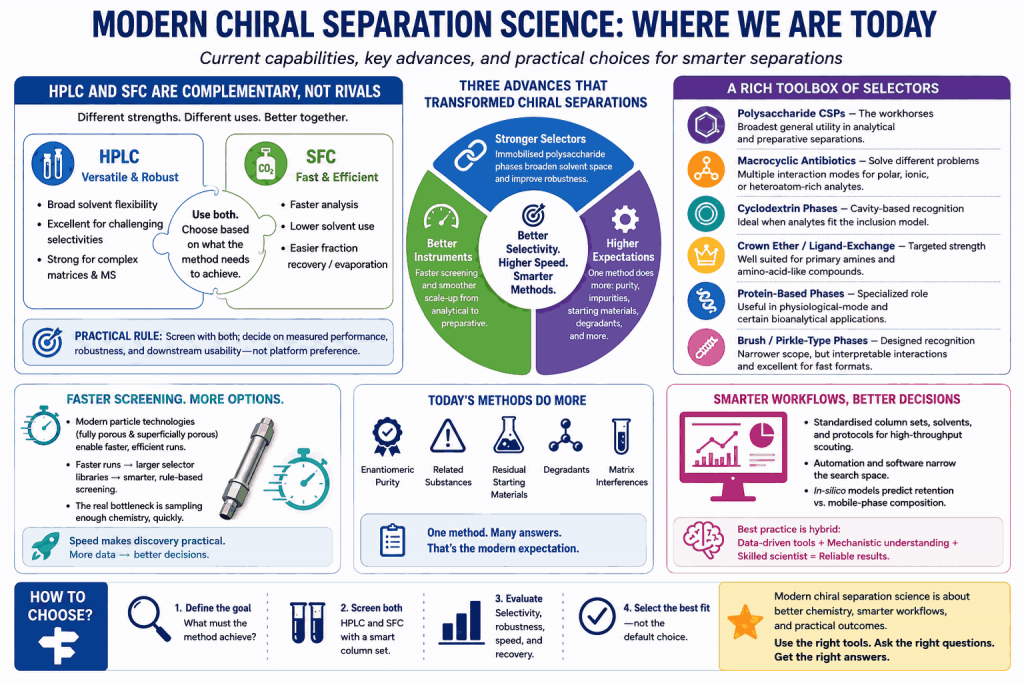
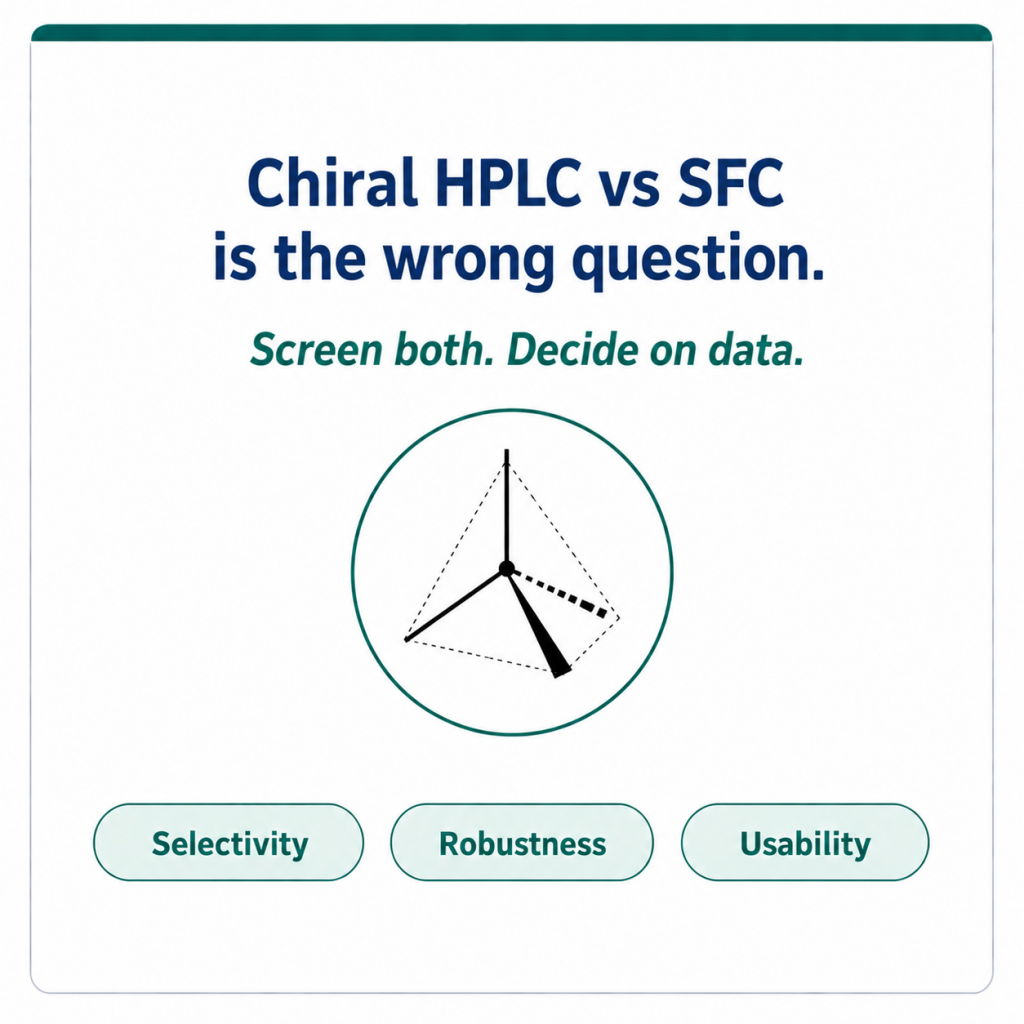
The most useful framing of the current landscape is that it is no longer sensible to ask, in the abstract, whether chiral HPLC or chiral SFC is “the best” approach. Modern laboratories operate with both, or at least develop methods in full awareness of both, because selector chemistry, solvent mode, throughput requirement, detector needs, and scale all shape the right answer. Recent reviews consistently describe a field in which HPLC and SFC are complementary rather than mutually exclusive. [1,2,3]
That complementarity was enabled by three developments. First, polysaccharide phases became broader and more chemically robust through immobilisation. Second, instrumentation improved enough to make fast column screening and analytical-to-preparative translation more routine. Third, pharmaceutical programmes now expect a method to do more than resolve a racemate; a single method is increasingly asked to assess enantiomeric purity, related substances, residual starting materials, degradants, and sometimes matrix-derived interferences. [4,5]
Modern selector families and what they add
Polysaccharide CSPs remain the dominant platform. That is established practice, not fashion. They offer the broadest general utility in both analytical and preparative separations, and immobilised versions have widened the permissible solvent space substantially. [4,6]
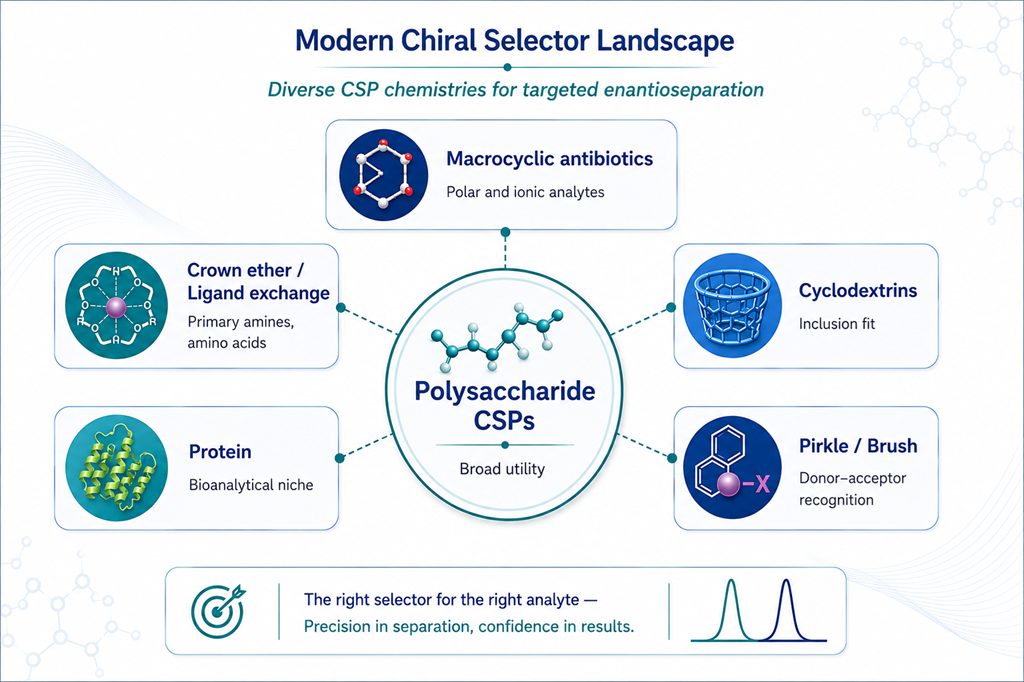
Macrocyclic antibiotic phases remain important because they solve different problems rather than merely substituting for polysaccharides. Their densely functionalised structures permit several simultaneous interaction modes, useful for polar, ionic, or heteroatom-rich analytes. Cyclodextrin phases offer cavity-based recognition that can be decisive for analytes fitting the inclusion model, and crown-ether or ligand-exchange phases suit primary amines and amino-acid-like compounds. Protein-based phases are less central in routine API impurity work but remain relevant in physiological-mode and certain bioanalytical applications. [7,8,9,10]
Brush-type or Pirkle-type phases deserve continued attention. They are sometimes overshadowed by polysaccharides because their general applicability is narrower, but their more interpretable interaction motifs make them valuable when a defined donor-acceptor and aromatic recognition pattern is likely, and they translate well into fast UHPLC-like formats. [11]
UHPLC-compatible chiral phases and faster screening
Chiral method development once accepted long run times as normal. That is no longer necessary in many settings. Advances in particle technology, including smaller fully porous particles and superficially porous particles, improved the speed-efficiency relationship for several selector classes and opened practical routes to fast chiral screening. [11,12]
The operational effect is larger than the particle literature alone suggests. Faster runs make bigger selector libraries realistic; bigger libraries make rule-based or platform screening feasible without committing to full brute-force exploration. The bottleneck in chiral development is often not the chemistry alone but the speed with which enough of the chemical space can be sampled to find a viable path. [13]
HPLC and SFC are complementary, not rivals
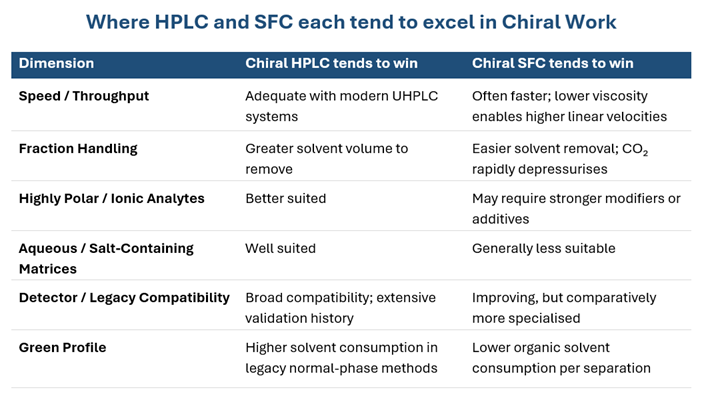
SFC has strong advantages in many chiral workflows. Carbon-dioxide-based mobile phases permit higher linear velocities at lower viscosity than conventional LC, often enabling faster runs and easier evaporation of collected fractions. The high-throughput and lower-solvent aspects of SFC are real, but success still depends on instrumentation, sample compatibility, and correct modifier selection. The decision table below summarises where each technique tends to win. [1,2, ]
High-throughput screening, automation, and platform workflows
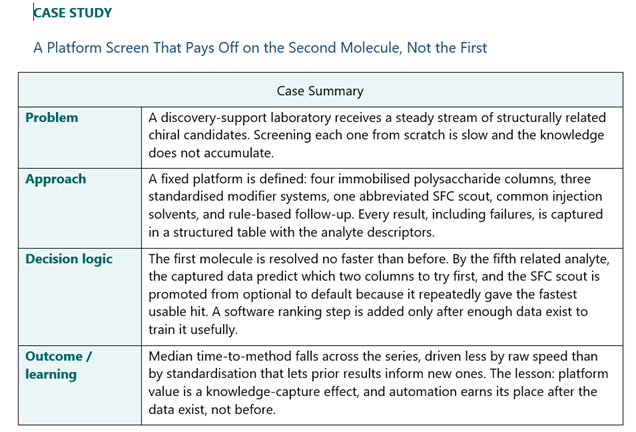
High-throughput chiral development is now an operational reality. Platform screening commonly uses a defined set of columns, standardised injection solvents, abbreviated run times, and rule-based follow-up experiments. The value is not only speed; standardisation improves knowledge capture across programmes, which compounds over time. [3]
Automation and software support extend this. Software-assisted optimisation can meaningfully narrow the experimental search in a real chiral assay-development problem, and data-driven in-silico strategies can predict retention behaviour as a function of mobile-phase composition. The most credible reading is cautious optimism: these tools are very useful when enough prior data exist and the experimental domain is well specified, but they do not replace a skilled scientist choosing the right selector families and failure tests. [14,15,16]
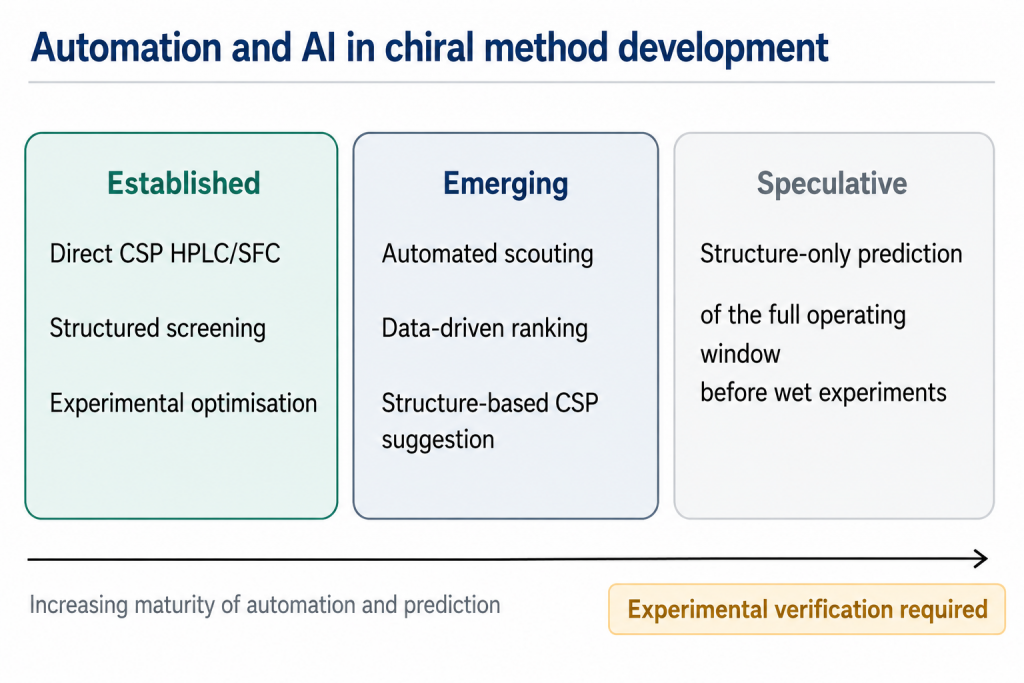
Current best practice is therefore hybrid. Use automated scouting, ranking, and modelling to compress experimental cycles, but anchor the process in mechanistic understanding and risk-based analytical targets. That approach aligns with Q14, which explicitly supports science- and risk-based development and knowledge management across the procedure lifecycle. [17]
Greener chromatography and solvent realism
Sustainability in chiral chromatography is no longer a peripheral talking point. Green-LC literature now treats solvent mass, toxicity, waste disposal, energy demand, and instrument cycle time as design factors. For chiral methods the issue is especially visible, because legacy normal-phase methods often rely on large volumes of hydrocarbons and alcoholic modifiers. Broad green-chromatography perspectives, together with SFC-specific literature, point in one direction: less solvent, less hazardous solvent, faster runs, and better reuse of separation data. [18,19]
This does not mean every hydrocarbon-based method should be abandoned. Established methods with excellent robustness and transfer history retain value. But current best practice is to ask early whether ethanol-rich systems, polar-organic modes, or SFC can deliver equal or better performance at lower environmental burden. The answer is often yes, but not always; some selector-analyte combinations still work best in conventional normal-phase-like conditions, and forcing a greener system can degrade selectivity or robustness enough to become a false economy. [4,18]
AI-assisted development, without mythology
AI-assisted chiral method development is real enough to discuss and still immature enough to discuss carefully. Peer-reviewed studies now describe machine-learning or software-assisted workflows for retention prediction, experiment ranking, and optimisation, and at least one structure-based approach predicts suitable chiral stationary phases directly from three-dimensional molecular conformations across a large enantioseparation dataset. These tools can reduce the number of experiments, accelerate data review, and improve reuse of historical screening data. [14,15,20]
What they do not yet do reliably is infer a universally transferable chiral-recognition model from structure alone across the full diversity of pharmaceutical analytes and selectors. Recognition remains too dependent on conformation, solvation, selector microenvironment, and subtle mobile-phase effects. A balanced position follows. Emerging technology: data-rich ranking systems, automated scouting, and constrained optimisation with experimental verification. Speculative future direction: routine structure-only prediction of the winning CSP and full operating window before any wet experiment. The literature does not support the stronger claim yet. [20,21,22]
The remaining bottlenecks
Several practical bottlenecks persist. Some analytes remain poorly soluble in the modes that give the best recognition. Highly polar or salt-containing samples can force a compromise between sample-preparation practicality and chromatographic ideality. Trace-level impurity methods are still challenging when the main peak is large, the impurity response factor is uncertain, or an apparently simple enantiomeric pair sits inside a complex impurity background. Simultaneous chiral-achiral separations are improving but not universal. [3,5]
Those bottlenecks explain why preparative isolation continues to matter. Analytical methods do not remove the need to isolate and characterise low-level chiral impurities; they identify the target and define the purity problem. Episode 4 addresses how that analytical insight is translated into semi-preparative or preparative isolation that is scientifically defensible and operationally productive.
References
1. Desfontaine V, Guillarme D, Francotte E, Novakova L. Supercritical fluid chromatography in pharmaceutical analysis. J Pharm Biomed Anal. 2015;113:56-71. https://doi.org/10.1016/j.jpba.2015.03.007
2. Lemasson E, Bertin S, West C. Use and practice of achiral and chiral supercritical fluid chromatography in pharmaceutical analysis and purification. J Sep Sci. 2016;39(1):212-233. https://doi.org/10.1002/jssc.201501062
3. De Luca C, Felletti S, Franchina FA, Bozza D, Compagnin G, Nosengo C, Pasti L, Cavazzini A, Catani M. Recent developments in the high-throughput separation of biologically active chiral compounds via high performance liquid chromatography. J Pharm Biomed Anal. 2024 Jan 20;238:115794. doi: 10.1016/j.jpba.2023.115794.
4. Chankvetadze B. Recent trends in preparation, investigation and application of polysaccharide-based chiral stationary phases for separation of enantiomers in high-performance liquid chromatography. TrAC Trends Anal Chem. 2020;122:115709. https://doi.org/10.1016/j.trac.2019.115709
5. Papp, L.A.; Szabó, Z.I.; Hancu, G.; Farczádi, L.; Mircia, E. Comprehensive Review on Chiral Stationary Phases in Single-Column Simultaneous Chiral–Achiral HPLC Separation Methods. Molecules 2024, 29, 1346. https://doi.org/10.3390/molecules29061346
6. Ibrahim AE, El Gohary NA, Aboushady D, Samir L, Karim SEA, Herz M, Salman BI, Al-Harrasi A, Hanafi R, El Deeb S. Recent advances in chiral selectors immobilization and chiral mobile phase additives in liquid chromatographic enantio-separations: A review. J Chromatogr A. 2023 Sep 13;1706:464214. doi: 10.1016/j.chroma.2023.464214
7. Ward TJ, Farris AB. Chiral separations using the macrocyclic antibiotics: a review. J Chromatogr A. 2001;906(1-2):73-89. https://doi.org/10.1016/S0021-9673(00)00941-9
8. Berkecz R, Tanacs D, Peter A, Ilisz I. Enantioselective liquid chromatographic separations using macrocyclic glycopeptide-based chiral selectors. Molecules. 2021;26(11):3380. https://doi.org/10.3390/molecules26113380
9. Du, W.; Jia, J.; Zhao, Y.; Ning, A.; Huang, R. Research Progress on the Development and Application of Cyclodextrin-Based Chromatographic Stationary Phases. Separations 2025, 12, 97. https://doi.org/10.3390/separations12040097.
10. Haginaka J. Protein-based chiral stationary phases for high-performance liquid chromatography enantioseparations. J Chromatogr A. 2001;906(1-2):253-273. https://doi.org/10.1016/S0021-9673(00)00504-5
11. Cavazzini A, Pasti L, Massi A, Marchetti N, Dondi F. Recent applications in chiral high performance liquid chromatography: A review. Anal Chim Acta. 2011;706(2):205–222. doi: 10.1016/j.aca.2011.08.038.
12. Schmitt K, Woiwode U, Kohout M, Zhang T, Lindner W, Lammerhofer M. Comparison of small-size fully porous particles and superficially porous particles of chiral anion-exchange type stationary phases in ultra-high performance liquid chromatography. J Chromatogr A. 2018;1569:149-159. https://doi.org/10.1016/j.chroma.2018.07.056
13. Tarafder A, Miller L. Chiral chromatography method screening strategies: past, present and future. J Chromatogr A. 2021;1638:461878. https://doi.org/10.1016/j.chroma.2021.461878
14. Ferencz E, et al. Possibilities and limitations of computer-assisted chiral HPLC method development. Sci Rep. 2024;14. https://doi.org/10.1038/s41598-024-78415-1
15. Marchetto A, Tirapelle M, Mazzei L, Sorensen E, Besenhard MO. In Silico High-Performance Liquid Chromatography Method Development via Machine Learning. Anal Chem. 2025 Apr 8;97(13):6991-7001. doi: 10.1021/acs.analchem.4c03466.
16. Welch CJ. Are We Approaching a Speed Limit for the Chromatographic Separation of Enantiomers? ACS Cent Sci. 2017 Aug 23;3(8):823-829. doi: 10.1021/acscentsci.7b00250.
17. International Council for Harmonisation. Q14 Analytical Procedure Development. Geneva: ICH; 2023. Available from: https://database.ich.org/sites/default/files/ICH_Q14_Guideline_2023_1116.pdf
18. Ahmed M, et al. Advances in green liquid chromatography for pharmaceutical analysis: A comprehensive review on analytical greenness to sustainable chemistry approaches. Microchemical Journal, October 2024. doi: 10.1016/j.microc.2024.111400
19.Buljan A, Roje M. Application of Green Chiral Chromatography in Enantioseparation of Newly Synthesized Racemic Marinoepoxides. Mar Drugs. 2022 Aug 19;20(8):530. doi: 10.3390/md20080530.
20. Hong Y, Welch CJ, Piras P, Tang H. Enhanced Structure-Based Prediction of Chiral Stationary Phases for Chromatographic Enantioseparation from 3D Molecular Conformations. Anal Chem. 2024 Feb 13;96(6):2351-2359. doi: 10.1021/acs.analchem.3c04028.
21. Ali I, Messali M, Gogolashvili A, Sekkoum K. Chiral Chromatography and Artificial Intelligence Integration in Enantiomers Separation. Chirality. 2025 Dec;37(12):e70066. doi: 10.1002/chir.70066.
22. Pieter De Gauquier, , Kenno Vanommeslaeghe, , Yvan Vander Heyden, , Debby Mangelings. Modelling approaches for chiral chromatography on polysaccharide-based and macrocyclic antibiotic chiral selectors: A review. Analytica Chimica Acta, 2021. 10.1016/j.aca.2021.338861
Further Reading