Introduction
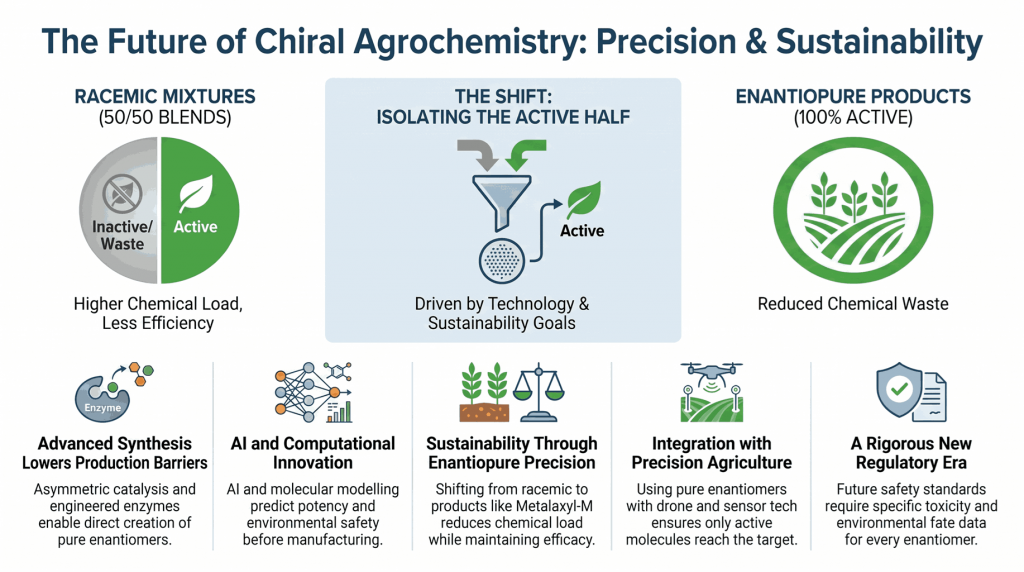
Chirality has already transformed how agrochemicals are designed, evaluated, and applied. From the early reliance on racemic formulations to today’s enantiopure products such as metalaxyl-M, the trajectory shows a clear shift toward stereochemistry as a cornerstone of innovation. The future of chiral agrochemistry lies at the intersection of asymmetric synthesis, biocatalysis, computational design, and green chemistry. These innovations promise safer, more effective, and more sustainable solutions for global agriculture.
This final episode examines the technologies, trends, and strategies that will define the future of chiral agrochemicals.
Advances in Asymmetric Synthesis
The cost of producing enantiopure agrochemicals has historically been a barrier to widespread adoption. Traditional separation techniques, such as chiral chromatography, are expensive at industrial scale. Emerging catalytic methods are changing this landscape.
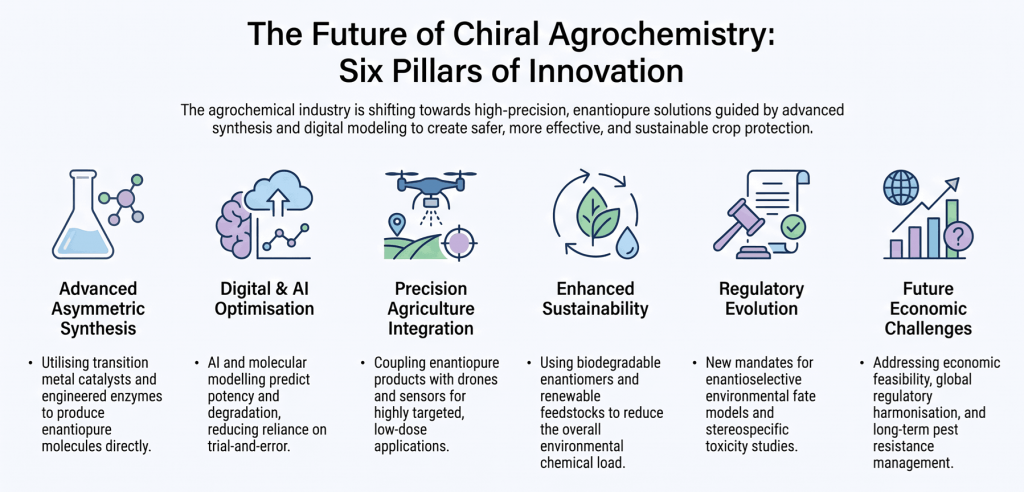
- Asymmetric Catalysis: Transition metal catalysts and organocatalysts enable enantioselective bond formation with high yields and selectivity. These advances allow agrochemical companies to design enantiopure molecules directly, reducing the need for costly separations (Knowles, 2001).
- Biocatalysis: Enzymes engineered to catalyze enantioselective reactions are gaining traction. They provide high stereoselectivity under mild, environmentally friendly conditions, aligning with green chemistry principles (Bornscheuer et al., 2012).
Computational Tools and AI
Computational chemistry is increasingly used to model enantioselective interactions between agrochemicals and biological targets. Molecular docking and dynamics simulations predict which enantiomer will show higher potency or lower toxicity.
Artificial intelligence (AI) and machine learning (ML) are also being applied to design new chiral scaffolds, optimize synthesis routes, and predict enantioselective degradation pathways in soil and water. These tools can accelerate discovery and reduce reliance on trial-and-error experimentation (Walters, 2019).
Green Chemistry and Sustainability
Sustainability is driving innovation across the agrochemical sector. Future chiral agrochemicals will be designed not only for potency but also for environmental compatibility.
- Biodegradable Enantiomers: Designing enantiopure molecules that degrade rapidly into harmless metabolites reduces environmental persistence.
- Renewable Feedstocks: Using bio-based starting materials for asymmetric synthesis supports circular economy models.
- Reduced Chemical Load: By focusing on the active enantiomer only, future formulations will require smaller amounts of product for equivalent or greater efficacy.
Integration with Precision Agriculture
Precision agriculture technologies, including drones, sensors, and AI-based decision systems, are reshaping pesticide application. Enantiopure agrochemicals will complement this shift by enabling highly targeted, lower-dose applications.
For example, coupling enantiopure herbicides with real-time weed detection systems could ensure only the necessary enantiomer is applied, at the correct site and dosage, minimizing waste and off-target effects (Shaner, 2014).
Regulatory Innovation
As stereochemistry becomes central to pesticide design, regulatory frameworks are expected to expand their requirements. Future dossiers may mandate:
- enantioselective environmental fate models
- stereospecific toxicity studies in humans and non-target organisms
- enantiomer-specific residue monitoring in food and feed
This will create a regulatory environment that encourages industry investment in enantiopure products while ensuring greater consumer and environmental protection (EFSA, 2019).
Challenges Ahead
Despite technological progress, several challenges remain:
- Economic Feasibility: Enantiopure synthesis must compete with cheaper racemic alternatives.
- Global Harmonization: Regulatory differences between regions can slow adoption.
- Resistance Management: Even with enantiopure products, pests and pathogens will continue to evolve, requiring ongoing vigilance.
Addressing these challenges will require collaboration between chemists, biologists, regulators, and farmers.
Conclusion
The future of chiral agrochemistry will be defined by precision, sustainability, and innovation. Advances in asymmetric catalysis, biocatalysis, computational chemistry, and precision agriculture will enable the design of enantiopure products that are more effective, safer, and environmentally compatible.
As the agricultural sector adapts to feed a growing population under the constraints of climate change and ecological fragility, chirality will remain a guiding principle in developing the next generation of crop protection solutions.
This concludes the 10-part series on chirality in agrochemicals. From the foundations of stereochemistry to the future of enantiopure innovation, the series has shown that chirality is not a peripheral detail but a central determinant of agrochemical science, regulation, and sustainability.
References
Bartlett DW, Clough JM, Godwin JR, Hall AA, Hamer M, Parr-Dobrzanski B. (2002). The strobilurin fungicides. Pest Manag Sci. 58(7):649-62. doi: 10.1002/ps.520. Erratum in: Pest Manag Sci. 2004 Mar;60(3):309.
Bornscheuer UT, Huisman GW, Kazlauskas RJ, Lutz S, Moore JC, Robins K. Engineering the third wave of biocatalysis. Nature. 2012 May 9;485(7397):185-94. doi: 10.1038/nature11117.
Crosby D.G. (1995). Environmental fate of pesticides: stereochemistry as a factor in transformation and degradation. Pure Appl Chem. 67(3): 407–412.
Dayan FE, Cantrell CL, Duke SO. Natural products in crop protection. Bioorg Med Chem. 2009 Jun 15;17(12):4022-34. doi: 10.1016/j.bmc.2009.01.046.
European Food Safety Authority (EFSA); Bura L, Friel A, Magrans JO, Parra-Morte JM, Szentes C. (2019). Guidance of EFSA on risk assessments for active substances of plant protection products that have stereoisomers as components or impurities and for transformation products of active substances that may have stereoisomers. EFSA J. 26;17(8):e05804. doi: 10.2903/j.efsa.2019.5804.
Knowles W.S. (2001). Asymmetric hydrogenations. Angew Chem Int Ed. 40(12): 2102–2118.
Müller T., Kohler H.P.E. (2004). Chirality of pesticides: stereoselectivity of enzymatic reactions. J Environ Qual. 33(2): 556–564.
Shaner D.L. (2014). Herbicide handbook, 10th edition. Weed Science Society of America, Champaign, IL.
Walters W.P. (2019). Artificial intelligence in drug discovery and agrochemicals research. Mol Inform. 38(3): 1800109.
Williams, A. (1996), Opportunities for chiral agrochemicals. Pestic. Sci., 46: 3-9. https://doi.org/10.1002/(SICI)1096-9063(199601)46:1<3::AID-PS337>3.0.CO;2-J
Yamamoto H., Miyake T., Ohkawa H. (1987). Enantioselective activity of metalaxyl enantiomers against plant pathogens. Pestic Biochem Physiol. 28(2): 163–171.
Further Reading