When Molecular Handedness Shapes Food Safety: Understanding the Hidden Side of Agrochemical Toxicity.
Introduction
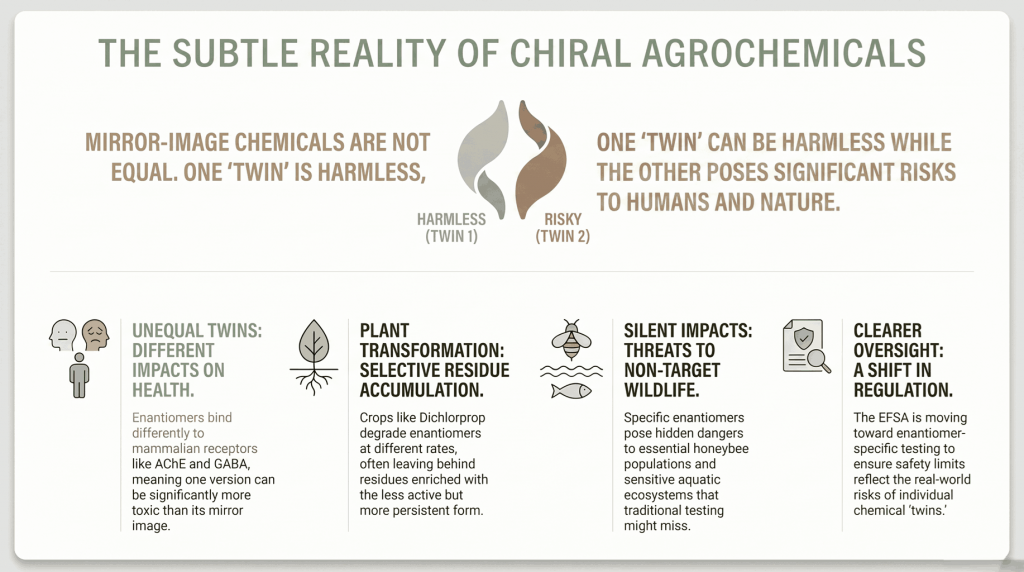
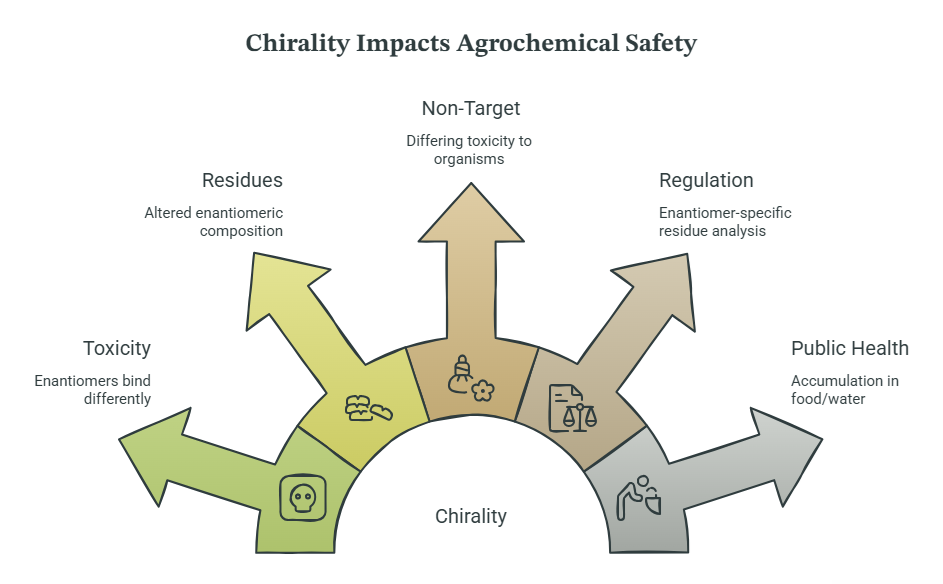
The toxicity of agrochemicals is a central concern for agriculture, food security, and public health. Chiral agrochemicals complicate this issue further because their enantiomers often differ in both biological activity and toxicological effects. While one enantiomer may efficiently control pests, the other may be less active or even harmful to humans, livestock, pollinators, or aquatic life. These stereochemical differences persist into the food chain, raising concerns about residues and consumer safety.
This episode explores how chirality shapes toxicological outcomes, residue accumulation, food safety regulations, and the broader implications for public health.
Enantioselective Toxicity in Humans and Animals
Agrochemical enantiomers may bind differently to mammalian receptors and enzymes. Organophosphate and carbamate insecticides, for example, inhibit acetylcholinesterase (AChE), but one enantiomer can be dramatically more potent than the other, leading to orders-of-magnitude differences in toxicity.
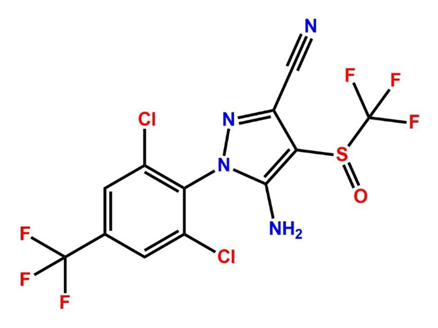
Fipronil is another case in point. Its enantiomers vary in their affinity for mammalian GABA receptors, resulting in distinct neurotoxic profiles. The more active enantiomer against pests has also been shown to cause stronger effects in non-target vertebrates. Such examples highlight the importance of testing both enantiomers individually, rather than relying on data from racemic mixtures.
Residues in Food Products
Residues of chiral agrochemicals in crops can have altered enantiomeric composition compared to the formulations applied in the field. This occurs because plants metabolize enantiomers differently, leading to selective degradation and accumulation.
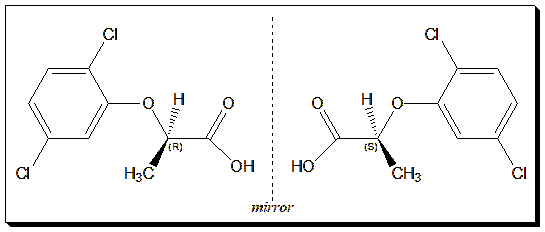
Phenoxy herbicides illustrate this well. Dichlorprop is applied as a racemic mixture, but the R-enantiomer degrades more quickly than the S-form in plants, leaving residues enriched in the less biologically active stereoisomer. For consumers, this means that the residues ingested may not reflect the original 50:50 ratio, complicating dietary exposure assessments.
Toxicity to Non-Target Organisms
Enantiomers may also differ in toxicity to beneficial insects, birds, aquatic organisms, and soil fauna. In pyrethroid insecticides, stereochemistry governs not only insecticidal potency but also aquatic toxicity, with some isomers more harmful to fish and invertebrates than to target pests. Neonicotinoids such as imidacloprid display stereoselective binding to insect nicotinic acetylcholine receptors. The stereochemistry affects both pest efficacy and collateral toxicity to pollinators like honeybees, raising concerns about their role in declining bee populations.
Food Safety and Regulatory Monitoring
Traditional pesticide residue monitoring measures only total chemical concentration, without distinguishing between enantiomers. This approach can mask the disproportionate presence of the more persistent or toxic stereoisomer.
The European Food Safety Authority now recommends enantiomer-specific residue analysis for chiral pesticides. This ensures that maximum residue limits (MRLs) reflect real risk profiles and that toxic or persistent enantiomers do not escape regulatory oversight. Such enantioselective monitoring represents an important evolution in consumer protection.
Public Health Implications
If stereochemistry is ignored, the toxic enantiomer of an agrochemical may accumulate in food and water supplies. Potential consequences include endocrine disruption, neurotoxicity, and chronic health risks for humans and animals.
By developing enantiopure formulations and integrating enantiomer-specific residue analysis into regulatory practice, it is possible to reduce chemical inputs, minimize risks to consumers, and strengthen public trust in food safety.
Conclusion
Chirality profoundly influences the toxicity and food safety of agrochemicals. Enantiomers can differ in potency, persistence, and toxicological profiles, making it essential to evaluate them separately. Regulatory frameworks are beginning to require enantiomer-specific monitoring, but broader adoption is needed. Moving toward enantiopure formulations and enantioselective residue testing will improve food safety while maintaining agricultural productivity.
The next episode will explore how chirality supports sustainable pest management strategies and integrated approaches to crop protection.
References
Ariëns E.J. (1984). Stereochemistry, a basis for sophisticated nonsense in pharmacokinetics and clinical pharmacology. Eur J Clin Pharmacol. 26(6): 663–668.
Fang Wang, Xiaoyun Li, Shanxue Jiang, Jiajun Han, Junxue Wu, Meilin Yan, and Zhiliang Yao (2023). Enantioselective Behaviors of Chiral Pesticides and Enantiomeric Signatures in Foods and the Environment. J. Agric. Food Chem. 71, 33, 12372–12389. https://doi.org/10.1021/acs.jafc.3c02564
Nillos MG, Gan J, Schlenk D. Chirality of organophosphorus pesticides: analysis and toxicit. (2010). J Chromatogr B Analyt Technol Biomed Life Sci. 2010 May 15;878(17-18):1277-84. doi: 10.1016/j.jchromb.2009.11.022.
Li L, Zhou S, Jin L, Zhang C, Liu W. (2010). Enantiomeric separation of organophosphorus pesticides by high-performance liquid chromatography, gas chromatography and capillary electrophoresis and their applications to environmental fate and toxicity assays. J Chromatogr B Analyt Technol Biomed Life Sci. 878(17-18):1264-76. doi: 10.1016/j.jchromb.2009.10.031.
Nonkululeko Landy Mdeni, Abiodun Olagoke Adeniji , Anthony Ifeanyi Okoh and Omobola Oluranti Okoh. (2022). Analytical Evaluation of Carbamate and Organophosphate Pesticides in Human and Environmental Matrices: A Review. Molecules,,27, 618. doi: 10.3390/molecules27030618.
Philip W. Lee, Reza Allahyari, T.Roy Fukuto (1978). Studies on the chiral isomers of fonofos and fonofos oxon: II. In vitro metabolism. Pestic Biochem Physiol. 8(2):158-169. https://doi.org/10.1016/0048-3575(78)90036-6
Jing Ye, Meirong Zhao, Lili Niu, Weiping Liu (2015). Enantioselective Environmental Toxicology of Chiral Pesticides. Chem. Res. Toxicol. 28, 3, 325–338. https://doi.org/10.1021/tx500481n
Buser H.R., Müller M.D., Rappe C. (1992). Enantioselective determination of chiral phenoxy herbicides and their environmental behavior. Anal Chem. 64(13): 1461–1467.
Crosby D.G. (1995). Environmental fate of pesticides: stereochemistry as a factor in transformation and degradation. Pure Appl Chem. 67(3): 407–412.
EFSA (European Food Safety Authority). (2019). Guidance on the assessment of the safety of pesticides with stereoisomers. EFSA Journal. 17(6): e05760.
Garrison A.W., Avants J.K., Jones W.J. (1996). Enantiomeric selectivity in the environmental degradation of pesticides. Environ Sci Technol. 30(8): 2449–2455.
Kan C.A., Meijer G.A.L., Traag W.A. (2013). Enantioselective toxicity of fipronil to non-target organisms. Chemosphere. 93(9): 2106–2112.
Müller T., Kohler H.P.E. (2004). Chirality of pesticides: stereoselectivity of enzymatic reactions. J Environ Qual. 33(2): 556–564.
Soderlund D.M., Clark J.M., Sheets L.P., Mullin L.S., Piccirillo V.J., Sargent D., Stevens J.T., Weiner M.L. (2002). Mechanisms of pyrethroid neurotoxicity: implications for cumulative risk assessment. Toxicology. 171(1–2): 3–59.
Tomizawa M., Casida J.E. (2005). Neonicotinoid insecticide toxicology: mechanisms of selective action. Annu Rev Pharmacol Toxicol. 45: 247–268.
Zhou Q., Wang Y., Zhang H., Xie X. (2010). Enantioselective toxicology of chiral pesticides. J Environ Sci Health Part B. 45(1): 1–26.
Karla Irazú Ventura-Hernández, Enrique Delgado-Alvarado, Tushar Janardan Pawar, José Luis Olivares-Romero (2024). Chirality in Insecticide Design and Efficacy. J. Agric. Food Chem. 72, 38, 20722–20737. https://doi.org/10.1021/acs.jafc.4c05363
Yue Zhang, Dong Chen, Yizhu Xu, Lianlian Ma, Mingyi Du, Ping Li, Zhibin Yin, Hanhong Xu, Xinzhou Wu (2022). Stereoselective toxicity mechanism of neonicotinoid dinotefuran in honeybees: New perspective from a spatial metabolomics study. Science of The Total Environment, 809, 25 February ,151116. https://doi.org/10.1016/j.scitotenv.2021.151116
Further Reading