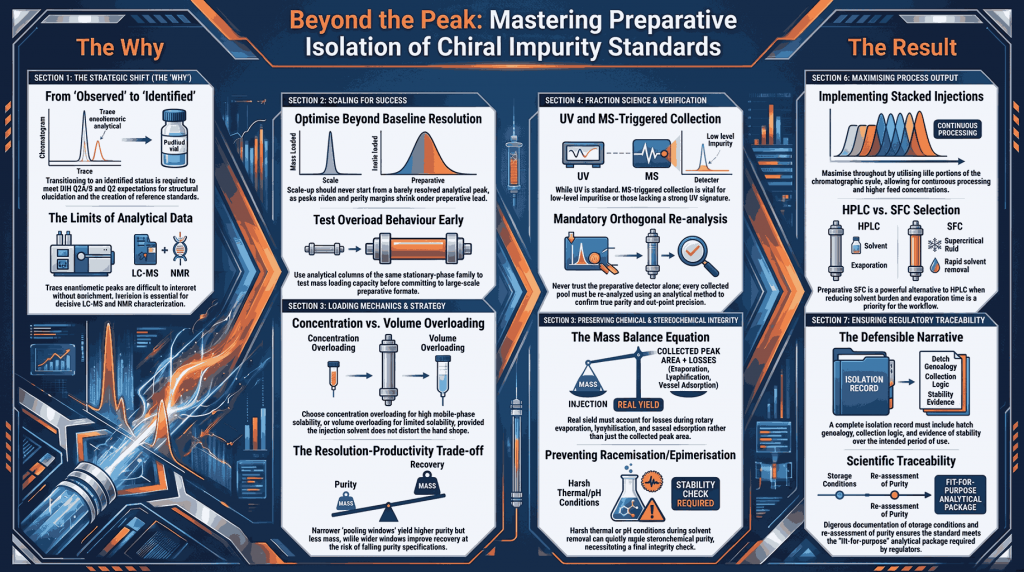
“Turning an analytical separation into an isolated, characterised, defensible impurity standard”
Why isolate a chiral impurity at all
Analytical scientists ask for isolated chiral impurities when a chromatogram is no longer enough. The reasons are concrete: structural elucidation of an unknown peak, preparation of a reference standard, response-factor determination, qualification under ICH impurity expectations, forced-degradation assignments, toxicology support, or a defensible regulatory narrative in which an impurity has been identified rather than merely observed. ICH Q3A(R2) and Q3B(R2) frame the need to identify and qualify relevant impurities, while Q2(R2) expects validated procedures and suitable reference materials as part of a fit-for-purpose analytical package. [1,2,3]
For chiral impurities, isolation can matter more than for achiral ones because trace enantiomeric peaks are hard to interpret without orthogonal information. If a peak could be the opposite enantiomer, a chiral degradant, a new diastereomer, or an unrelated achiral impurity that happens to co-elute in a chiral system, then preparative work and structural characterisation become the route to certainty. LC-MS and NMR become far more decisive once the chromatographic target has been enriched or isolated. [4,5]
Analytical and preparative chromatography serve different objectives
Analytical chiral HPLC seeks accurate measurement. Preparative chiral HPLC seeks purified mass at acceptable productivity and purity. The goals overlap but are not identical. The step from analytical to preparative work requires a shift in criteria: a narrow, beautiful analytical peak is not automatically a good preparative method if loading capacity is poor, fractions are hard to concentrate, or the solvent system is operationally impractical. [6,7]
This is why scale-up should never start from a barely acceptable analytical resolution. Under load, peaks widen, displacement effects emerge, and the purity margin shrinks. The analytical method should be optimised beyond mere baseline resolution when the intended use is isolation. When the target is present only at trace level, the challenge is often not separating it from its nearest peak under dilute conditions but preserving enough selectivity under overload to yield a recoverable, characterisable fraction. [6,7]
Scaling from analytical to semi-preparative and preparative work
Established practice is to develop overload behaviour on an analytical column packed with the same stationary-phase family as the intended preparative column, because analytical retention factors alone do not predict behaviour under load. Analytical data can support prediction of preparative conditions, but only when the assumptions are tested. [8]
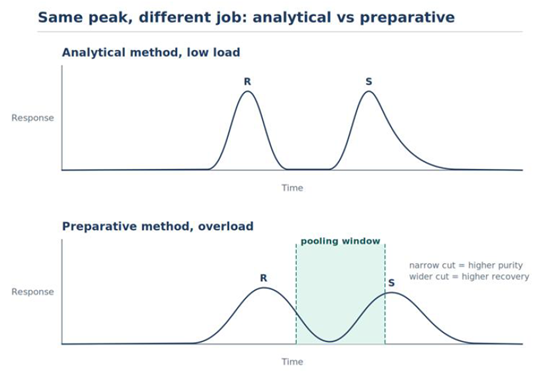
Semi-preparative work is often the most efficient intermediate step for impurity isolation in development. It allows rapid confirmation of loadability, pooling windows, and recovery without committing large quantities of sample or solvent. Once behaviour is clear, the method moves to a larger preparative format if more material is needed. Column-dimension studies illustrate how diameter changes affect yield, purity, and system behaviour during one-step purification. [9]
The scale-up logic is straightforward: maintain comparable linear velocity and stationary-phase chemistry, then determine how much mass can be loaded before purity drops below target. A chiral method selected only for analytical convenience may be a poor preparative option, while a slightly less elegant analytical method may load cleanly and yield fractions that are easier to process. [6,7]
Loading strategy determines productivity
Preparative productivity is controlled by loading more than by almost anything else. Three loading variables matter immediately: sample concentration, injection volume, and injection solvent. If analyte and impurity are both highly soluble in the mobile phase, concentration overloading is efficient. If solubility is limited, volume overloading may be the practical route, but only if the injection solvent does not destroy band shape on entry. Viscous or strongly mismatched injection solvents are a frequent cause of broad, distorted preparative peaks. [6,7]
The resolution-productivity trade-off is especially sharp for low-level chiral impurities. A narrow pooling window gives higher purity but less mass; a wider window improves recovery but risks the purity specification. The strictness of the purity target should be linked to intended use rather than imposed reflexively: a reference standard for quantitative method validation demands a different purity profile from a sample intended for preliminary structural elucidation. [3]
Fraction collection is a science, not a clerical step
Fraction-collection strategy determines whether preparative work succeeds. Time-based collection is simple but fragile. Threshold- or slope-based UV collection is usually better when the chromatogram is stable and the target absorbs well. Mass-spectrometry-triggered collection becomes attractive when the impurity is low-level, embedded in a matrix, or lacks a clean UV signature, and it reduces the number of irrelevant fractions in multi-technique impurity work. [4]
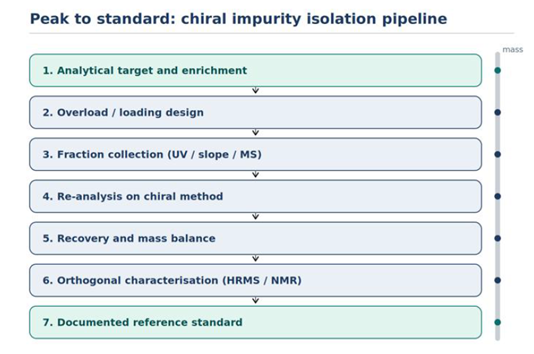
After collection, every pool must be re-analysed by an orthogonal or at least revalidated analytical method. A common mistake is to trust the preparative detector alone: preparative peak shape, detector lag, and delay volume can create an overly optimistic impression of cut-point precision. Re-injection on the analytical chiral method, with achiral purity profiling where relevant, is part of the isolation process, not post-hoc documentation. [6,7]
Recovery, solvent removal, and stability decide the real yield
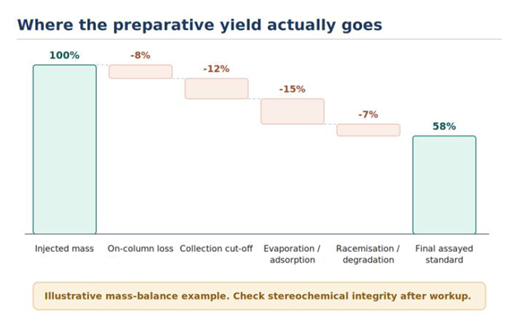
Preparative isolation does not end when a fraction bottle fills. Real yield is often lost after the separation, so it is best treated as a mass-balance problem: account for injected mass, collected mass, post-processing losses, and final assayed mass, and reconcile the difference. Losses accrue in rotary evaporation, lyophilisation, adsorption to vessel surfaces, precipitation during solvent swap, and chemical instability during concentration. [6,7]
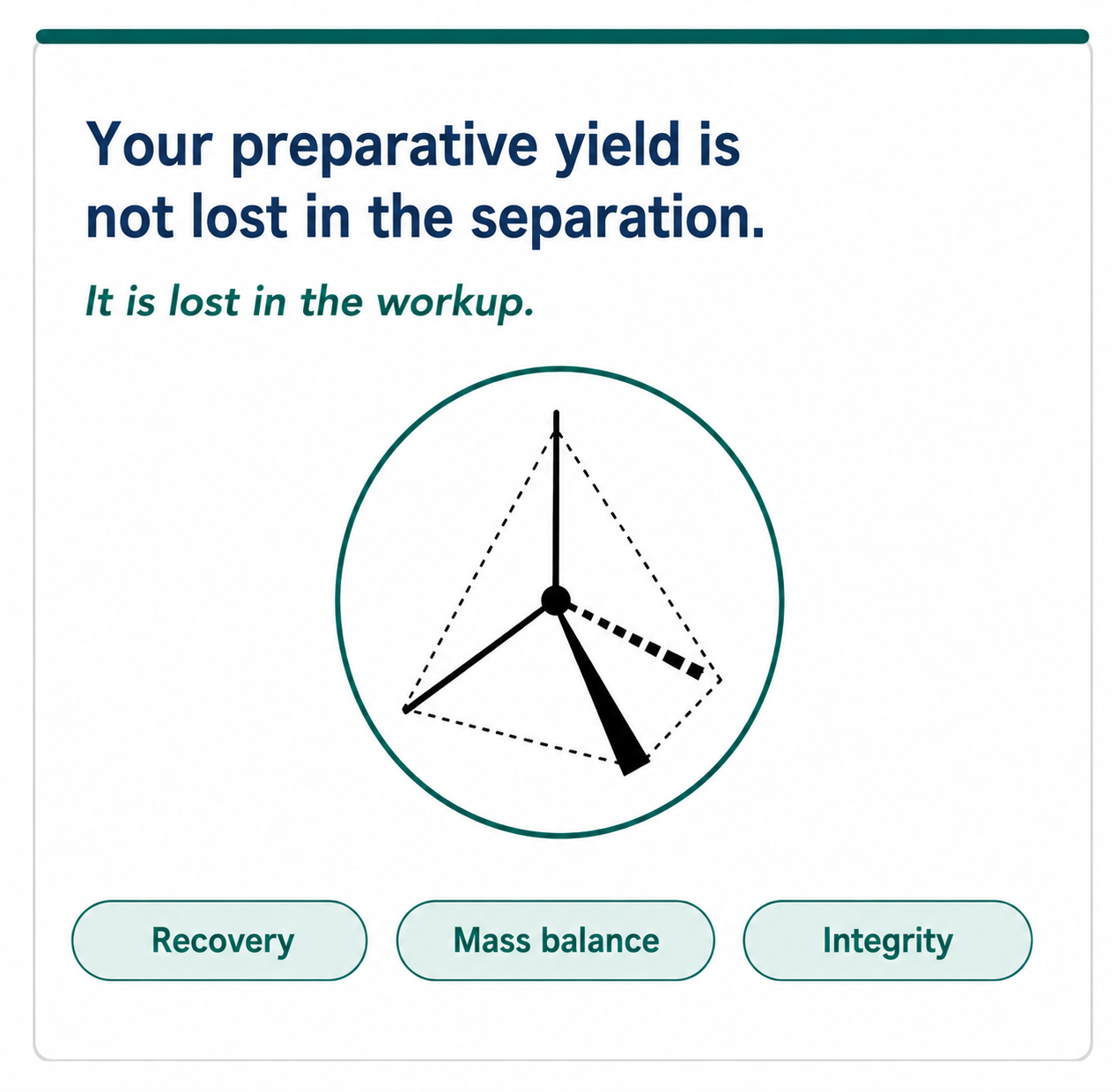
For chiral impurities this last point is acute. A collected enantiomer or epimer can racemise or epimerise under the acidic, basic, or thermal conditions used to concentrate it, quietly eroding the very stereochemical purity the isolation was meant to deliver. The correct recovery figure therefore requires mass balance and a stereochemical-integrity check on the final material, not collected peak area alone. [6,7]
Additives matter here. Volatile acids and bases are easier to manage than persistent or nonvolatile modifiers. Trifluoroacetic acid can be chromatographically useful but awkward in downstream MS interpretation and solvent removal, and it can suppress electrospray signal through ion pairing. Strong amine additives may improve peak shape yet leave column memory effects and complicate evaporation. Preparative scientists therefore prefer the mildest additive system that still delivers acceptable peak shape and selectivity. [10,11]
Productivity tools: stacked injections, recycling, and prep SFC
Once a separation is proven, productivity becomes the next question. Stacked injections are among the most practical ways to raise output because they use idle portions of the chromatographic cycle more efficiently; throughput can be raised materially by stacked injections, higher feed concentrations where feasible, and better use of the separation window. [12,13]
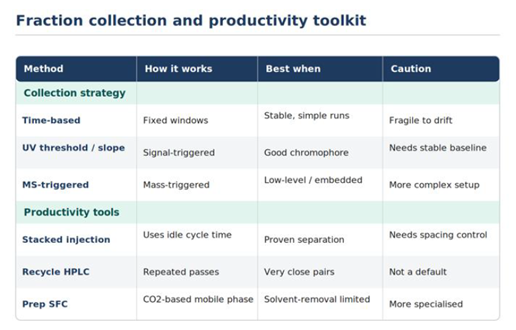
Recycling preparative HPLC is a useful but selective tool. It increases effective separation length by passing peaks repeatedly through the system and is valuable when the analyte pair is too close for single-pass purity yet the method is otherwise stable. It is not the default for high-throughput impurity isolation. [14,15]
Preparative chiral SFC is an important alternative, especially when solvent-removal time and total solvent burden are limiting. Reviews of preparative chiral separations consistently note the throughput and evaporation advantages of SFC for many enantiomer purifications. For impurity work, the choice between prep HPLC and prep SFC should turn on actual selectivity, sample solubility, detector compatibility, and downstream concentration burden, not on platform habit. [6,12]
Isolating trace chiral impurities from real matrices
Trace chiral-impurity isolation from stressed samples, mother liquors, reaction mixtures, or drug-product extracts usually requires enrichment before preparative chromatography becomes efficient. Enrichment may involve bulk API depletion, achiral prefractionation, selective extraction, or repeated analytical-to-semi-preparative pooling of the chiral window. Combined LC-MS and NMR strategies are markedly more effective once the target has been concentrated away from the dominant matrix. [4,5]
Documentation and traceability
If the isolated impurity will support validation or a submission, traceability requirements tighten. The isolation record should identify source material, batch genealogy, chromatographic conditions, collection logic, purity re-assessment, orthogonal confirmation, storage conditions, and evidence for stability of the isolated standard over its intended use period. Q2(R2) expects suitably characterised reference materials, and the impurity framework under Q3A and Q3B requires that impurity identification and control be scientifically defensible. That regulatory reality is the bridge to Episode 5. [1,2,3]
References
1. International Council for Harmonisation. Q3A(R2) Impurities in New Drug Substances. Geneva: ICH; 2006. Available from: https://database.ich.org/sites/default/files/Q3A%28R2%29%20Guideline.pdf
2. International Council for Harmonisation. Q3B(R2) Impurities in New Drug Products. Geneva: ICH; 2006.
3. International Council for Harmonisation. Q2(R2) Validation of Analytical Procedures. Geneva: ICH; 2023. Available from: https://database.ich.org/sites/default/files/ICH_Q2%28R2%29_Guideline_2023_1130.pdf
4. Provera S, et al. A multi-technique approach using LC-NMR, LC-SPE-NMR, LC-MS and semi-preparative chromatography for the characterization of low-level pharmaceutical impurities. J Pharm Biomed Anal. 2010;53(3):389-395. https://doi.org/10.1016/j.jpba.2010.04.017
5. Gathungu RM, Kautz R, Kristal BS, Bird SS, Vouros P. The integration of LC-MS and NMR for the analysis of low molecular weight trace analytes in complex matrices. Mass Spectrom Rev. 2020 Mar;39(1-2):35-54. doi: 10.1002/mas.21575. doi: 10.1002/mas.21575
6. Pinto MMM, Fernandes C, Tiritan ME. Chiral separations in preparative scale: a medicinal chemistry point of view. Molecules. 2020;25(8):1931. https://doi.org/10.3390/molecules25081931
7. Gumustas M, Ozkan SA, Chankvetadze B. Analytical and preparative scale separation of enantiomers of chiral drugs by chromatography and related methods. Curr Med Chem. 2018;25(33):4152-4188. https://doi.org/10.2174/0929867325666180129094955
8. P. Sajonz , T.K. Natishan, F.D. Antia, R. Frenette. Optimization of the preparative separation of a chiral pharmaceutical intermediate by high performance liquid chromatography. J Chromatogr A. 2005. doi: 10.1016/j.chroma.2005.06.070
9. Chen Y, Mant CT, Hodges RS. Preparative reversed-phase high-performance liquid chromatography collection efficiency for an antimicrobial peptide on columns of varying diameters (1mm to 9.4mm I.D.). J Chromatogr A. 2007 Jan 26;1140(1-2):112-20. doi: 10.1016/j.chroma.2006.11.052. doi: 10.1016/j.chroma.2006.11.052
10. Gustavsson SA, Samskog J, Markides KE, Langstrom B. Studies of signal suppression in liquid chromatography-mass spectrometry using volatile ion-pairing reagents. J Chromatogr A. 2001;937(1-2):41-47. https://doi.org/10.1016/S0021-9673(01)01328-0
11. Honorine Lardeux, Bastiaan L. Duivelshof, Olivier Colas, Alain Beck, David V. McCalley, Davy Guillarme, Valentina D’Atri. Alternative mobile phase additives for the characterization of protein biopharmaceuticals in liquid chromatography – Mass spectrometry. Analytica Chimica Acta, 2021. doi: 10.1016/j.aca.2021.338347
12. Speybrouck D, Lipka E. Productivity and solvent waste in supercritical fluid chromatography for preparative chiral separations: a guide for a convenient strategy. J Chromatogr A. 2020 Jan 11;1610:460549. doi: 10.1016/j.chroma.2019.460549
13. Taheri M, Fotovati M, Hosseini SK, Ghassempour A. Optimization of throughput in semipreparative chiral liquid chromatography using stacked injection. Chirality. 2017 Oct;29(10):579-588. doi: 10.1002/chir.22727. doi: 10.1002/chir.22727
14. Sidana J, Joshi LK. Recycle HPLC: a powerful tool for the purification of natural products. Chromatography Research International. 2013;2013:509812. https://doi.org/10.1155/2013/509812
15. Grill CM, Miller L, Yan TQ. Resolution of a racemic pharmaceutical intermediate: a comparison of preparative HPLC, steady-state recycling, and simulated moving bed. J Chromatogr A. 2004;1026(1-2):101-108. https://doi.org/10.1016/j.chroma.2003.11.008
Further Reading