Valliappan Kannappan

Episode 8: Sustainable Pest Management and Chirality

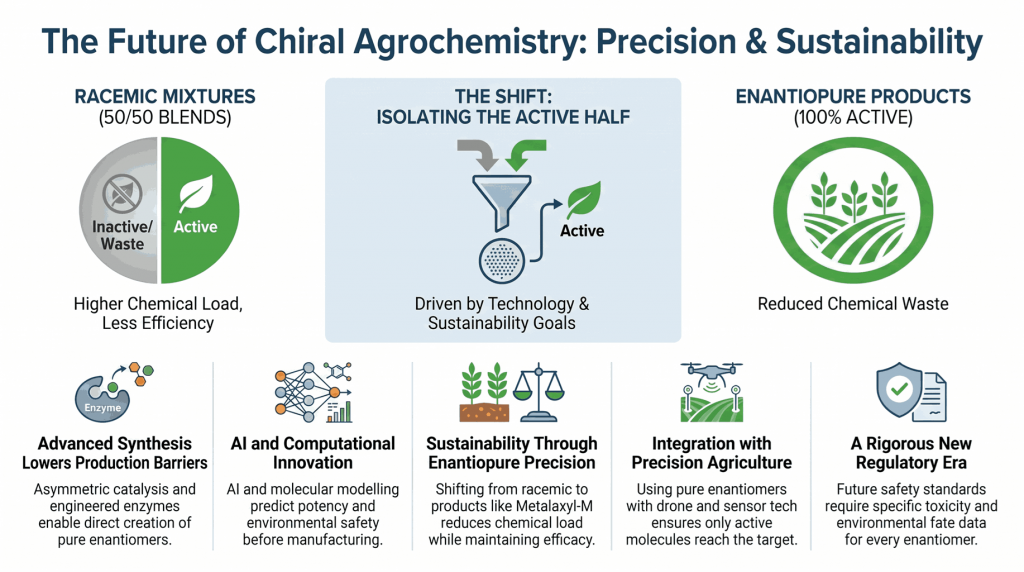
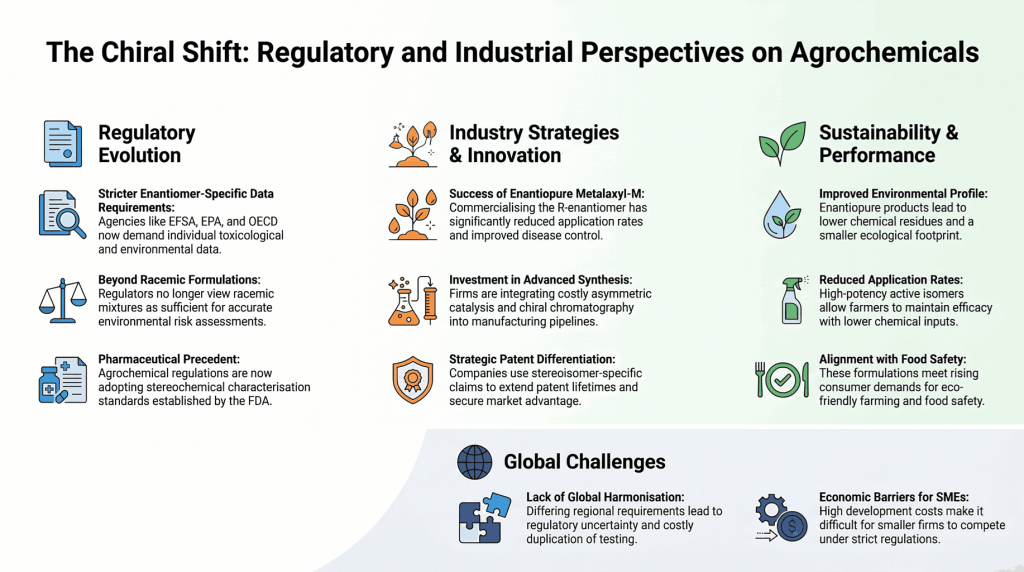
Precision at the Molecular Level, Sustainability in the Field 🌱 Introduction Sustainable agriculture aims to balance crop productivity with environmental protection and food safety. Agrochemicals play a central role in pest management, but their widespread use has raised concerns about resistance, biodiversity loss, and long-term ecological impacts. Chirality offers a path toward sustainability because enantiopure …

Episode 8: Sustainable Pest Management and Chirality Read More »

Episode 7: Toxicity and Food Safety Considerations of Chiral Agrochemicals

When Molecular Handedness Shapes Food Safety: Understanding the Hidden Side of Agrochemical Toxicity. Introduction The toxicity of agrochemicals is a central concern for agriculture, food security, and public health. Chiral agrochemicals complicate this issue further because their enantiomers often differ in both biological activity and toxicological effects. While one enantiomer may efficiently control pests, the …

Episode 7: Toxicity and Food Safety Considerations of Chiral Agrochemicals Read More »

Episode 6: Environmental Impact of Chiral Agrochemicals

🌍 From Soil to Streams: How Molecular Handedness Shapes Environmental Fate. Introduction When agrochemicals are applied in the field, they do not remain confined to the crops they are intended to protect. They enter soil, water, and air, where they interact with complex ecosystems. For chiral agrochemicals, these interactions are influenced not only by chemical …

Episode 6: Environmental Impact of Chiral Agrochemicals Read More »

Episode 5: Natural Products as Chiral Templates

🌿 Nature’s Handedness, Agriculture’s Inspiration. Introduction Nature is the ultimate chemist, and chirality is one of its most powerful design principles. Many of the most effective agrochemicals are inspired by or derived directly from natural compounds, which are overwhelmingly chiral. These natural products serve as templates for synthetic agrochemistry, guiding the development of pesticides, herbicides, …

Episode 5: Natural Products as Chiral Templates Read More »

Episode 4: Fungicides and Stereochemistry

🌱When Molecular Handedness Determines Fungal Control for a More Sustainable Future. πŸ„ Introduction Fungal infections cause devastating losses in agriculture, threatening global food security. Fungicides are therefore essential tools in crop protection. Many fungicides are chiral, and their enantiomers can differ significantly in fungicidal potency, environmental behavior, and toxicity to non-target organisms. The stereochemistry of …

Episode 4: Fungicides and Stereochemistry Read More »

Episode 3: Herbicides and the Role of Chirality

🌱 Herbicides Have Two Faces β€” Chirality Decides Their Impact.” 🧬 Introduction Herbicides are among the most widely used agrochemicals worldwide. They are applied to protect crops from weed competition, ensuring higher yields and food security. A significant number of herbicides are chiral, and their enantiomers often show large differences in biological activity, environmental fate, …

Episode 3: Herbicides and the Role of Chirality Read More »

Episode 2: Stereoselectivity and Biological Activity in Pesticides

🧬🌱 β€œWhen Mirror Images Decide Between Protection and Toxicity.” Introduction Pesticides are essential tools in modern agriculture, protecting crops from insects, weeds, and pathogens. Many of these compounds are chiral, meaning they exist as two or more non-superimposable mirror-image forms called enantiomers. Enantiomers often exhibit very different biological activities, toxicities, and environmental behaviors. Understanding these …

Episode 2: Stereoselectivity and Biological Activity in Pesticides Read More »

Episode 1: Introduction to Chirality in Agrochemicals

What happens when π’„π’‰π’Šπ’“π’‚π’π’Šπ’•π’š π’Žπ’†π’†π’•π’” 𝒄𝒓𝒐𝒑 π’”π’„π’Šπ’†π’π’„π’†? Introduction Chirality, the property of a molecule that makes it non-superimposable on its mirror image, is a crucial consideration in agrochemistry. Agrochemicals such as pesticides, herbicides, and fungicides often contain one or more stereogenic centers. The two enantiomers of a chiral molecule can behave very differently in biological …

Episode 1: Introduction to Chirality in Agrochemicals Read More »

Germanium 🧬: Beyond Carbon β€” A Chiralpedia Guide to a New Dimension of Chirality

Demonstrates that chirality extends beyond carbon into heavier elements Introduction: Beyond Carbon-Centered Chirality Chirality is one of the most fundamental concepts in chemistry, typically introduced through tetrahedral carbon atoms bearing four different substituents. However, chirality is not limited to carbonβ€”it extends across the periodic table. Germanium, a Group 14 element positioned below silicon, presents a …

Germanium 🧬: Beyond Carbon β€” A Chiralpedia Guide to a New Dimension of Chirality Read More »

X-ray Reveals the Truth. R/S Makes It Speak.

Why stereochemistry is not just about seeing moleculesβ€”but learning how to describe them In modern chemistry, we have powerful tools like X-ray crystallography that can reveal the exact three-dimensional structure of a molecule with remarkable precision. So it raises a compelling question: If we already know what a molecule truly looks like in 3D… why …

X-ray Reveals the Truth. R/S Makes It Speak. Read More »