AI in Chirality

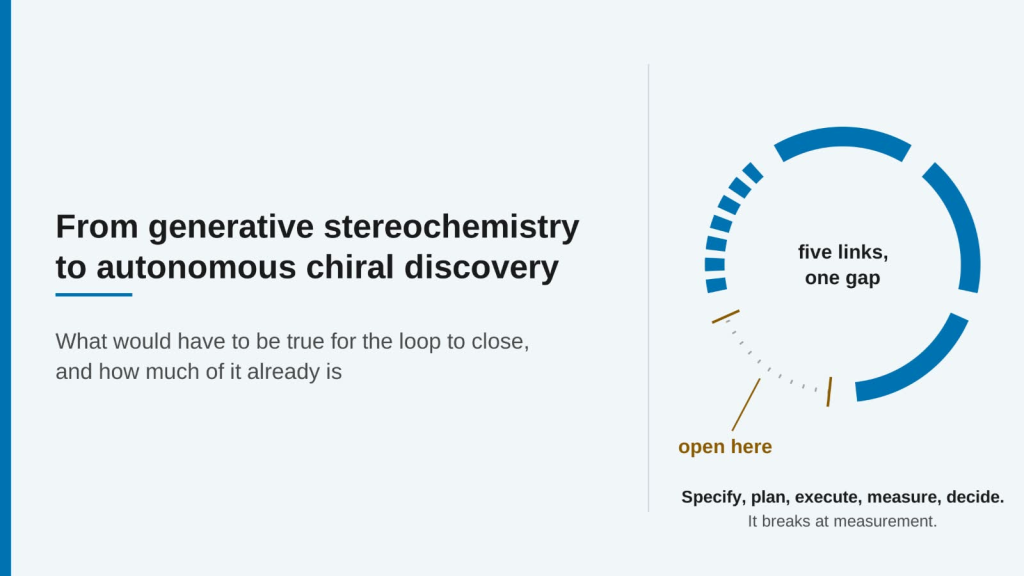
Episode 5: From Generative Stereochemistry to Autonomous Chiral Discovery

From Generative Stereochemistry to Autonomous Chiral Discovery Summary A closed loop for chirality would design a stereochemically defined molecule, plan a route, execute it, measure enantiomeric excess, and decide what to run next. Every link now exists somewhere in the literature. None have been joined end to end for a stereochemical objective. The weakest links …

Episode 5: From Generative Stereochemistry to Autonomous Chiral Discovery Read More »
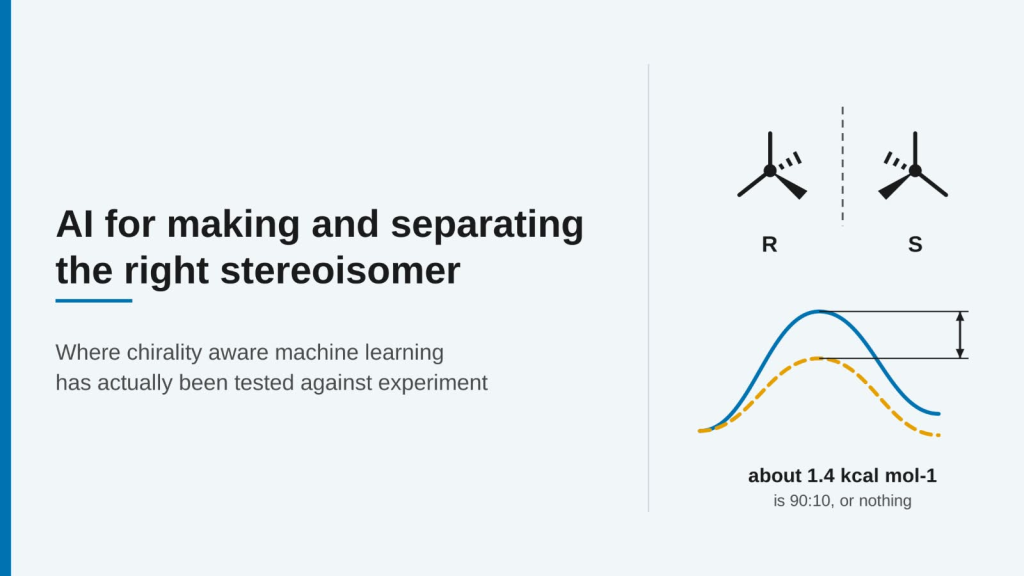
Episode 4: AI for making and separating the right stereoisomer

Where chirality aware machine learning has actually been tested against experiment Summary This is the part of the field with a genuine experimental track record. Models have proposed catalysts, enzyme variants, reactions and resolving agents that were then made and tested, and that worked. A model designed resolution screen resolved three of six previously unseen …

Episode 4: AI for making and separating the right stereoisomer Read More »

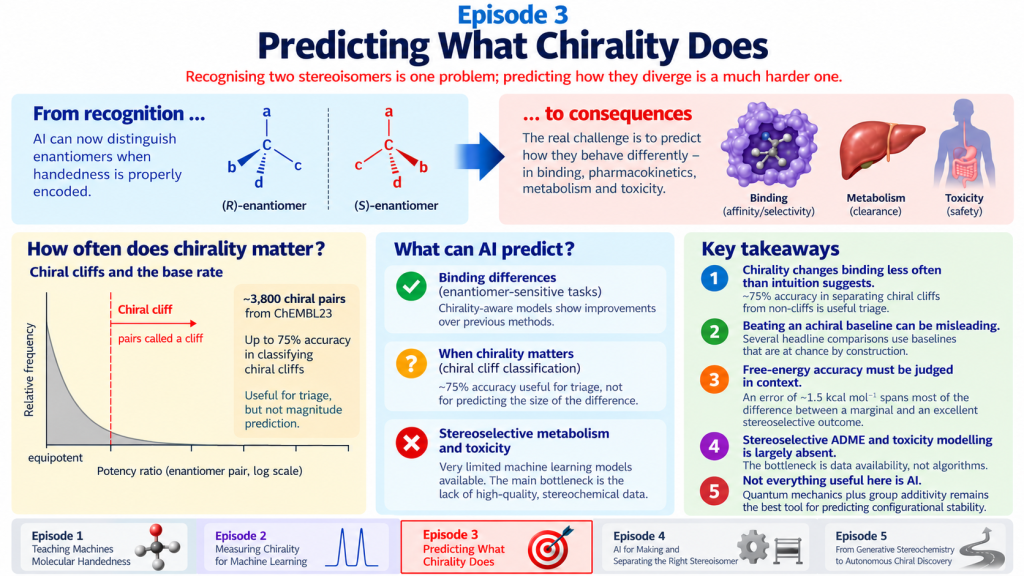
Episode 3: Predicting What Chirality Does

Recognising two stereoisomers is one problem; predicting how they diverge is a much harder one Summary The reason to build chirality-aware models is not to classify stereocentres but to predict consequences: which enantiomer binds, which is cleared faster, which carries the toxicity. This is where the evidence base is thinnest. Chirality-aware architectures win on benchmark …

Episode 3: Predicting What Chirality Does Read More »

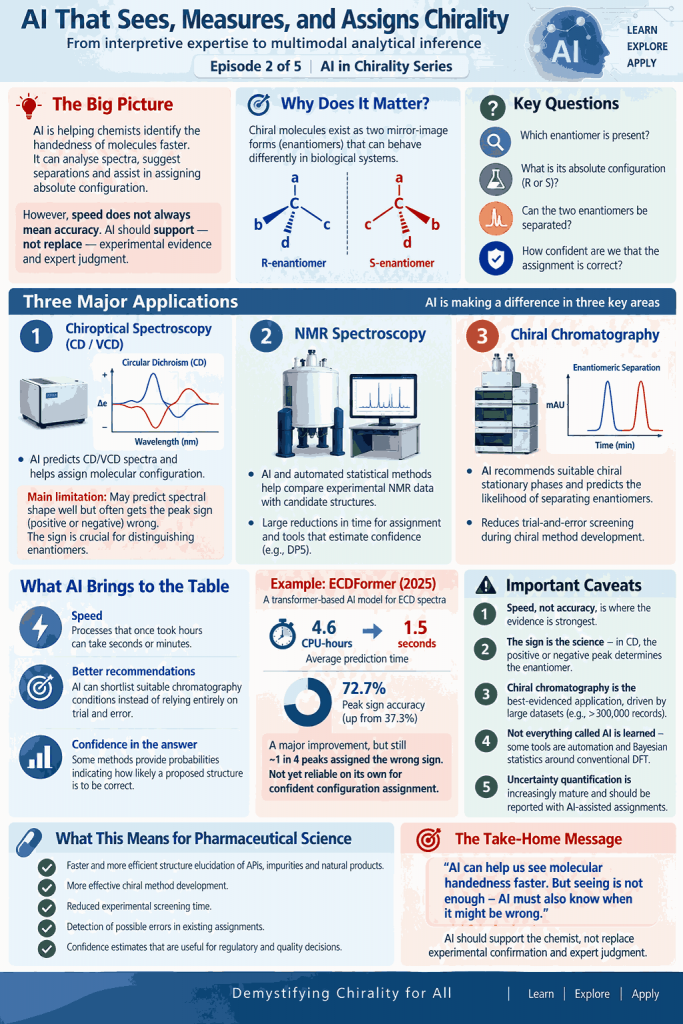
Episode 2: AI That Sees, Measures, and Assigns Chirality

From interpretive expertise to multimodal analytical inference Summary Determining a molecule’s configuration, or resolving its enantiomers on a column, has traditionally meant comparing experimental data against a computed reference  a process gated by quantum chemistry and by expert judgement. Machine learning is now compressing that comparison from hours to seconds and, in chiral chromatography, is …

Episode 2: AI That Sees, Measures, and Assigns Chirality Read More »

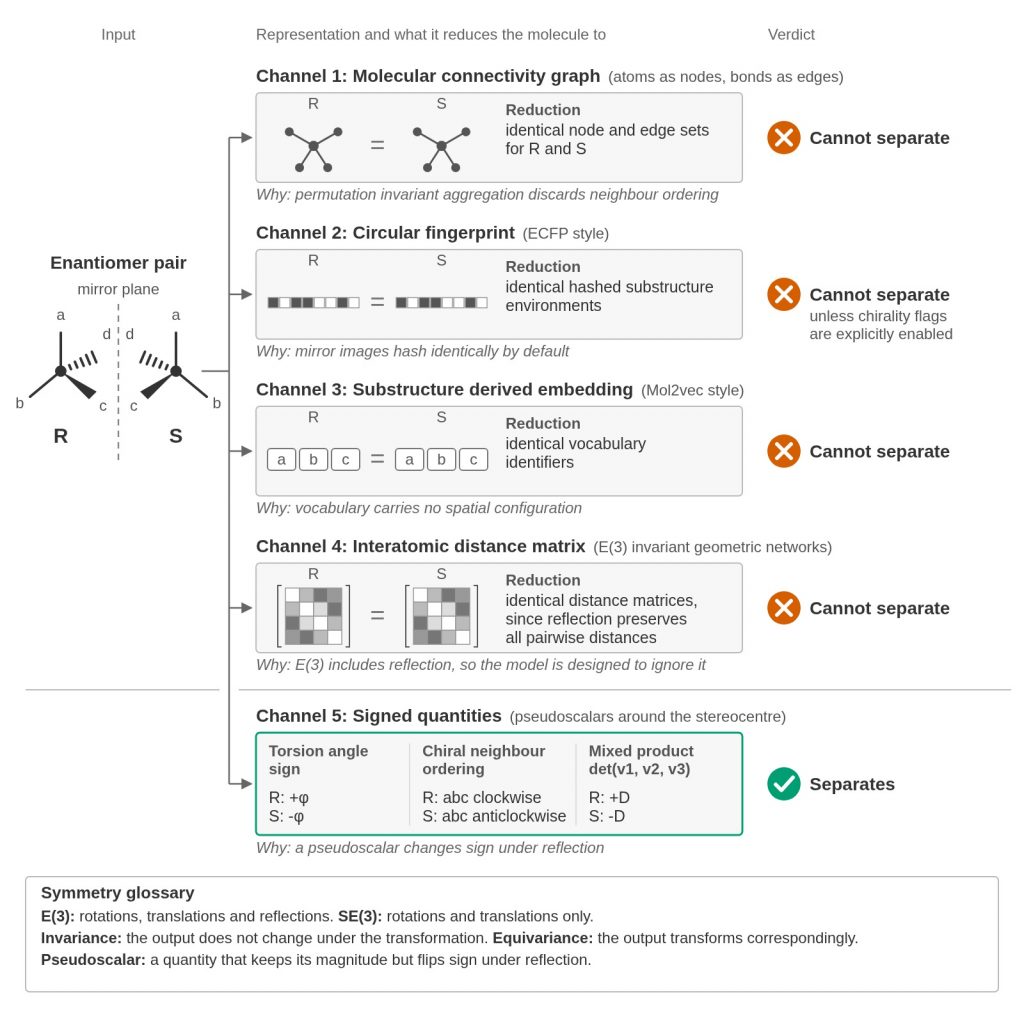
Episode 1: Teaching Machines Molecular Handedness

Why chirality has to be built into a molecular representation before any model can learn it Episode 1 of 5 Summary Two enantiomers can differ by an order of magnitude in potency, yet to most molecular machine learning models they are the same molecule. This is not a data problem that more training examples will …

Episode 1: Teaching Machines Molecular Handedness Read More »