Prelude
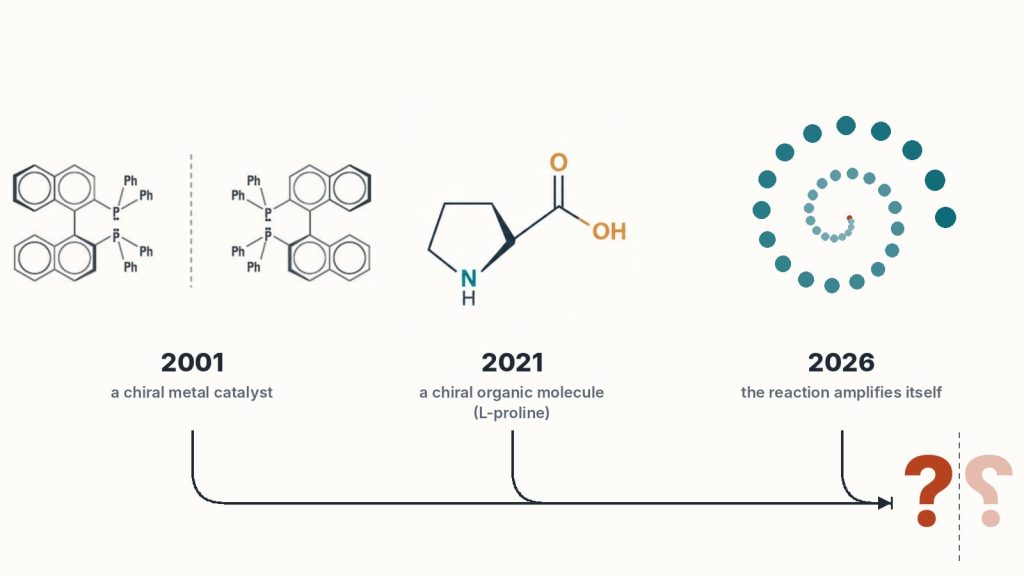
Few ideas in chemistry have been honoured so consistently by the Nobel committee. The prizes of 2001, 2021 and 2026 each rewarded a different way of making one mirror image in preference to the other: first through chiral metal catalysts, then through small organic molecules, and most recently through reactions that amplify their own handedness from almost nothing.
This blog traces that progression from Pasteur’s tartrate crystals of 1848 to the Soai reaction, and explains what each prize actually discovered, citing the primary papers throughout. It then turns to the questions that remain open: why life chose a single hand, what handedness does to an electron, and whether chemists will ever predict enantioselectivity before running the experiment. The chemistry is mature. The understanding behind it is not.
The question that will not go away
Three Nobel Prizes in Chemistry in twenty-five years (2001, 2021 and 2026) [1 to 3] have rewarded chemists for learning to make one mirror image of a molecule and not the other. That is a remarkable run for a single idea, and it tells you something: handedness is not a niche of stereochemistry. It sits underneath pharmacology, the origin of life, the physics of the electron and the limits of what we can measure.
A chiral molecule is one that cannot be superimposed on its mirror image. Your left and right hands are the usual analogy, and it holds up well. Hands are built from the same parts in the same connectivity, yet a left glove does not fit a right hand. The two mirror forms of a molecule, its enantiomers, have identical melting points, identical spectra in an achiral environment and identical reactivity toward achiral reagents. Put them in a chiral environment, such as a protein, a receptor or another chiral molecule, and they behave as different substances.
That last fact is why the pharmaceutical industry cares. Roughly half of the small molecule drugs in use are chiral, and the two enantiomers of a racemic drug can differ in potency, metabolism and toxicity. The 1992 FDA policy statement on stereoisomeric drugs [30] made the development of single enantiomers the expected path and the racemate the exception that must be justified. Everything downstream of that decision, from process chemistry to chiral chromatography to regulatory submissions, depends on being able to make, separate and quantify handedness.
This post walks through what those three prizes actually discovered, in the words of the primary papers, and then turns to what nobody has yet explained. The gaps are not small. We still do not know why life chose one hand, whether that choice was forced by physics or fixed by chance, or what handedness does to an electron passing through a molecule. Those are the grand challenges, and the next prize for chirality will probably go to whoever closes one of them.
From a pile of crystals to a tetrahedral carbon
The story begins in 1848 with a 25-year-old Louis Pasteur and a dish of sodium ammonium tartrate. Pasteur noticed that the crystals came in two forms related as mirror images, sorted them by hand under a lens, dissolved each pile separately and found that the solutions rotated plane polarised light in opposite directions. He reported it to the Académie des Sciences the same year [5]. It was the first resolution of a racemate, and it was done with tweezers.
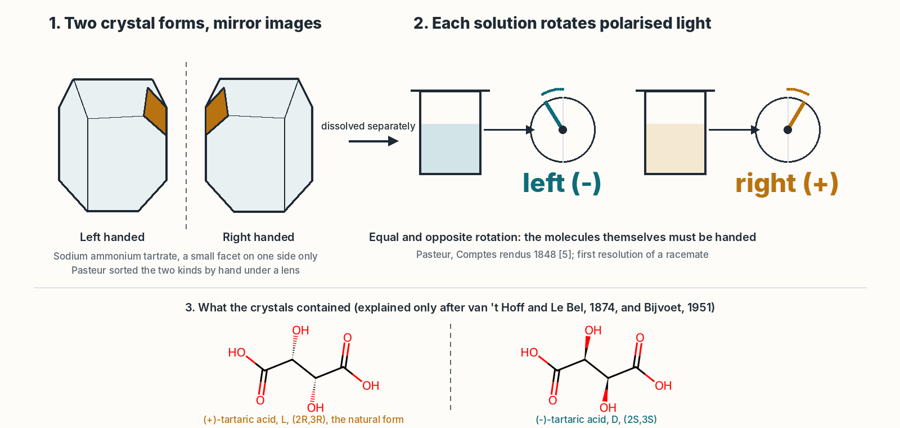
Pasteur drew the right conclusion: the molecules themselves must be dissymmetric. He could not say why. The structural explanation arrived in 1874 when Jacobus van ‘t Hoff in Utrecht and Joseph Le Bel in Paris independently proposed that the four bonds of carbon point to the corners of a tetrahedron, so that a carbon carrying four different groups must exist in two non-superimposable forms [6, 7]. Van ‘t Hoff was ridiculed for it by Hermann Kolbe and went on to receive the very first Nobel Prize in Chemistry in 1901, though the citation named his work on solutions and reaction dynamics rather than the tetrahedron.
Two further milestones matter for what follows. In 1951 Bijvoet used anomalous X ray scattering to determine the absolute configuration of sodium rubidium tartrate, finally connecting Pasteur’s crystals to a real spatial arrangement and confirming that Emil Fischer‘s 1891 D/L convention had been assigned correctly by luck [8]. In 1966 Cahn, Ingold and Prelog published the R/S descriptor system that every chemist now uses [9]. Prelog shared the 1975 Nobel Prize with John Cornforth for the stereochemistry of organic molecules and of enzyme catalysed reactions [4], so stereochemistry had already been honoured before the three prizes that concern us here.
By the mid-1960s chemists could name handedness and could determine it. What they could not do was make it. Every synthesis that created a new stereocentre from achiral starting materials gave a racemate, because the two transition states leading to the two enantiomers are mirror images of each other and therefore of equal energy. Breaking that symmetry needs a chiral influence. The three prizes are three different answers to the question of where that influence should come from.
Nobel 1, 2001: a chiral metal catalyst does the choosing
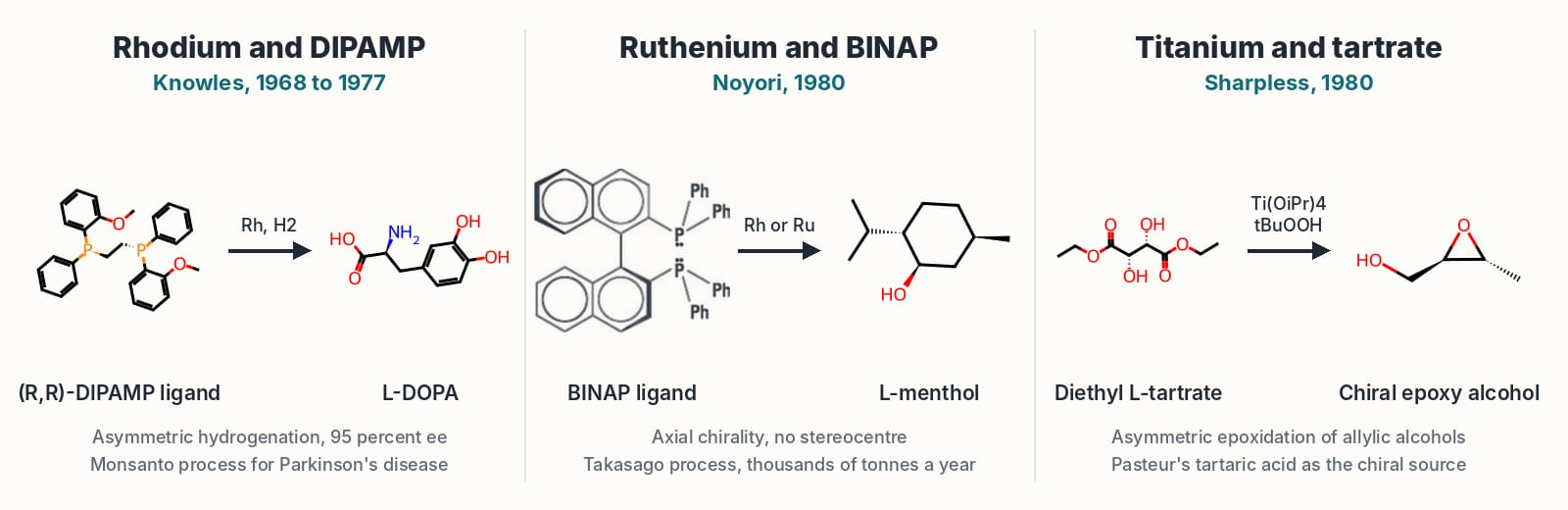
The 2001 prize [3] went to William Knowles, Ryoji Noyori and Barry Sharpless for chirally catalysed hydrogenation (Knowles and Noyori) and chirally catalysed oxidation (Sharpless). The idea they shared was that a tiny amount of a chiral catalyst, with the metal held in a chiral ligand, could pass its handedness on to millions of product molecules.
Knowles at Monsanto took the first step in 1968. He replaced the triphenylphosphine of Wilkinson’s rhodium hydrogenation catalyst with a phosphine that was chiral at phosphorus and obtained a modest 15 percent enantiomeric excess, the first homogeneous asymmetric hydrogenation [11]. Within a decade the DIPAMP ligand pushed that to 95 percent, and Monsanto used it to manufacture L-DOPA for Parkinson’s disease [12]. This was the first industrial asymmetric catalysis, and the fact that it worked at scale is a large part of why the prize was given.
Noyori’s contribution was the BINAP ligand, a binaphthyl whose chirality comes not from a stereocentre but from restricted rotation about a biaryl axis [13]. Rhodium and later ruthenium BINAP complexes hydrogenate a wide range of substrates with very high selectivity, and the Takasago process for L-menthol, which uses a Rh BINAP catalysed isomerisation, still runs at thousands of tonnes a year.
Sharpless worked on oxidation rather than reduction. The Sharpless asymmetric epoxidation uses titanium tetraisopropoxide, tert-butyl hydroperoxide and diethyl tartrate (the same tartaric acid Pasteur handled) to epoxidise allylic alcohols with predictable facial selectivity [14]. The reaction was general, the outcome could be predicted from a simple mnemonic, and it made chiral epoxides a routine building block.
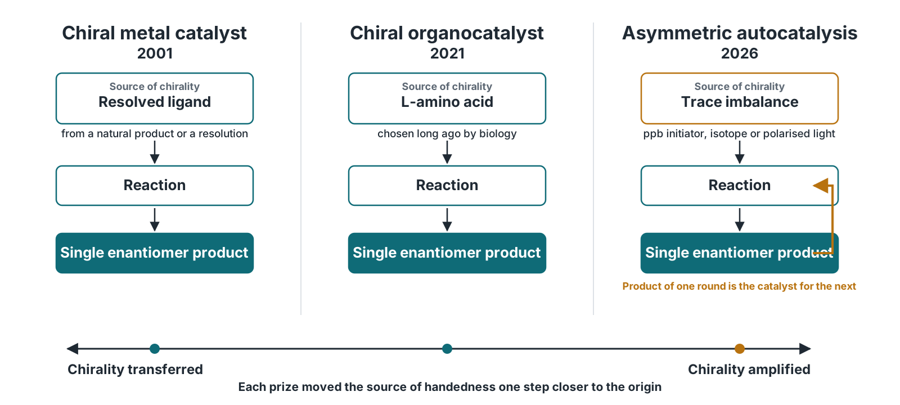
What the 2001 chemistry did not answer was the question of origin. Each of these catalysts is itself chiral, and its chirality comes from a natural product or a resolved intermediate. The catalyst transfers handedness; it does not create it from nothing.
Nobel 2, 2021: a small organic molecule does the choosing
For most of the twentieth century it was taken as given that there were two kinds of catalyst for asymmetric synthesis: enzymes and chiral metal complexes. In 2000 two papers published within weeks of each other showed a third kind, and the 2021 prize [2] went to their authors, Benjamin List and David MacMillan, for asymmetric organocatalysis.
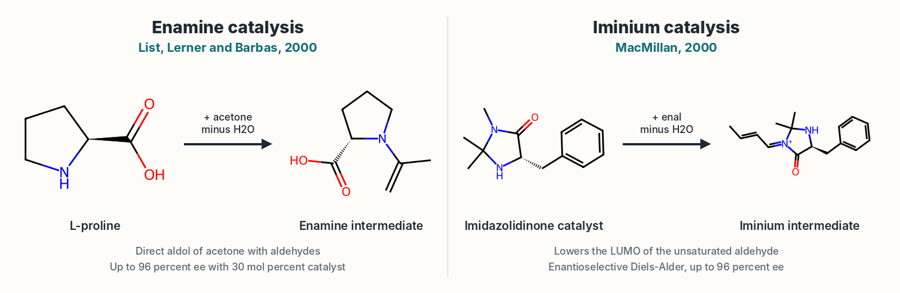
List, working with Richard Lerner and Carlos Barbas at Scripps, asked whether the amino acid proline on its own could do what a class I aldolase enzyme does. It could. Thirty mole percent of L-proline catalysed the direct aldol reaction of acetone with aldehydes in up to 96 percent enantiomeric excess, with the secondary amine of proline forming an enamine with the ketone and the carboxylic acid steering the approach of the aldehyde [15]. The paper was short, the catalyst cost almost nothing, and the mechanism was something an undergraduate could draw.
MacMillan, then at Berkeley, took the complementary approach. His chiral imidazolidinone catalysts condense with unsaturated aldehydes to form iminium ions, which lower the LUMO of the dienophile and allow Diels-Alder reactions to run with high enantioselectivity [16]. MacMillan also gave the field its name, organocatalysis, and made the explicit argument that these catalysts were cheaper, less toxic and easier to handle than metals.
Twenty years later the toolbox includes chiral phosphoric acids, thioureas, N-heterocyclic carbenes and photoredox organocatalysts, and the Nobel committee could point to pharmaceutical manufacturing routes that use them. The intellectual contribution was not a reagent but a permission: small chiral organic molecules, including things as humble as an amino acid, are legitimate catalysts.
Once again, though, the catalyst brings its own handedness to the reaction. Proline is L-proline because life makes it that way. The question of why life makes it that way is untouched.
Nobel 3, 2026: the reaction amplifies its own handedness
The 2026 prize, announced on 7 October [1], went to Henri Kagan and Kenso Soai for the discovery of non-linear effects and autocatalysis in asymmetric organic synthesis. The Nobel committee framed it as the solution to a century old mystery: how a tiny, even accidental, imbalance between enantiomers can grow into homochirality. This is the first chirality prize that deals with creation rather than transfer.
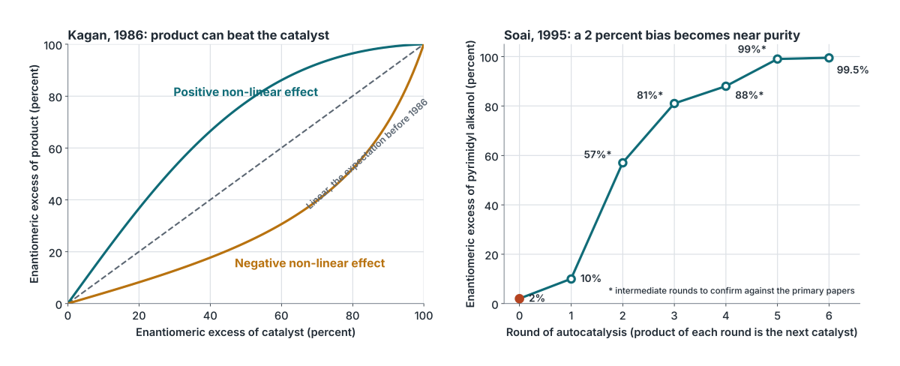
Kagan’s contribution came in 1986. Until then every chemist assumed that if you used a chiral catalyst or auxiliary of, say, 50 percent enantiomeric excess, you would get a product of roughly 50 percent excess. Kagan and his coworkers at Orsay showed that this linear relationship breaks down. In the Sharpless epoxidation and in a proline mediated aldol, a partly racemic chiral source gave a product with a higher enantiomeric excess than the source, because the minor enantiomer of the chiral ligand was being tied up in a less reactive heterochiral complex [18]. The positive non-linear effect, as it is now called, means that handedness can be amplified by a reaction rather than merely conserved. Kagan was already known for the DIOP ligand of 1971, the first C2 symmetric diphosphine and an ancestor of the ligands in the 2001 prize [17].
Soai, at Tokyo University of Science, found the reaction that pushes amplification to its limit. In 1995 his group reported that a pyrimidine-5-carbaldehyde reacts with diisopropylzinc to give a pyrimidyl alkanol, and that the alkanol product catalyses its own formation with the same handedness. A catalyst of 2 percent enantiomeric excess gave product of 10 percent; feeding that product back as catalyst raised the excess to 88 percent in a few rounds [19]. Later versions of the reaction start from almost nothing: a chiral initiator present at parts per billion, an isotopically chiral molecule where the only difference is carbon-13 versus carbon-12, circularly polarised light, or quartz crystals, and still deliver product of greater than 99.5 percent excess [20, 21].
The mechanism was worked out largely by Donna Blackmond and coworkers, who showed by kinetic analysis that the active catalyst is a homochiral dimer and that heterochiral dimers are inactive, which is exactly the combination of autocatalysis and mutual inhibition that Frank had proposed in 1953 as a sufficient condition for spontaneous symmetry breaking [10, 22, 23].
The Soai reaction is, to this day, the only known chemical reaction that behaves this way. That is the awkward footnote to a prize that the committee described as solving the homochirality puzzle. It shows that homochirality can emerge; it does not show that it did, nor how, nor in which molecules.
Grand challenge 1: why did life pick one hand?
Every protein on Earth is built from L-amino acids and every nucleic acid from D-sugars. The 2026 prize explains how a small bias could have been amplified. It leaves open where the bias came from, why it has the sign it has, and whether it was ever a chemical event at all.
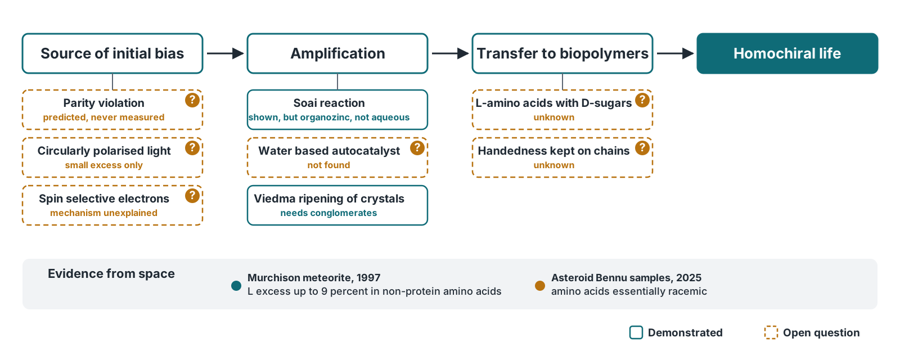
There are three families of answer and none has won. The first is chance: a random fluctuation in some prebiotic pool was amplified by a Frank type process, and the sign is an accident. If so, the question has no further answer and life elsewhere should be L or D with equal probability. The second is a deterministic physical bias. The weak nuclear force violates parity, so the two enantiomers of any molecule are not exactly degenerate; the calculated energy difference is of the order of 10 to the minus 11 joules per mole for amino acids, which is far below anything measured and which no experiment has yet detected despite decades of attempts [27]. Circularly polarised ultraviolet light from star forming regions can preferentially photolyse one enantiomer, and this is the current favourite because the third family of evidence points to space.
That evidence is the enantiomeric excess found in meteorites. Cronin and Pizzarello reported in 1997 that non-protein amino acids such as isovaline in the Murchison meteorite carry an L excess of up to 9 percent, in compounds that cannot have been contaminated by terrestrial biology because terrestrial biology does not make them [24]. The excess has since been seen in other carbonaceous chondrites. Yet the picture is not clean. Analysis of the pristine samples returned from the asteroid Bennu by OSIRIS-REx in 2025 found abundant amino acids that were essentially racemic [25]. If the solar system delivered a bias, it did not do so uniformly.
The open problems are concrete. No experiment has shown amplification from a parity violating energy difference. No chemical autocatalyst other than the Soai system has been found, and the Soai system involves organozinc reagents that would not survive water. Viedma showed in 2005 that grinding a slurry of a conglomerate forming compound drives the whole solid phase to a single enantiomer, which is a plausible prebiotic amplifier, but it needs a racemising solution and a crystal that happens to form conglomerates [26]. Whether any of these mechanisms operated on the early Earth, and in which order, is unknown. A detection of chiral molecules in a Mars or Enceladus sample with a measurable excess, or with none, would be the single most informative experiment available.
Grand challenge 2: what does a chiral molecule do to an electron?
In 1999 Ron Naaman, David Waldeck and coworkers reported that when electrons pass through a thin film of chiral molecules, their transmission depends on the spin of the electron and the handedness of the film [28]. This chiral induced spin selectivity, or CISS, effect has since been measured in DNA, in oligopeptides, in helicenes and in chiral perovskites, with spin polarisations that can exceed 60 percent at room temperature. Those numbers are far larger than conventional spin orbit coupling in light organic elements can explain.
That is the mystery. Theory has proposed roles for electron correlation, for coupling to molecular vibrations, for the interface with the metal electrode and for dissipation, and none of these has yet reproduced the measured magnitudes from first principles. A phenomenon that has been reproduced in dozens of laboratories for twenty-five years, with clear applications in spintronics, enantioseparation on magnetised surfaces and possibly in the mechanism of enzymes, still lacks an agreed quantitative explanation. There is also a serious suggestion that CISS itself may be a missing piece in the homochirality story, since spin polarised electrons from magnetised minerals could have provided a persistent chiral bias to prebiotic chemistry.
A related and older puzzle is the detection of parity violation in molecules. Quantum chemistry predicts that enantiomers should show a tiny difference in their vibrational frequencies, estimated at a few millihertz for suitable heavy element compounds. Experiments in Paris on chiral methyltrioxorhenium derivatives and molecular beam experiments in Zurich have been chasing this for two decades. The first unambiguous measurement of a parity violating frequency shift in a chiral molecule would be a test of the Standard Model in a chemical system and a first answer to whether physics prefers one hand at all. It has not happened yet.
Grand challenge 3: handedness at will, and handedness seen
The practical frontier is less romantic but just as open. Three problems stand out for anyone working in pharmaceutical development.
The first is prediction. After three prizes we still cannot reliably predict, before running the experiment, which catalyst will give which enantiomer in what excess for a new substrate. Catalyst discovery remains a screening exercise. Machine learning on reaction databases has produced models that work within the chemical space they were trained on, but a general, mechanism aware predictor of enantioselectivity does not exist. The honest statement is that the energy differences between diastereomeric transition states that decide an ee of 95 percent are around 2 kilocalories per mole, and that is at the edge of what computation can resolve for a flexible catalyst substrate complex in solution.
The second is absolute asymmetric synthesis in the strict sense: making a single enantiomer from achiral starting materials using a physical field rather than a chiral molecule. Circularly polarised light works but gives small ee values that then need a Soai type amplifier. Magnetic fields alone cannot induce chirality, a point Pasteur got wrong and Barron later made rigorous by distinguishing true from false chirality [29]. Spin polarised electrons through CISS might. None of this is yet a usable synthetic method.
The third is measurement. Chiral high performance liquid chromatography (HPLC), polarimetry and vibrational circular dichroism (VCD) are mature, but assigning the absolute configuration of a new natural product with a single stereocentre and no crystal remains slow, and quantifying an enantiomeric impurity at the 0.1 percent level required by guideline Q3A of the International Council for Harmonisation (ICH) still depends on finding a column that separates the pair. Microwave three wave mixing and Coulomb explosion imaging can now determine the handedness of a single molecule in the gas phase, which would have sounded like fiction to Prelog, but neither is a routine analytical tool.
There is also a growing list of chirality that falls outside the molecular definition altogether. Atropisomeric drugs whose handedness interconverts on a timescale of hours, supramolecular helices that can be switched with light, chiral plasmonic nanostructures and chiral phonons in crystals all raise the same question: what counts as a stable enantiomer when the barrier to inversion is low? ICH guidance was written for molecules whose chirality is fixed. The next decade of regulatory science will have to deal with molecules whose chirality is a rate.
What the fourth prize will reward
Look at the three prizes as a sequence and a pattern appears. In 2001 the handedness came from a metal held in a natural product derived ligand. In 2021 it came from a small organic molecule, in the simplest case an amino acid that life had already chosen. In 2026 it came from the reaction itself, amplified from almost nothing. Each prize moved the source of chirality one step closer to the origin.
The next step is the origin itself. Looking ahead, a fourth Nobel Prize related to chirality might one day recognise a major breakthrough in one of three areas: the direct measurement of parity violation in a molecule, a mechanistic theory that can quantitatively predict the magnitude of the CISS effect, or compelling evidence that prebiotically plausible chemistry in water can amplify a physical bias towards homochirality. Whether and when such breakthroughs will occur remains an open question. The 2026 citation [1] says chemists now know how homochirality can emerge. The more careful statement is that we know one way it could have, in one reaction, under conditions that never existed on the early Earth. That is a real achievement. It is not the end of the story.
For those of us who spend our working lives on the practical side, in chiral method development, in process optimisation, in writing the stereochemistry section of a regulatory dossier, the lesson is a useful one. The tools are mature; the understanding behind them is not. Every chiral separation we run is, in a small way, still Pasteur with his tweezers.
References
- Nobel Prize in Chemistry 2026, press release and scientific background, Royal Swedish Academy of Sciences, 7 October 2026. Scientific background PDF: Non-linear effects and autocatalysis in asymmetric organic synthesis.
- Nobel Prize in Chemistry 2021, List and MacMillan, asymmetric organocatalysis.
- Nobel Prize in Chemistry 2001, Knowles, Noyori and Sharpless, chirally catalysed hydrogenation and oxidation.
- Nobel Prize in Chemistry 1975, Cornforth and Prelog, stereochemistry.
- Pasteur, L. (1848). Mémoire sur la relation qui peut exister entre la forme cristalline et la composition chimique, et sur la cause de la polarisation rotatoire. Comptes rendus de l’Académie des Sciences, 26, 535 to 538.
- van ‘t Hoff, J. H. (1874). Voorstel tot uitbreiding der tegenwoordig in de scheikunde gebruikte structuurformules in de ruimte. Utrecht: J. Greven. French version: Bulletin de la Société Chimique de France, 1875, 23, 295 to 301.
- Le Bel, J. A. (1874). Sur les relations qui existent entre les formules atomiques des corps organiques et le pouvoir rotatoire de leurs dissolutions. Bulletin de la Société Chimique de France, 22, 337 to 347.
- Bijvoet, J. M., Peerdeman, A. F. and van Bommel, A. J. (1951). Determination of the absolute configuration of optically active compounds by means of X-rays. Nature, 168, 271 to 272. doi:10.1038/168271a0
- Cahn, R. S., Ingold, C. and Prelog, V. (1966). Specification of molecular chirality. Angewandte Chemie International Edition, 5, 385 to 415. doi:10.1002/anie.196603851
- Frank, F. C. (1953). On spontaneous asymmetric synthesis. Biochimica et Biophysica Acta, 11, 459 to 463. doi:10.1016/0006-3002(53)90082-1
- Knowles, W. S. and Sabacky, M. J. (1968). Catalytic asymmetric hydrogenation employing a soluble, optically active, rhodium complex. Chemical Communications, 1445 to 1446. doi:10.1039/C19680001445
- Vineyard, B. D., Knowles, W. S., Sabacky, M. J., Bachman, G. L. and Weinkauff, D. J. (1977). Asymmetric hydrogenation. Rhodium chiral bisphosphine catalyst. Journal of the American Chemical Society, 99, 5946 to 5952. doi:10.1021/ja00460a018
- Miyashita, A., Yasuda, A., Takaya, H., Toriumi, K., Ito, T., Souchi, T. and Noyori, R. (1980). Synthesis of 2,2′-bis(diphenylphosphino)-1,1′-binaphthyl (BINAP). Journal of the American Chemical Society, 102, 7932 to 7934. doi:10.1021/ja00547a020
- Katsuki, T. and Sharpless, K. B. (1980). The first practical method for asymmetric epoxidation. Journal of the American Chemical Society, 102, 5974 to 5976. doi:10.1021/ja00538a077
- List, B., Lerner, R. A. and Barbas, C. F. (2000). Proline-catalyzed direct asymmetric aldol reactions. Journal of the American Chemical Society, 122, 2395 to 2396. doi:10.1021/ja994280y
- Ahrendt, K. A., Borths, C. J. and MacMillan, D. W. C. (2000). New strategies for organic catalysis: the first highly enantioselective organocatalytic Diels-Alder reaction. Journal of the American Chemical Society, 122, 4243 to 4244. doi:10.1021/ja000092s
- Dang, T. P. and Kagan, H. B. (1971). The asymmetric synthesis of hydratropic acid and amino-acids by homogeneous catalytic hydrogenation. Journal of the Chemical Society D: Chemical Communications, 481. doi:10.1039/C29710000481
- Puchot, C., Samuel, O., Duñach, E., Zhao, S., Agami, C. and Kagan, H. B. (1986). Nonlinear effects in asymmetric synthesis. Examples in asymmetric oxidations and aldolization reactions. Journal of the American Chemical Society, 108, 2353 to 2357. doi:10.1021/ja00269a036
- Soai, K., Shibata, T., Morioka, H. and Choji, K. (1995). Asymmetric autocatalysis and amplification of enantiomeric excess of a chiral molecule. Nature, 378, 767 to 768. doi:10.1038/378767a0
- Shibata, T., Yamamoto, J., Matsumoto, N., Yonekubo, S., Osanai, S. and Soai, K. (1998). Amplification of a slight enantiomeric imbalance in molecules based on asymmetric autocatalysis: the first correlation between high enantiomeric enrichment in a chiral molecule and circularly polarized light. Journal of the American Chemical Society, 120, 12157 to 12158. doi:10.1021/ja980815w
- Kawasaki, T., Matsumura, Y., Tsutsumi, T., Suzuki, K., Ito, M. and Soai, K. (2009). Asymmetric autocatalysis triggered by carbon isotope (13C/12C) chirality. Science, 324, 492 to 495. doi:10.1126/science.1170322
- Blackmond, D. G., McMillan, C. R., Ramdeehul, S., Schorm, A. and Brown, J. M. (2001). Origins of asymmetric amplification in autocatalytic alkylzinc additions. Journal of the American Chemical Society, 123, 10103 to 10104. doi:10.1021/ja0165133
- Blackmond, D. G. (2004). Asymmetric autocatalysis and its implications for the origin of homochirality. Proceedings of the National Academy of Sciences, 101, 5732 to 5736. doi:10.1073/pnas.0308363101
- Cronin, J. R. and Pizzarello, S. (1997). Enantiomeric excesses in meteoritic amino acids. Science, 275, 951 to 955. doi:10.1126/science.275.5302.951
- Glavin, D. P. et al. (2025). Abundant ammonia and nitrogen-rich soluble organic matter in samples from asteroid (101955) Bennu. Nature Astronomy, 9, 199 to 210. doi:10.1038/s41550-024-02472-9
- Viedma, C. (2005). Chiral symmetry breaking during crystallization: complete chiral purity induced by nonlinear autocatalysis and recycling. Physical Review Letters, 94, 065504. doi:10.1103/PhysRevLett.94.065504
- Quack, M. (2002). How important is parity violation for molecular and biomolecular chirality? Angewandte Chemie International Edition, 41, 4618 to 4630. doi:10.1002/anie.200290005
- Ray, K., Ananthavel, S. P., Waldeck, D. H. and Naaman, R. (1999). Asymmetric scattering of polarized electrons by organized organic films of chiral molecules. Science, 283, 814 to 816. doi:10.1126/science.283.5403.814
- Barron, L. D. (1986). True and false chirality and absolute asymmetric synthesis. Journal of the American Chemical Society, 108, 5539 to 5542. doi:10.1021/ja00278a029
- US Food and Drug Administration (1992). Development of new stereoisomeric drugs. Policy statement, 1 May 1992.
Further Reading
Image disclosure
The illustrations in this post were created with AI image generation tools from prompts written by the author and were reviewed by the author for scientific accuracy before publication. The pictorial images are artistic interpretations and are not photographs of real experiments, molecules or locations. The quantitative chart (Figure 4) was plotted from the equations and values cited in the caption, and the chemical structures in Figures 1 to 3 were drawn with the open source toolkit RDKit from SMILES (simplified molecular input line entry system) strings; neither was generated by an image model.