Non-Linear Effects, Asymmetric Autocatalysis and the Amplification of Chirality
A prize for asymmetry that feeds itself
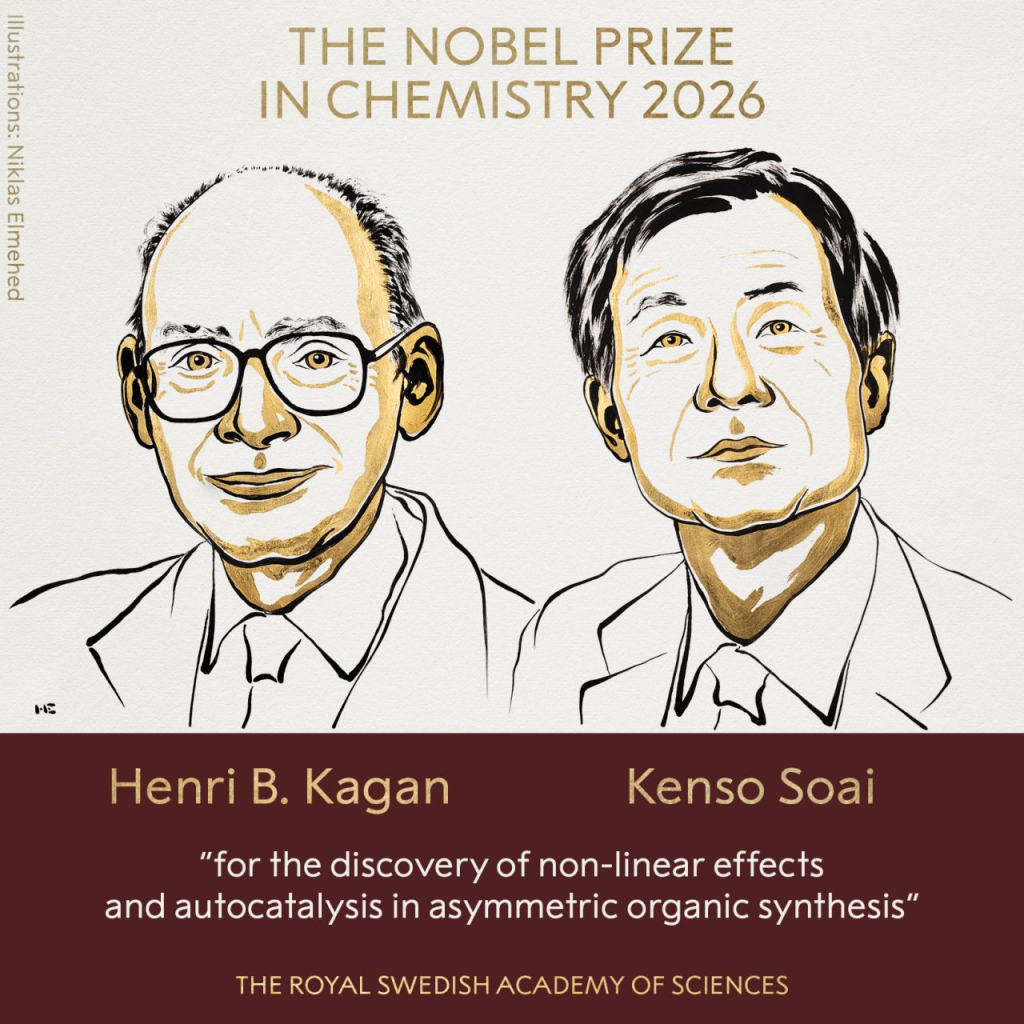
On 7 October 2026 the Royal Swedish Academy of Sciences awarded the Nobel Prize in Chemistry to Henri B. Kagan (Université Paris-Sud) and Kenso Soai (Tokyo University of Science) “for the discovery of non-linear effects and autocatalysis in asymmetric organic synthesis” [1, 37]. Kagan, born in 1930 in Boulogne-Billancourt, took his PhD at the Collège de France in 1960. Soai, born in 1950 in Hiroshima, took his at the University of Tokyo in 1979 [37]. This post covers Soai’s half of the story: a zinc alkoxide that catalyses its own formation and, in doing so, turns an almost undetectable enantiomeric imbalance into a nearly enantiopure product [2].
The Soai reaction is the only well characterised laboratory system that does what F. C. Frank proposed on paper in 1953 [3]. It is not a manufacturing route and it is not a prebiotic pathway. Its importance is conceptual: it proves that ordinary solution chemistry can break mirror symmetry and then lock in the result.
For readers of Chiralpedia the reaction is worth understanding for three reasons:
- It is the limiting case of asymmetric catalysis, where the chiral catalyst and the chiral product are the same species.
- It rests directly on Kagan’s non-linear effects, so the two halves of the prize are one argument.
- Its mechanism took 25 years to resolve and is still debated, which makes it a good case study in how aggregation controls enantioselectivity.
From Pasteur’s tweezers to asymmetric catalysis
The Academy presents the 2026 prize as the end of a chain of ideas that began in the mid 19th century [37]. Louis Pasteur separated the mirror-image crystals of a tartrate salt by hand and found that their solutions rotated polarised light in opposite directions. In 1857 he showed that microorganisms ferment one enantiomer of tartaric acid and leave the other untouched, the first sign that the chemistry of life is handed.
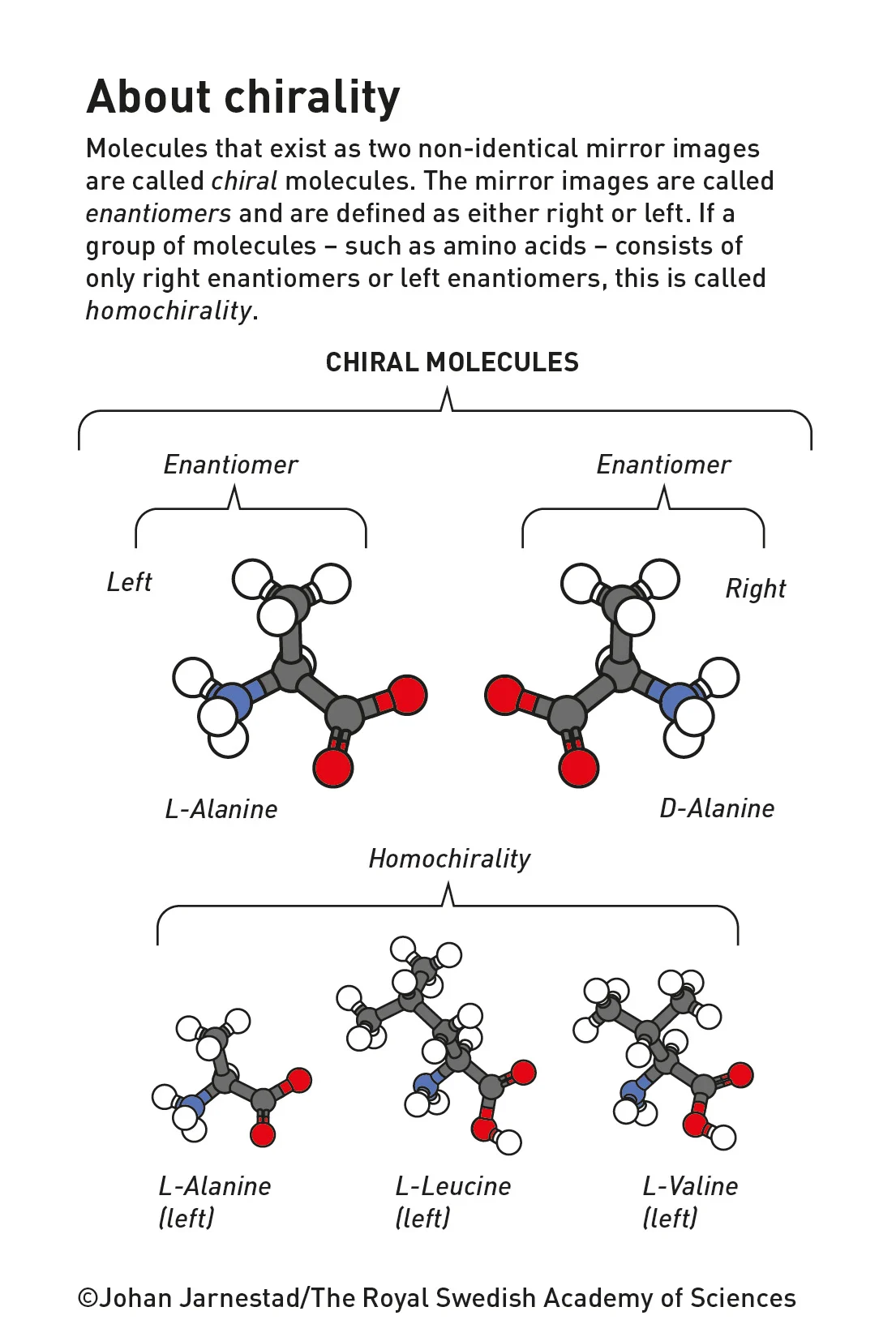
Laboratory synthesis from achiral starting materials gives both enantiomers in equal amounts. Marckwald’s 1904 experiment was the first to show that a chiral auxiliary can tilt that balance, even if only slightly [38]. Practical asymmetric catalysis followed much later and was recognised by the Nobel Prizes of 2001 (Knowles, Noyori, Sharpless) and 2021 (List, MacMillan).
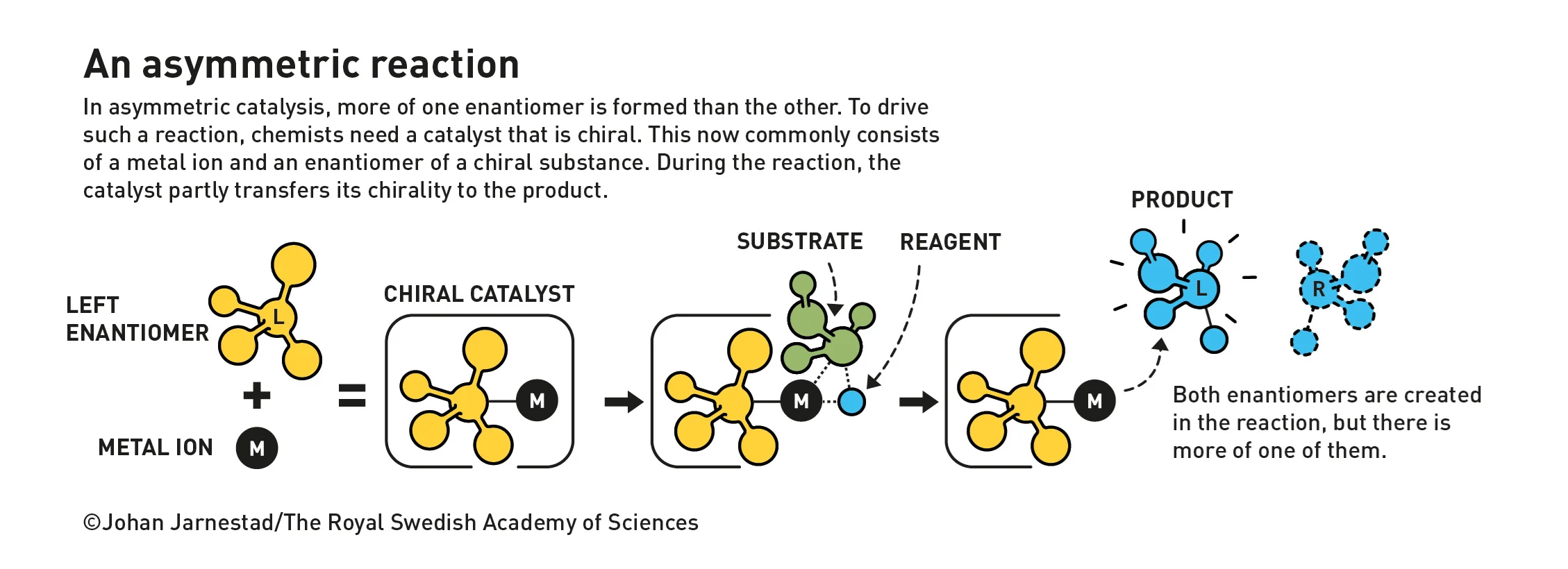
The pharmaceutical motivation is familiar to Chiralpedia readers. The Academy’s account cites thalidomide and attributes the harm to one enantiomer [37]. That is the textbook version; because thalidomide racemises in vivo, giving the single enantiomer would not have prevented the tragedy. The case still did more than any other to make enantiomeric purity a regulatory expectation.
All of this explains how handedness can be transferred from a catalyst that already has it. It does not explain where the first excess came from.
The question Frank asked in 1953
Biology uses L-amino acids and D-sugars almost exclusively, yet any reaction that starts from achiral materials in an achiral environment gives a racemate. Something had to break the symmetry, and something had to amplify the break.
Frank’s 1953 paper supplied the kinetic recipe [3]. Each enantiomer must catalyse its own production (autocatalysis), and each must suppress the other (mutual antagonism). Under those two conditions the racemic state is unstable, and any fluctuation grows until one hand dominates.
Frank was a theoretical physicist at the University of Bristol, and his paper opens by noting that a colleague had told him chemists lacked a mathematical account of the problem [37]. The Academy restates his model as three conditions: an asymmetric reaction with a chiral catalyst, a means of enhancing one mirror image while damping the other, and a product that is its own catalyst. Asymmetric catalysis met the first. Kagan met the second in 1986 and Soai the third in 1995 [37].
The model was elegant and, for four decades, purely theoretical. Autocatalytic reactions were known, and asymmetric catalysts were known, but no reaction combined both with a product ee that matched or exceeded the ee of the catalyst. Without that property, every catalytic cycle dilutes the chiral information and the system decays toward the racemate.
Kagan’s non-linear effects made amplification thinkable
Until 1986 chemists assumed that product ee scales linearly with the ee of the chiral auxiliary or ligand. Kagan’s group showed that this is not generally true [4]. In the Sharpless epoxidation of geraniol the product ee was higher than the linear prediction (a positive non-linear effect), while an asymmetric sulfide oxidation gave a negative deviation. A proline-mediated aldolisation also deviated from linearity.
The explanation is aggregation. When chiral ligands or catalysts associate, homochiral (R,R or S,S) and heterochiral (R,S) species form in different amounts and react at different rates. If the heterochiral aggregate is more stable and less active, it removes racemic material from the catalytic cycle and the remaining active catalyst is enriched. Kagan later formalised this in the MLn and reservoir models [7, 8].
The Academy’s worked example makes the arithmetic concrete [37]. Take a ligand that is 75% right-handed and 25% left-handed, an ee of 50%. If two ligands bind each metal at random, the catalyst population is about 56% right-right, 38% left-right and 6% left-left. If the mixed species barely turns over, the reaction is run by the two homochiral catalysts in a 90:10 ratio. A 50% ee ligand then behaves like an 80% ee catalyst.
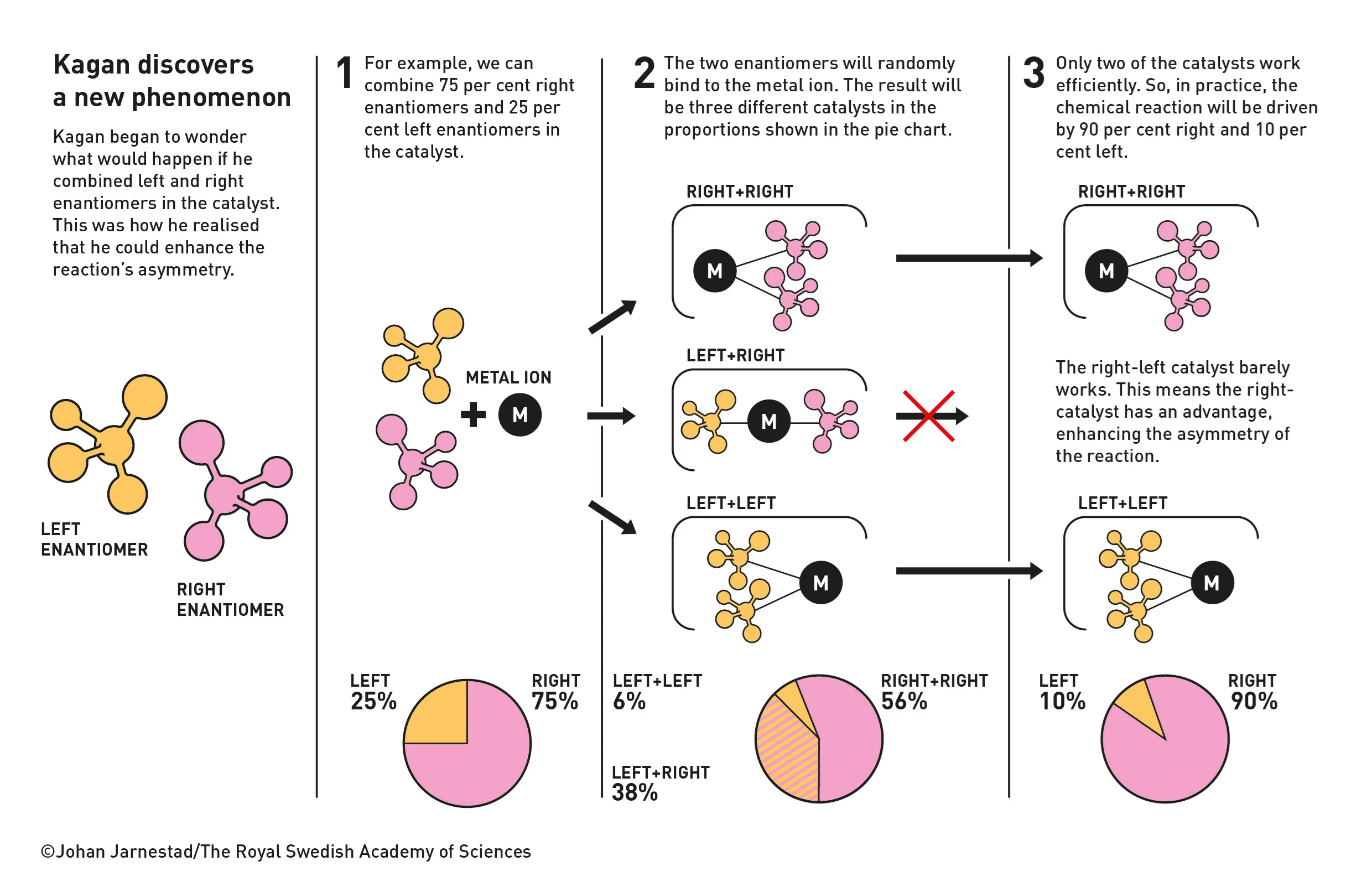
Dialkylzinc chemistry gave the most striking early examples. Oguni reported strong amplification in amino alcohol catalysed additions of diethylzinc to benzaldehyde [5]. Noyori and Kitamura then traced the effect to a stable, unreactive heterochiral dimer of the zinc amino alkoxide [6].
This is the link between the two laureates. A positive non-linear effect is Frank’s mutual antagonism in chemical form: the minor enantiomer is sequestered by the major one. Add autocatalysis to the same zinc alkoxide chemistry and both of Frank’s conditions are met.
The Soai reaction
The reaction is the addition of diisopropylzinc (i-Pr2Zn) to a pyrimidine-5-carbaldehyde. The product is the isopropylzinc alkoxide of a chiral 5-pyrimidyl alkanol, and that alkoxide catalyses the same addition with the same sense of induction.
According to the Academy, the idea came from a non-linear effect. Soai was studying an asymmetric alkylation that showed strong amplification, noticed that its catalyst and its product were structurally alike, and asked whether a product could be designed to act as its own catalyst [37]. Autocatalytic reactions were known in the early 1990s, but none was asymmetric.
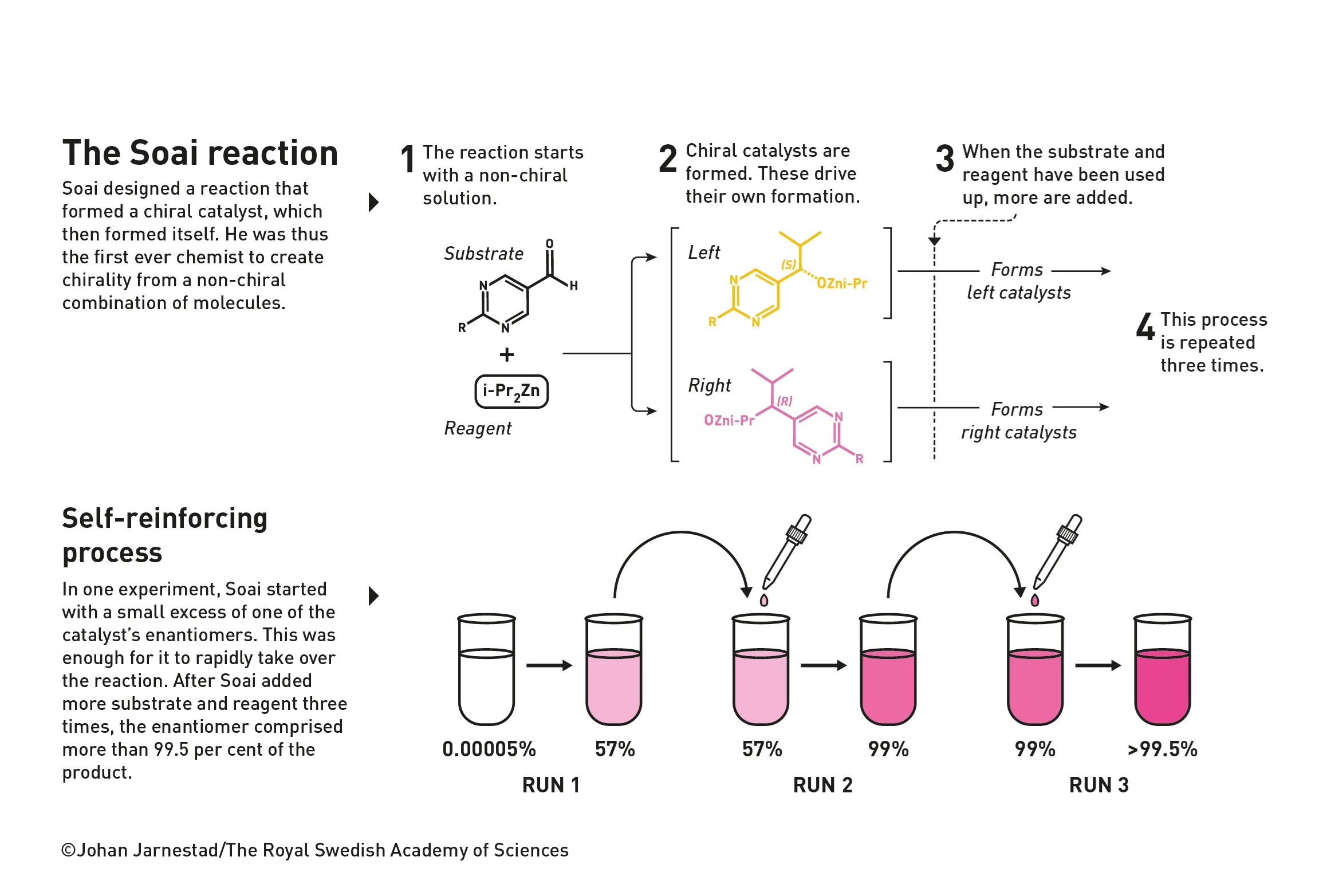
Three papers mark the development of the system:
- 1990, the pyridine precedent. Soai, Niwa and Hori showed that a 3-pyridyl alkanol catalyses its own formation from pyridine-3-carbaldehyde and i-Pr2Zn [9]. The reaction was autocatalytic and enantioselective, but the product ee was lower than the catalyst ee, so chirality eroded with each cycle.
- 1995, amplification. Moving the second nitrogen into the ring changed the outcome. With a 5-pyrimidyl alkanol, product ee exceeded catalyst ee, and using the product of one run as the catalyst for the next raised the ee from 2% to almost 90% over consecutive runs [2, 37]. The result met all of Frank’s conditions but stopped short of the complete enantiopurity seen in biology.
- 1996 to 1999, optimisation. A 2-methyl substituent gave near perfect enantioselectivity in the autocatalytic step [10]. A 2-(tert-butylethynyl) substituent then gave what the authors called practically perfect asymmetric autocatalysis, with yield above 99% and ee above 99.5% [11].
The structural requirements are narrow. The reaction needs the pyrimidine (or a closely related azine) core, the aldehyde at the 5 position, and diisopropylzinc specifically. Diethylzinc and most other aldehydes do not show amplifying autocatalysis. That sensitivity was a clue to the mechanism discussed below.
From 0.00005% ee to above 99.5% ee in three runs
The experiment shown in the lower half of Figure 4 was published by Sato, Urabe, Ishiguro, Shibata and Soai in 2003 [12]. The starting catalyst was the 2-alkynyl pyrimidyl alkanol with an ee of about 0.00005%. In molecular terms that is roughly 50.000025 molecules of one hand for every 49.999975 of the other, far below what any polarimeter or chiral HPLC method can detect.
| Stage | ee of alkanol |
|---|---|
| Initial catalyst | about 0.00005% |
| After run 1 | 57% |
| After run 2 | 99% |
| After run 3 | above 99.9% |
Each run used the product of the previous run as the catalyst, with fresh aldehyde and i-Pr2Zn. No other chiral substance was present at any point.
Two features deserve attention. The first run does most of the work, moving from an unmeasurable bias to a clear majority. And the amplification is not a purification: the major enantiomer is manufactured in large excess while the minor enantiomer grows far more slowly, which is the kinetic signature Frank predicted.
Enantiomeric excess is used throughout in its usual sense: ee (%) = ([S] − [R]) / ([S] + [R]) × 100
What can tip the balance
Because the system amplifies such small imbalances, it has been used as a detector for very weak sources of chirality. Each of the following has been shown to set the handedness of the final product.
| Chiral trigger | What was shown | Ref. |
|---|---|---|
| Amino acids and other organics of low ee | Leucine of about 2% ee, the level accessible by circularly polarised light photolysis, directs the product configuration | [13] |
| Circularly polarised light | Asymmetric photolysis of the racemic alkanol with left or right CPL gives opposite enantiomers in above 99.5% ee after autocatalysis | [14] |
| Chiral inorganic crystals | d- and l-quartz give opposite enantiomers in high ee; sodium chlorate crystals behave similarly | [15, 16] |
| Isotopic chirality | d- and l-quartz give opposite enantiomers in high ee; sodium chlorate crystals behave similarly Molecules chiral only through 12C/13C, 16O/18O or 14N/15N substitution direct the outcome | [17, 18, |
| Nothing added | See below | [20, 21, 22] |
The isotope results are the most surprising. A carbon isotopomer has no measurable optical rotation and would normally be treated as achiral for all practical purposes, yet the autocatalytic system reads its configuration reliably [17].
Absolute asymmetric synthesis
The last row is the closest experimental approach to Frank’s thought experiment. When the aldehyde and i-Pr2Zn react with no chiral additive at all, the product is still optically active. Soai’s group ran the reaction 37 times and obtained the S alkanol 19 times and the R alkanol 18 times [20]. Singleton and Vo independently reached the same conclusion and argued that a statistical excess of a few molecules is enough to decide the result [21, 22].
A near even distribution is what a stochastic origin predicts, and it is the reading the Academy adopts: chance decides which enantiomer gains the first small lead, and autocatalysis does the rest, in favourable cases to 99.99% of the product [37]. A hidden chiral contaminant would bias every run the same way. Mislow’s commentary remains the careful reference on what can and cannot be claimed as absolute asymmetric synthesis [23].
Mechanism: a 25 year problem
The phenomenology was clear by 2003. The identity of the active catalyst was not, because zinc alkoxides exist as several interconverting aggregates in solution.
Dimers (2001 onward). Blackmond and Brown’s kinetic study fitted the data with a dimeric catalyst in which homochiral and heterochiral dimers form statistically and only the homochiral dimer is active [24]. Blackmond’s later analysis showed how such a model satisfies Frank’s requirement for mutual antagonism [25]. NMR work by Gridnev and Brown confirmed that dimers are the resting state in solution [26].
Higher aggregates (2008 to 2015). Computation by Schiaffino and Ercolani [27] and NMR studies by the Blackmond and Brown groups [28, 29] pointed to tetrameric or larger species in the transition state. In 2015 Soai’s group obtained crystal structures of the isopropylzinc alkoxide and found tetrameric and oligomeric forms built from 12-membered macrocycles [30].
The SMS tetramer (2020). Denmark, Houk and co-workers combined kinetics, spectroscopy, substrate surrogates and DFT [31, 32]. Their model has four parts:
- The active catalyst is a homochiral square-macrocycle-square (SMS) tetramer of the product alkoxide.
- The aldehyde binds through two points, the ring nitrogen to one zinc and the carbonyl oxygen to another, which fixes the face presented to the incoming isopropyl group.
- The heterochiral tetramer is more stable and catalytically inactive, so it traps the minor enantiomer. This is Kagan’s reservoir effect operating inside an autocatalytic cycle.
- The isopropyl group matters because its bulk disfavours the compact cubic aggregates that other alkylzinc alkoxides prefer.
A pyridine analogue designed from this model was also autocatalytic and amplifying, which is good evidence that the structural logic is right [31].
The hemiacetal alternative (2020). Trapp and co-workers used in situ mass spectrometry and kinetics to propose a different catalyst: a transient hemiacetal formed from the product alkoxide and the aldehyde [33].
Geiger’s 2022 viewpoint argues that the two proposals need not exclude each other, since the key experiments used different substrates and the more electron poor pyrimidine aldehydes form hemiacetals more readily [34]. The fair summary today is that the homochiral aggregate picture explains most observations, and that the complete kinetic description is still open. Two recent reviews cover the debate in depth [35, 36].
What the reaction does and does not tell us
Origin of homochirality. The Soai reaction proves that Frank’s mechanism is chemically realisable and that the candidate symmetry breakers (polarised light, mineral surfaces, isotopic or statistical fluctuation) are large enough to be amplified. It does not show that life’s homochirality arose this way, and the Academy itself describes the reaction as artificial and different from the chemistry of life [37]. Diisopropylzinc is destroyed by water, the solvent is an anhydrous hydrocarbon or ether, and the substrate scope is very narrow. A prebiotically plausible analogue with comparable amplification has not been reported, and other routes such as attrition-enhanced crystal deracemisation remain serious alternatives [35, 36]. Extending Soai-type amplification to amino acids and sugars is now an active research goal [37].
Asymmetric synthesis and pharmaceutical development. The practical legacy runs mostly through Kagan’s half of the prize, and it reaches every sector that makes molecules meant to interact with living systems: pharmaceuticals, flavours, fragrances and agrochemicals, and in some cases new materials [37].
- A positive non-linear effect means a ligand or catalyst of modest ee can deliver product of high ee, which relaxes the purity specification on an expensive chiral input.
- A plot of product ee against catalyst ee is now a standard mechanistic test. Curvature signals aggregation or multiple ligands in the selectivity-determining step, which matters when a process is scaled or the catalyst loading is changed.
- A negative non-linear effect is a warning: a small drop in ligand ee can cause a disproportionate drop in product ee, so it belongs in the control strategy.
Chirality sensing. The Soai system is among the most sensitive chiral discriminators known. It assigns absolute configuration to cryptochiral compounds, such as isotopomers, that give no usable chiroptical signal [17].
A design target. The 2020 mechanistic work turned an empirical curiosity into a set of structural rules [31, 32]. Whether those rules can produce new amplifying autocatalysts outside the azine and diisopropylzinc family is the open question for the field.
Milestones
| Year | MIlestone | Ref. |
|---|---|---|
| 1953 | Frank proposes autocatalysis with mutual antagonism as a route to spontaneous asymmetric synthesis | [3] |
| 1986 | Kagan reports non-linear effects in asymmetric synthesis | [4] |
| 1988-1989 | Oguni, then Noyori and Kitamura, show and explain amplification in dialkylzinc additions | [5,6] |
| 1990 | Soai reports asymmetric autocatalysis of a pyridyl alkanol, without amplification | [9] |
| 1995 | Soai reports asymmetric autocatalysis with amplification of ee in the pyrimidyl system | [2] |
| 1999 | 2-Alkynyl pyrimidyl alkanol gives yield above 99% and ee above 99.5% | [11] |
| 2003 | Amplification from about 0.00005% ee to above 99.5% ee; absolute asymmetric synthesis reported | [12,20] |
| 2009 | Carbon isotope chirality triggers the reaction | [17] |
| 2015 | [30] | |
| 2020 | [31,33] | |
| 2026 | Nobel Prize in Chemistry to Kagan and Soai | [1] |
References
- The Royal Swedish Academy of Sciences. Press release: The Nobel Prize in Chemistry 2026, 7 October 2026. nobelprize.org
- Soai, K.; Shibata, T.; Morioka, H.; Choji, K. Nature 1995, 378, 767-768. doi:10.1038/378767a0
- Frank, F. C. Biochim. Biophys. Acta 1953, 11, 459-463. doi:10.1016/0006-3002(53)90082-1
- Puchot, C.; Samuel, O.; Duñach, E.; Zhao, S.; Agami, C.; Kagan, H. B. J. Am. Chem. Soc. 1986, 108, 2353-2357. doi:10.1021/ja00269a036
- Oguni, N.; Matsuda, Y.; Kaneko, T. J. Am. Chem. Soc. 1988, 110, 7877-7878.
- Kitamura, M.; Okada, S.; Suga, S.; Noyori, R. J. Am. Chem. Soc. 1989, 111, 4028-4036.
- Guillaneux, D.; Zhao, S.-H.; Samuel, O.; Rainford, D.; Kagan, H. B. J. Am. Chem. Soc. 1994, 116, 9430-9439.
- Girard, C.; Kagan, H. B. Angew. Chem. Int. Ed. 1998, 37, 2922-2959.
- Soai, K.; Niwa, S.; Hori, H. J. Chem. Soc., Chem. Commun. 1990, 982-983.
- Shibata, T.; Morioka, H.; Hayase, T.; Choji, K.; Soai, K. J. Am. Chem. Soc. 1996, 118, 471-472.
- Shibata, T.; Yonekubo, S.; Soai, K. Angew. Chem. Int. Ed. 1999, 38, 659-661.
- Sato, I.; Urabe, H.; Ishiguro, S.; Shibata, T.; Soai, K. Angew. Chem. Int. Ed. 2003, 42, 315-317.
- Shibata, T.; Yamamoto, J.; Matsumoto, N.; Yonekubo, S.; Osanai, S.; Soai, K. J. Am. Chem. Soc. 1998, 120, 12157-12158.
- Kawasaki, T.; Sato, M.; Ishiguro, S.; Saito, T.; Morishita, Y.; Sato, I.; Nishino, H.; Inoue, Y.; Soai, K. J. Am. Chem. Soc. 2005, 127, 3274-3275.
- Soai, K.; Osanai, S.; Kadowaki, K.; Yonekubo, S.; Shibata, T.; Sato, I. J. Am. Chem. Soc. 1999, 121, 11235-11236.
- Sato, I.; Kadowaki, K.; Soai, K. Angew. Chem. Int. Ed. 2000, 39, 1510-1512.
- Kawasaki, T.; Matsumura, Y.; Tsutsumi, T.; Suzuki, K.; Ito, M.; Soai, K. Science 2009, 324, 492-495.
- Kawasaki, T.; Okano, Y.; Suzuki, E.; Takano, S.; Oji, S.; Soai, K. Angew. Chem. Int. Ed. 2011, 50, 8131-8133.
- Matsumoto, A.; Ozaki, H.; Harada, S.; Tada, K.; Ayugase, T.; Ozawa, H.; Kawasaki, T.; Soai, K. Angew. Chem. Int. Ed. 2016, 55, 15246-15249.
- Soai, K.; Sato, I.; Shibata, T.; Komiya, S.; Hayashi, M.; Matsueda, Y.; Imamura, H.; Hayase, T.; Morioka, H.; Tabira, H.; Yamamoto, J.; Kowata, Y. Tetrahedron: Asymmetry 2003, 14, 185-188.
- Singleton, D. A.; Vo, L. K. J. Am. Chem. Soc. 2002, 124, 10010-10011.
- Singleton, D. A.; Vo, L. K. Org. Lett. 2003, 5, 4337-4339.
- Mislow, K. Collect. Czech. Chem. Commun. 2003, 68, 849-864.
- Blackmond, D. G.; McMillan, C. R.; Ramdeehul, S.; Schorm, A.; Brown, J. M. J. Am. Chem. Soc. 2001, 123, 10103-10104.
- Blackmond, D. G. Proc. Natl. Acad. Sci. U.S.A. 2004, 101, 5732-5736.
- Gridnev, I. D.; Serafimov, J. M.; Brown, J. M. Angew. Chem. Int. Ed. 2004, 43, 4884-4887.
- Schiaffino, L.; Ercolani, G. Angew. Chem. Int. Ed. 2008, 47, 6832-6835.
- Quaranta, M.; Gehring, T.; Odell, B.; Brown, J. M.; Blackmond, D. G. J. Am. Chem. Soc. 2010, 132, 15104-15107.
- Gehring, T.; Quaranta, M.; Odell, B.; Blackmond, D. G.; Brown, J. M. Angew. Chem. Int. Ed. 2012, 51, 9539-9542.
- Matsumoto, A.; Abe, T.; Hara, A.; Tobita, T.; Sasagawa, T.; Kawasaki, T.; Soai, K. Angew. Chem. Int. Ed. 2015, 54, 15218-15221.
- Athavale, S. V.; Simon, A.; Houk, K. N.; Denmark, S. E. Nat. Chem. 2020, 12, 412-423. doi:10.1038/s41557-020-0421-8
- Athavale, S. V.; Simon, A.; Houk, K. N.; Denmark, S. E. J. Am. Chem. Soc. 2020, 142, 18387-18406.
- Trapp, O.; Lamour, S.; Maier, F.; Siegle, A. F.; Zawatzky, K.; Straub, B. F. Chem. Eur. J. 2020, 26, 15871-15880.
- Geiger, Y. Chem. Soc. Rev. 2022, 51, 1206-1211. doi:10.1039/D1CS01038G
- Blackmond, D. G. Chem. Rev. 2020, 120, 4831-4847.
- Buhse, T.; Cruz, J.-M.; Noble-Terán, M. E.; Hochberg, D.; Ribó, J. M.; Crusats, J.; Micheau, J.-C. Chem. Rev. 2021, 121, 2147-2229.
- The Royal Swedish Academy of Sciences. They solved chemistry’s asymmetric mystery. Popular science background to the Nobel Prize in Chemistry 2026. Text: Ann Fernholm. Illustrations: Johan Jarnestad. nobelprize.org
- Marckwald, W. Ber. Dtsch. Chem. Ges. 1904, 37, 349-354.
Figures 1 to 4 are © Johan Jarnestad / The Royal Swedish Academy of Sciences and are reproduced with attribution from reference 37.