Why chirality has to be built into a molecular representation before any model can learn it
Episode 1 of 5
Summary
Two enantiomers can differ by an order of magnitude in potency, yet to most molecular machine learning models they are the same molecule. This is not a data problem that more training examples will fix. It is a structural property of how molecules are represented and of the symmetry assumptions built into modern neural architectures. A model whose input is a bond-connectivity graph, a standard circular fingerprint, or a set of interatomic distances is mathematically incapable of separating mirror images. This article explains where handedness is lost, examines the representations and architectures designed to recover it, and shows that the measured gains from chirality-aware methods are real but frequently modest. Chirality has to be made machine-readable before AI can measure it, predict its consequences, or design around it.
Key Takeaways
- Enantiomers are invisible to achiral representations by construction. Identical connectivity graphs, identical circular fingerprints, and identical interatomic distance matrices all follow from the definition of a mirror image, not from insufficient data.
- E(3)-invariant geometric networks provably cannot distinguish enantiomers, because E(3) includes reflection. This has been formally demonstrated, not merely observed empirically (Dumitrescu et al., 2025).
- Handedness requires a signed quantity. Any working solution torsion signs, neighbour ordering, triple products, CIP tags introduces something that changes sign under reflection.
- Reported gains are often modest. Chirality-aware fingerprints and descriptors frequently outperform their achiral counterparts only slightly on general benchmarks, and this should temper expectations.
- Evaluation is the weak link. No published benchmark I could find guarantees that stereoisomers of the same constitution never appear on both sides of a train–test split.
Opening: Why this Series Begins with Representation
This series follows a single argument across five articles: that AI is moving from a supporting calculation in chirality-related science toward a driver of it, but unevenly, and with the strongest evidence in places that are not always the ones attracting attention. The argument has a necessary order. Before AI can assign a configuration from a spectrum, predict how two enantiomers diverge in a patient, or design a catalyst that delivers one of them, a model has to be able to tell the two apart at all.
That turns out to be a surprisingly deep problem, and it is where we start.
The Central Problem: Handedness has no 2D Signature
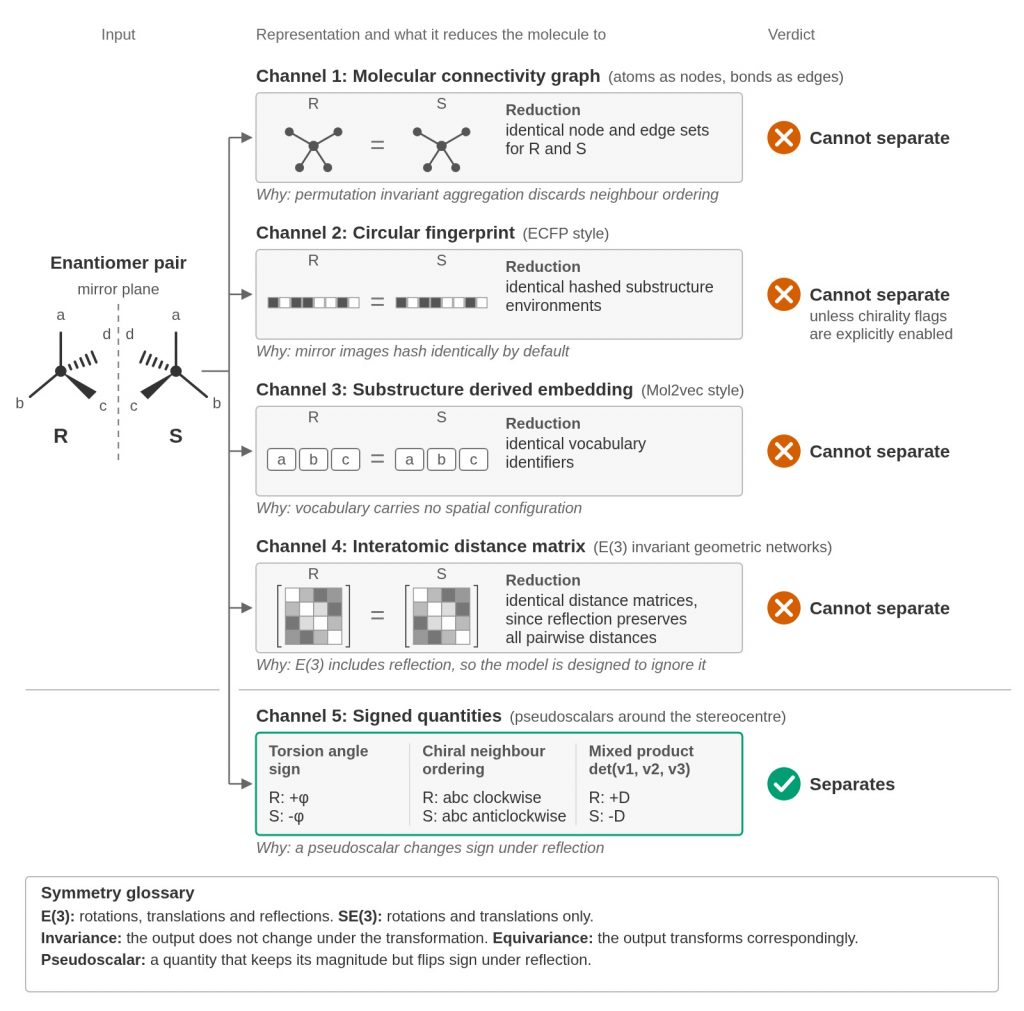
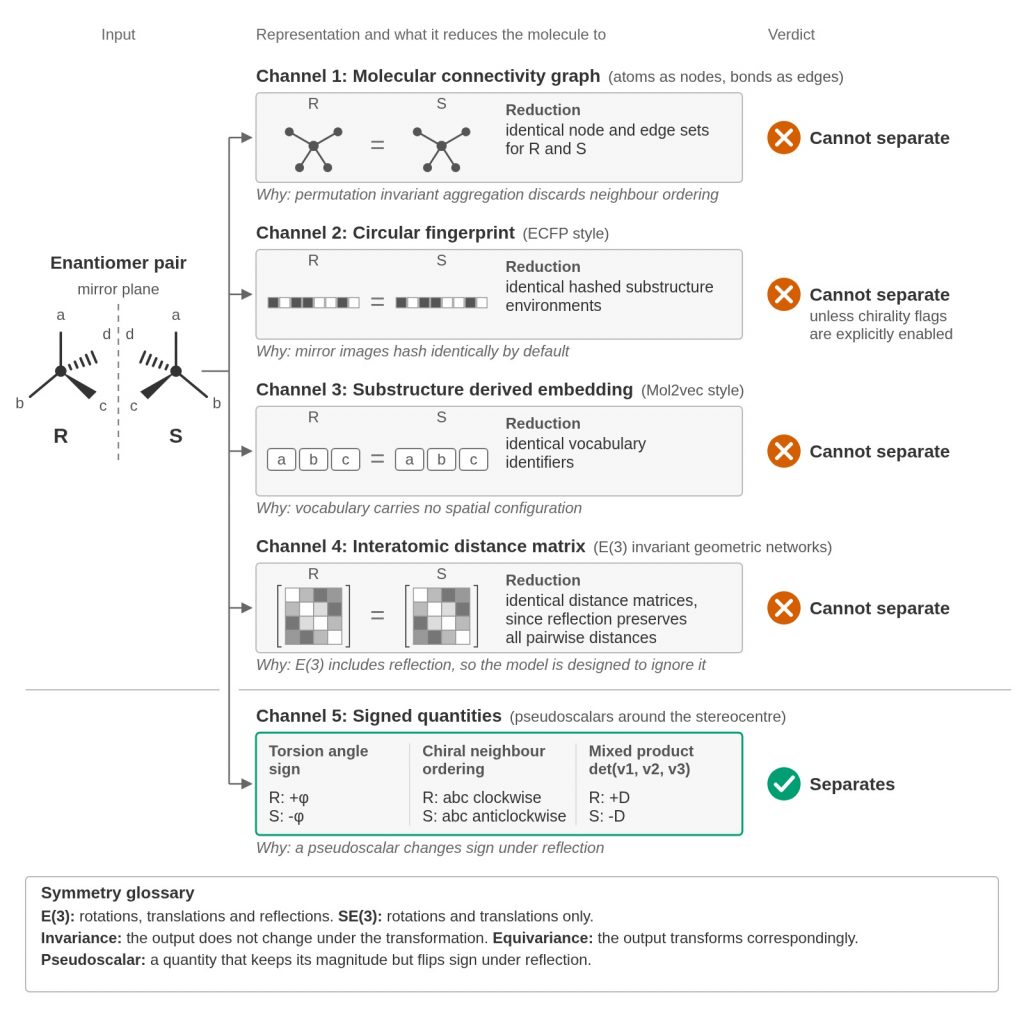
Chirality is the property of an object that cannot be superimposed on its mirror image by rotation and translation. For a tetrahedral carbon with four different substituents, the two arrangements R and S are distinct three-dimensional objects. But they contain the same atoms joined by the same bonds. Their molecular graphs, in which atoms are nodes and bonds are edges, are identical.
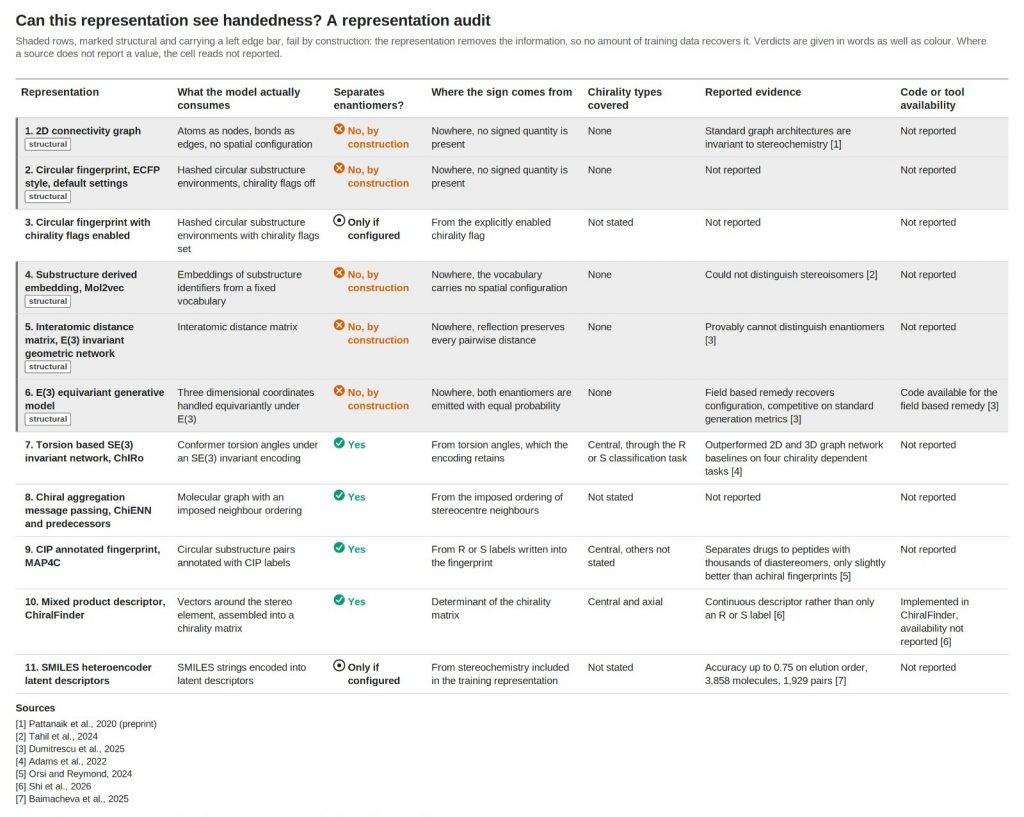
Most molecular machine learning consumes exactly that graph. Message-passing neural networks build an atom’s representation by aggregating messages from its neighbours using a permutation-invariant operator such as a sum, mean, or maximum. Permutation invariance is the point: the network should not care about the arbitrary order in which neighbours happen to be listed. But the difference between R and S is an ordering a clockwise versus anticlockwise arrangement of the same four neighbours. A symmetric aggregator discards it. As Pattanaik et al. (2020) put it when they first proposed custom chiral aggregators, standard architectures treat molecules as graph-structured data and are therefore invariant to stereochemistry.
The problem is not confined to graphs. Circular fingerprints such as ECFP enumerate substructure environments; unless chirality is deliberately switched on, mirror images hash identically. Embedding methods inherit the defect: Tahıl et al. (2024) found that Mol2vec, a widely used word-embedding approach for molecules, could not distinguish stereoisomers, because it derives its vocabulary from substructure identifiers that carry no spatial configuration. Their paper’s title is the honest summary: stereoisomers are not machine learning’s best friends.
Where 3D representations Fail Too
The intuitive fix is to move to three dimensions. It does not automatically work.
Modern geometric deep learning networks typically consume atomic positions and build features from interatomic distances. Distances are attractive because they are unchanged by rotation and translation, so the network’s predictions do not depend on how the molecule happens to be oriented. But reflect a molecule through a plane and every pairwise distance stays exactly the same. Two enantiomers have identical distance matrices. A model that sees only distances is blind to handedness for the same reason it is blind to orientation.
This is where the symmetry vocabulary matters, and it is worth being precise:
- E(3) is the Euclidean group: rotations, translations, and reflections.
- SE(3) is the special Euclidean group: rotations and translations only, excluding reflection.
- Equivariance means transforming the input transforms the output correspondingly; invariance means the output does not change at all.
- A pseudoscalar is a quantity that keeps its magnitude but flips sign under reflection.
A model that is E(3)-invariant cannot distinguish enantiomers, because reflection is one of the operations it has been designed to ignore. Dumitrescu et al. (2025) made this formal rather than anecdotal, proving that such models must disregard chirality and demonstrating empirically that E(3)-equivariant generative models emit the two enantiomers of a molecule with equal probability. Their proposed remedy replaces rotational symmetry constraints with a field-based representation and reference rotations, recovering configuration while staying competitive on standard generation metrics. Code is available.
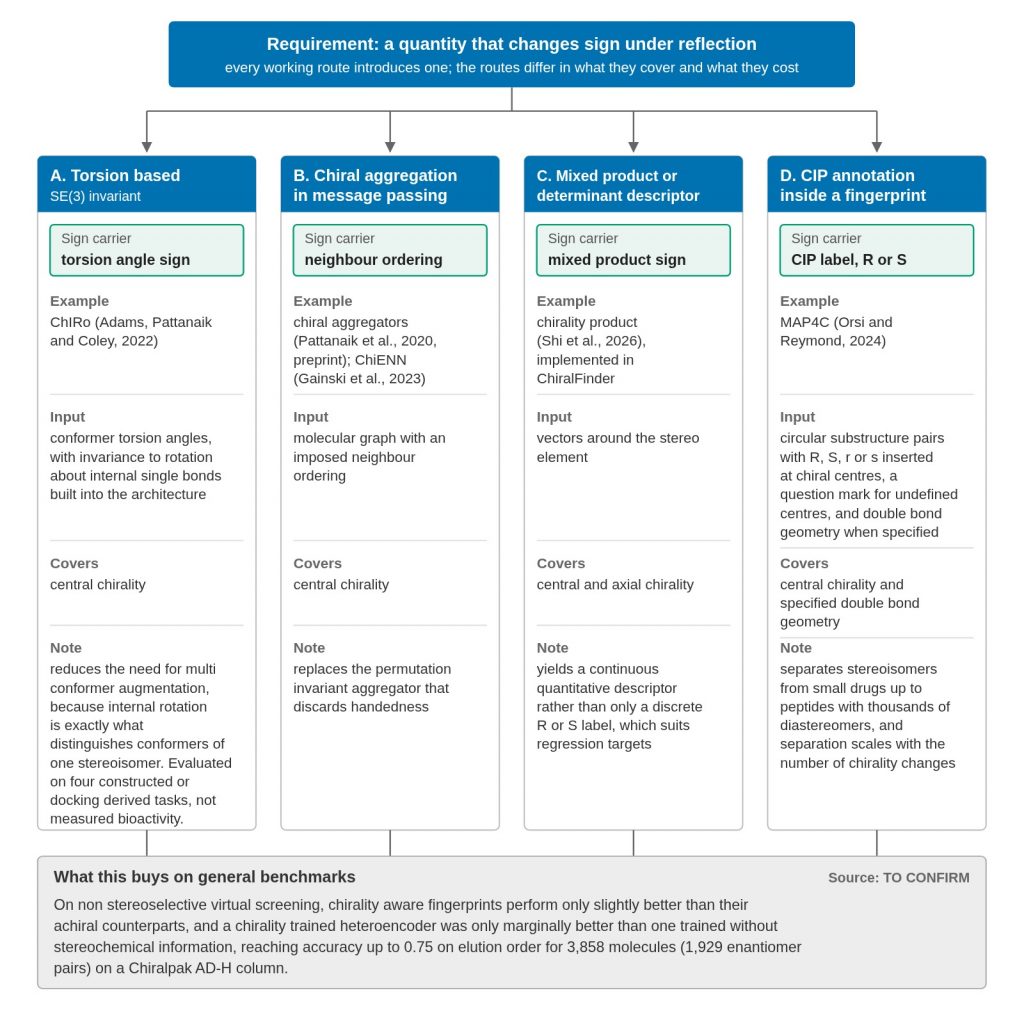
Every working solution introduces a signed quantity somewhere. Torsion angles carry a sign. A triple product of three vectors around a stereocentre equivalently, the determinant of a matrix built from those vectors is a pseudoscalar. Shi et al. (2026) build a unifying framework on exactly this, defining a “chirality product” as the determinant of a chirality matrix and implementing it in the ChiralFinder tool. Notably, their formalism handles axial as well as central chirality, and yields a continuous quantitative descriptor rather than only a discrete R/S label an advantage over the qualitative Cahn-Ingold-Prelog convention when the output has to feed a regression model.
Case Study 1: ChIRo, and the conformational complication
Adams, Pattanaik and Coley (2022) addressed a subtlety that pure symmetry reasoning misses. Chirality is a property of configuration, which is fixed. But a 3D model is shown conformers, which are not. A flexible drug-like molecule has many accessible conformers, all sharing the same configuration. A naive 3D model must either be given many conformers per molecule or risk learning conformer-specific artefacts.
Their model, ChIRo, is SE(3)-invariant and operates on the torsion angles of a conformer, with an additional invariance to rotations about internal single bonds built directly into the architecture. Because internal rotation is precisely what distinguishes conformers of the same stereoisomer, this reduces the need for multi-conformer data augmentation.
The evaluation is instructive. Rather than a single benchmark, the authors used four chirality-dependent tasks: contrastive discrimination of conformers belonging to different stereoisomers; classification of stereocentres as R or S; prediction of the direction in which enantiomers rotate plane-polarised light; and ranking enantiomers by docking score in an enantiosensitive protein pocket. ChIRo outperformed both 2D and 3D graph neural network baselines. That result is genuine, but its scope should be read carefully: the tasks are constructed or docking-derived rather than drawn from measured bioactivity, and an achiral baseline is at chance on several of them by construction, which makes “beating the baseline” a lower bar than it first appears.
Case Study 2: MAP4C, and an Honest Negative
The descriptor-level route is simpler and, for many working groups, more practical. Orsi and Reymond (2024) produced MAP4C, a chiral version of their MAP4 fingerprint. It computes MinHashes from strings describing pairs of circular substructures and their topological separation, and inserts the CIP annotation (R, S, r or s) whenever a chiral atom sits at the centre of one of those substructures. Undefined stereocentres get a question mark; double-bond geometry is included when specified.
The capability result is strong. MAP4C separates stereoisomers across a remarkable size range, from small-molecule drugs to natural products and peptides with thousands of diastereomers, and the degree of separation scales with the number of chirality changes a sensible, interpretable behaviour.
The performance result is more sobering, and the authors report it plainly: on non-stereoselective virtual screening benchmarks, MAP4C performs only slightly better than the achiral MAP4, ECFP and atom-pair fingerprints. A similar pattern appears in Baimacheva et al. (2025), who derived chirality descriptors from the latent space of SMILES heteroencoders and used latent-space arithmetic subtracting a molecule’s descriptor from its enantiomer’s, or from a stereochemistry-stripped version. Trained on 3,858 molecules (1,929 enantiomer pairs) to predict elution order on a Chiralpak AD-H column, the descriptors reached accuracy up to 0.75, but a chirality-trained encoder was only marginally better than one trained without stereochemical information.
Two independent groups, two representations, the same message: encoding chirality is necessary, and on its own it is often not sufficient.
What AI Adds
It makes an implicit failure explicit. For years, stereochemistry was quietly dropped in cheminformatics pipelines without the loss being quantified. Chirality-aware methods have forced the question of when handedness actually matters. Schneider et al. (2018) trained machine learning models on roughly 3,800 chiral pairs from ChEMBL and reached up to 75% accuracy in discriminating “chiral cliffs” pairs where configuration substantially changes binding from pairs where it does not, and derived practical guidance on when a racemate is an acceptable assay surrogate.
It scales stereochemical bookkeeping. MAP4C’s discrimination of thousands of diastereomers of a single peptide is not something a human can do by inspection.
It can audit the literature that trains it. Aguilar-Bejarano et al. (2025) applied a graph neural network to check published asymmetric-catalysis records for errors machine learning turned on the data quality problem rather than merely suffering from it.
Current Limitations and Evidence Gaps
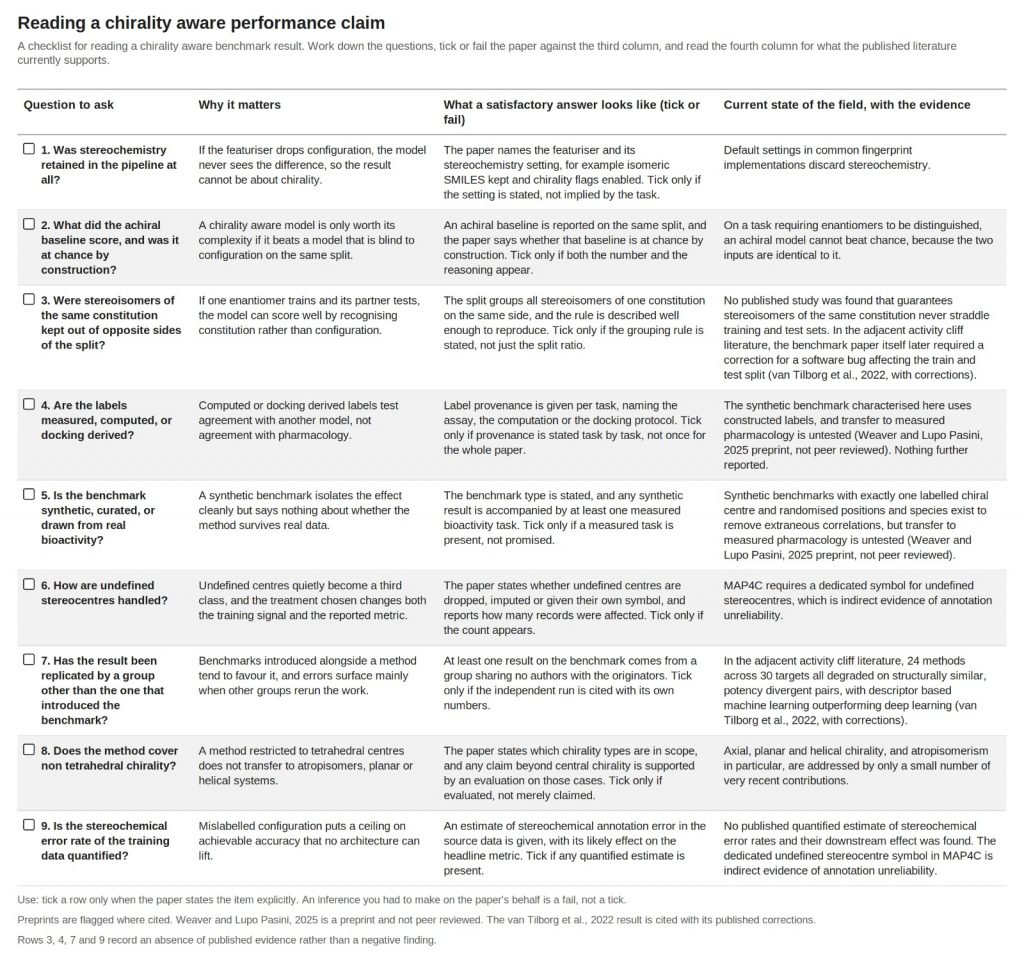
Benchmarks may not test what they claim. A chirality benchmark drawn from real bioactivity data contains ordinary scaffold variation alongside stereochemical variation, and a model can score well on the former. Synthetic benchmarks isolate the signal Weaver and Lupo Pasini (2025, preprint) generate graphs containing exactly one labelled chiral centre with randomised positions and species specifically to remove extraneous correlations but the transfer from synthetic graphs to measured pharmacology is untested.
Stereoisomer-aware splitting is essentially absent. I found no study that guarantees stereoisomers of the same constitution never straddle training and test sets. The consequences are well established in the adjacent activity-cliff literature: van Tilborg et al. (2022) benchmarked 24 methods across 30 targets and found all of them degraded on structurally similar, potency-divergent pairs, with descriptor-based machine learning outperforming deep learning. That paper itself later required a correction for a software bug affecting the train–test split, which is an apt illustration of how easily splitting errors escape notice.
Non-tetrahedral chirality is barely addressed. Axial, planar and helical chirality, and atropisomerism in particular, are handled by a small number of very recent contributions. Given how often atropisomerism now appears in medicinal chemistry programmes, this is a material gap.
Data quality is asserted more than measured. That stereochemical annotation in public databases is unreliable is widely accepted and is visible in tool design MAP4C needs a dedicated symbol for undefined stereocentres. What is missing is a published, quantified estimate of stereochemical error rates and their downstream effect on model performance.
Gains are modest and not always independently replicated. Several architectural results come from a small number of groups evaluating on benchmarks they introduced.
Implications and Drug Discovery and Development
For anyone running virtual screening or building property models, three practical consequences follow.
First, check whether your pipeline retains stereochemistry at all. Default settings in common fingerprint implementations discard it. If your compounds are single enantiomers and your model treats them as racemates, the model cannot distinguish your lead from its distomer.
Second, the decision to use a racemate in early assays is now partly a data question. The chiral-cliff work gives an empirical basis for when configuration is likely to change binding materially, rather than relying on habit.
Third, be sceptical of chirality-aware model performance claims. Ask what the achiral baseline scored, whether that baseline was at chance by construction, and how the data were split. On general screening tasks, the honest current position is that chirality-aware representations buy correctness rather than a large accuracy gain they stop the model from being wrong in a specific, silent way.
What Comes Next
Making chirality machine-readable is necessary but circular in one respect: the labels themselves come from measurement. Someone has to determine that a compound is the R enantiomer, that a mixture is 98% enantiomerically pure, or that two peaks in a chromatogram correspond to which configuration. Episode 2 turns to that measurement layer how machine learning is being applied to chiroptical spectroscopy, NMR-based configurational assignment, chiral chromatography and image-based structure recognition, and how reliable those AI-assisted assignments are when reference data are scarce.
References
Adams K, Pattanaik L Coley CW. Learning 3D Representaions of Moleculr Chirality with Invariance to Bond Rotations. Proceedings of the Tenth International Conference on Learning Representaions (ICLR). 2022. Conference Paper. no DOI assinged. Preprint: arXiv:2110.04383
Aguilar-Bejarano E, Deorukhkar V, Woodward S. Data Checking of Asymmetric Catalysis Literature Using a Graph Neural Network Approach. Molecules. 2025;30(2):355. DOI: 10.3390/molecules30020355
Baimacheva N, Gao X, Aires-de-Sousa J. Evaluation of chirality descriptors derived from SMILES heteroencoders. Journal of Cheminformatics. 2025;17(1):137. DOI: 10.1186/s13321-025-01080-7
Dumitrescu A, Korpela D, Heinonen M, Verma Y, Iakovlev V, Garg V, Lähdesmäki H. E(3)-equivariant models cannot learn chirality: Field-based molecular generation. Proceedings of the Thirteenth International Conference on Learning Representations (ICLR). 2025. Conference paper, no DOI assigned. Preprint: arXiv:2402.15864
Gaiński P, Koziarski M, Tabor J, Śmieja M. ChiENN: Embracing Molecular Chirality with Graph Neural Networks. In: Machine Learning and Knowledge Discovery in Databases: Research Track (ECML PKDD 2023). Lecture Notes in Computer Science, vol 14171. Springer, Cham; 2023:36–52. DOI: 10.1007/978-3-031-43418-1_3
Orsi M, Reymond J-L. One chiral fingerprint to find them all. Journal of Cheminformatics. 2024;16(1):53. DOI: 10.1186/s13321-024-00849-6 · PubMed 38741153
Schneider N, Lewis RA, Fechner N, Ertl P. Chiral Cliffs: Investigating the Influence of Chirality on Binding Affinity. ChemMedChem. 2018;13(13):1315–1324. DOI: 10.1002/cmdc.201700798 · PubMed 29749719
Shi R, Zhang C, Yu G, Huo X, Yang Y. A unifying geometric framework for computational representation of stereoisomers based on mixed product. Cell Reports Physical Science. 2026;7(1):103065. DOI: 10.1016/j.xcrp.2025.103065
Tahıl G, Delorme F, Le Berre D, Monflier É, Sayede A, Tilloy S. Stereoisomers Are Not Machine Learning’s Best Friends. Journal of Chemical Information and Modeling. 2024;64(14):5451–5469. DOI: 10.1021/acs.jcim.4c00318 · PubMed 38949069
van Tilborg D, Alenicheva A, Grisoni F. Exposing the Limitations of Molecular Machine Learning with Activity Cliffs. Journal of Chemical Information and Modeling. 2022;62(23):5938–5951. DOI: 10.1021/acs.jcim.2c01073 · PubMed 36456532 Two corrections have been published and are cited here for transparency; the authors state the original conclusions were unchanged: DOI: 10.1021/acs.jcim.3c00423 (methods description) and DOI: 10.1021/acs.jcim.3c01576 (software bug affecting train/test splitting).
Preprints
Pattanaik L, Ganea O-E, Coley I, Jensen KF, Green WH, Coley CW. Message Passing Networks for Molecules with Tetrahedral Chirality. 2020. Preprint (also presented at the NeurIPS 2020 Machine Learning for Molecules workshop). arXiv:2012.00094
Weaver R, Lupo Pasini M. Chi-Geometry: A Library for Benchmarking Chirality Prediction of GNNs. 2025. Preprint, not peer reviewed at time of writing. arXiv:2508.09097
Datasets, software and technical resources
ChiENN implementation: https://github.com/gmum/ChiENN
ChiralFinder: https://compbio.sjtu.edu.cn/services/chiralfinder
FMG (field-based molecular generation) implementation: https://github.com/Dumitrescu-Alexandru/FMG
MoleculeACE benchmarking platform: https://github.com/molML/MoleculeACE