From interpretive expertise to multimodal analytical inference
Summary
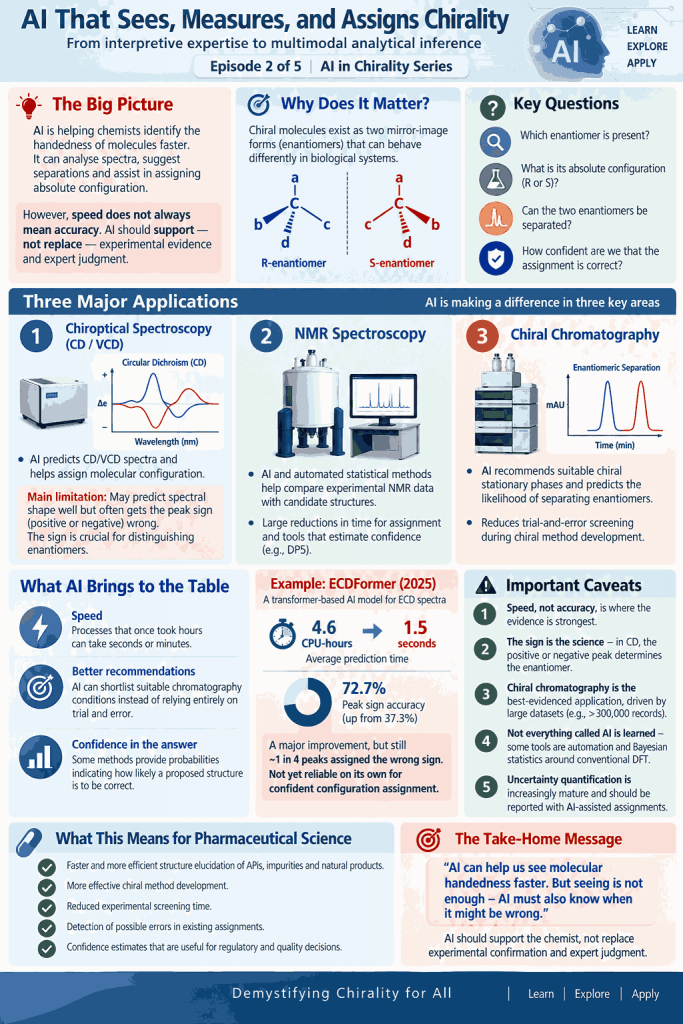
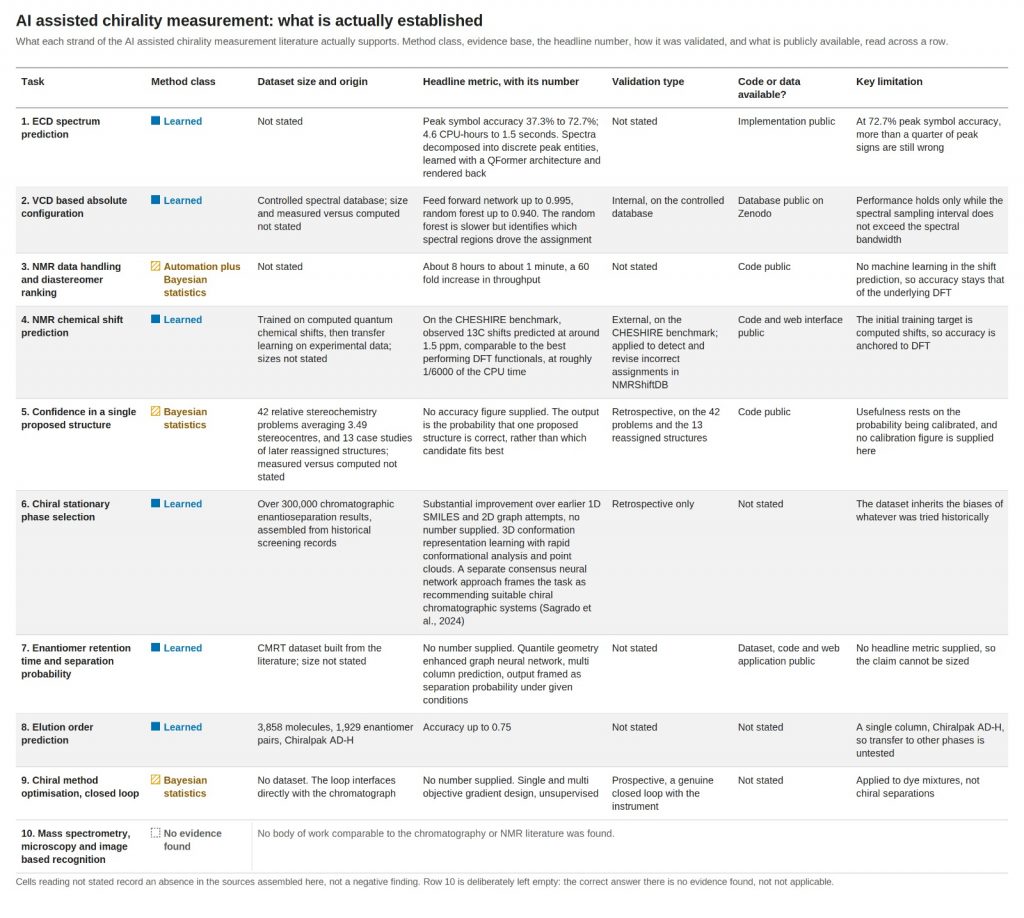
Determining a molecule’s configuration, or resolving its enantiomers on a column, has traditionally meant comparing experimental data against a computed reference a process gated by quantum chemistry and by expert judgement. Machine learning is now compressing that comparison from hours to seconds and, in chiral chromatography, is beginning to replace trial-and-error method development with structure-based recommendation. The gains in speed are large and well documented. The gains in accuracy are more mixed, and much of the evidence remains retrospective. This article examines chiroptical spectroscopy, NMR-based assignment, and chiral separations, and pays particular attention to a question that matters more here than anywhere else in the series: how reliable is an AI-assisted assignment, and how is that reliability communicated?
key takeaways
- Speed, not accuracy, is where the evidence is strongest. Reported improvements of 60-fold, 6,000-fold and larger in time-to-answer are consistent across NMR and chiroptical work; accuracy improvements are more modest.
- The sign is the science. In circular dichroism, configurational information sits in whether a peak is positive or negative. A model that predicts spectral shape well but peak sign poorly has not solved the assignment problem.
- Chiral chromatography is the best-evidenced application in this episode, driven by unusually large datasets one study drew on over 300,000 separation records.
- Not everything called AI here is learned. Some of the most useful tools are automation plus Bayesian statistics wrapped around conventional DFT, which is a different thing and should be described as such.
- Uncertainty quantification is unusually mature in this corner of the field, and offers a template the rest of chirality-aware AI has not yet adopted.
Opening: the labels have to come from somewhere
Episode 1 argued that chirality must be made machine-readable before a model can learn anything from it. But that argument is incomplete in one respect. The R/S labels, the enantiomeric excess values, and the elution orders that train those models are not free-standing facts. Someone measured them.
That measurement layer is itself expensive, slow and judgement-laden and it is where a second, quite different application of machine learning has taken hold.
The central problem: Assignment is a comparison, and the comparison is the bottleneck
Absolute configuration cannot usually be read directly off a spectrum. The standard workflow is comparative: propose candidate structures, compute their expected spectra using quantum chemistry, and see which computed spectrum best matches the experiment. For a flexible molecule this means computing a conformational ensemble for every candidate, and the number of candidates grows as 2^n for n stereocentres.
This creates three distinct bottlenecks, and it is worth separating them because different AI methods attack different ones:
- Computation cost. Time-dependent DFT for electronic circular dichroism, or GIAO calculations for NMR shifts, dominate the wall-clock time.
- Data handling. Peak picking, matching computed shifts to noisy experimental peaks, and assignment are laborious and were, until recently, manual.
- Decision-making. Given an imperfect match, how confident should a chemist be?
Chiroptical spectroscopy: fast presiction, imperfect signs
Case study 1: ECDFormer and the peak-sign problem
Li et al. (2025) built a large-scale dataset of chiral molecular ECD (Electronic Circular Dichroism) spectra and a transformer-based model, ECDFormer, that takes a deliberately unusual approach. Rather than predicting the spectrum as a continuous sequence of intensities, it decomposes each spectrum into discrete peak entities, learns the properties of those peaks using a QFormer architecture, and renders them back into a spectrum.
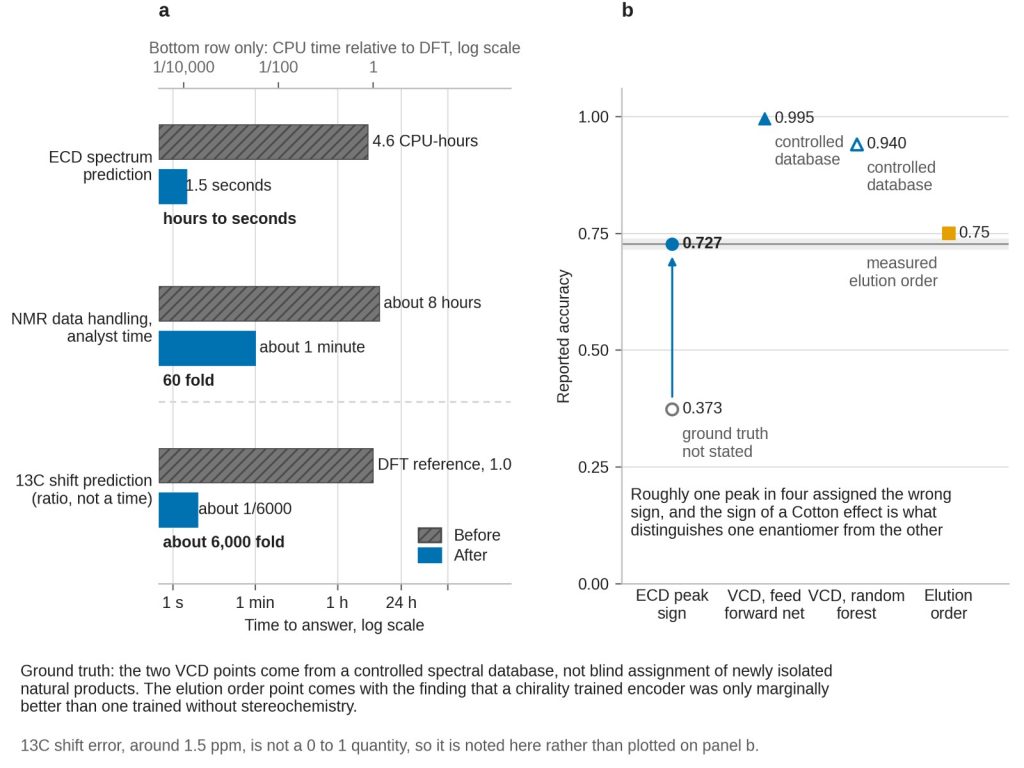
The efficiency result is dramatic: average prediction time fell from 4.6 CPU-hours to 1.5 seconds. The accuracy result deserves closer reading. Peak symbol accuracy whether a peak is correctly predicted as positive or negative improved from 37.3% to 72.7%.
That is roughly a doubling, and it is a real advance. It is also, in absolute terms, roughly one peak in four assigned the wrong sign. Since the sign of a Cotton effect is precisely what distinguishes one enantiomer from the other, this is the metric that matters, and 72.7% is not yet a number on which a chemist would confidently rest a configurational assignment without corroboration. The authors’ own framing accurate and interpretable prediction, with the decoupled peak structure enabling attribution of peaks to chromophores is more honest about what the tool is for: it is a fast, inspectable first pass, not a replacement for the comparison workflow.
Vibrational circular dichroism, and what a controlled dataset can and cannot tell you
Vermeyen et al. (2021) asked a narrower question: can supervised learning assign absolute configuration directly from a VCD spectrum, without the DFT comparison step? Testing several methods, they found a feed-forward neural network reached accuracy up to 0.995 and a random forest up to 0.940. The random forest was slower but had a property the neural network lacked it identified which spectral regions drove the assignment, which is what a spectroscopist needs in order to trust the answer. They also established a useful practical rule: performance is preserved as long as the spectral sampling interval does not exceed the spectral bandwidth, which means input dimensionality can be reduced substantially without loss.
The caveat is important and the authors are clear about it. These accuracies come from a controlled spectral database, not from blind assignment of newly isolated natural products with unknown conformational behaviour. An accuracy of 0.995 on a curated set is a statement about the method’s ceiling, not about field performance.
NMR: automation, learned shifts, and honest probabilities
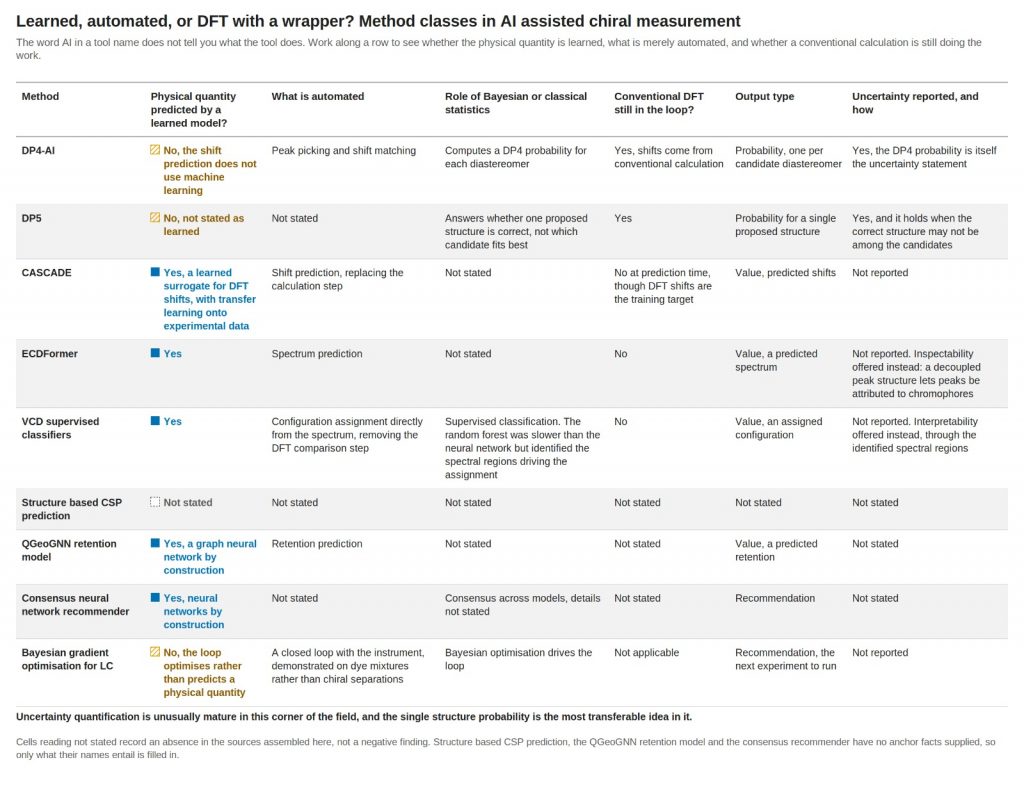
NMR-based configurational work illustrates the distinction between automation, statistics and machine learning particularly clearly, and conflating them would be a mistake.
DP4-AI (Howarth, Ermanis and Goodman, 2020) automates the handling problem. It performs peak picking using objective model selection, matches DFT-calculated shifts to noisy experimental peaks, and computes a DP4 probability for each diastereomer. Starting from a structure with undefined stereochemistry and raw 1D data, the workflow runs unattended. Processing that previously took roughly eight hours of a chemist’s time takes about a minute a 60-fold increase in throughput. Note what this is: automation plus Bayesian inference layered on conventional DFT. The name contains “AI”; the shift prediction does not use machine learning.
CASCADE (Guan et al., 2021) attacks the computation bottleneck instead, and here the learning is genuine. A 3D graph neural network is trained on quantum-chemical shifts and then improved by transfer learning on experimental data. On the CHESHIRE benchmark it predicts observed ¹³C shifts with accuracy comparable to the best-performing DFT functionals around 1.5 ppm at roughly 1/6000 of the CPU time. Critically for our purposes, because it takes 3D structures as input, it distinguishes stereoisomers and conformers rather than collapsing them, which is exactly the failure mode Episode 1 described. The authors also turned the model back on the data: they used it to detect and revise incorrect chemical shift assignments in NMRShiftDB.
DP5 (Howarth and Goodman, 2022) addresses the decision problem, and is the most conceptually interesting of the three. DP4 answers “which of these candidates fits best?” which is unhelpful if the correct structure is not among the candidates. DP5 answers a different question: given one structure and one ¹³C spectrum, what is the probability that this structure is correct? It was evaluated on 42 relative-stereochemistry problems averaging 3.49 stereocentres per molecule, and on 13 case studies of structures that were published incorrectly and later reassigned.
This is the uncertainty-quantification template the rest of chirality-aware AI largely lacks: a calibrated probability attached to a single proposed answer, tested specifically against cases where experts previously got it wrong.
Chiral chromatography: the best-evidenced application
Separation science has an advantage the rest of this episode does not large, structured datasets accumulated from decades of routine screening.
Case study 2: structure-based chiral stationary phase selection
Choosing which chiral stationary phase will resolve a given racemate has historically been screening-led. Hong et al. (2024) note that earlier machine learning attempts at structure-based CSP prediction relied on 1D SMILES strings or 2D graphical representations and met with only limited success which is precisely the representational failure Episode 1 anatomised, appearing here as a practical ceiling rather than a theoretical one.
Their approach applies 3D molecular conformation representation learning, using rapid conformational analysis and point clouds of atomic positions, trained on a dataset of over 300,000 chromatographic enantioseparation results. Moving to a 3D representation produced a substantial improvement over the 1D and 2D attempts.
Two things should temper enthusiasm. The evaluation is retrospective; no prospective screen of unseen racemates is reported. And a dataset assembled from historical screening records inherits whatever biases governed which compound–CSP combinations were tried in the first place.
Retention, elution order and separation probability
Xu et al. (2023) took the complementary route, building the CMRT dataset of chiral molecular retention times in HPLC from the literature and training a quantile geometry-enhanced graph neural network on it. Two design choices stand out. Chromatographic domain knowledge was incorporated to enable multi-column prediction rather than one model per column. And the output is framed as a separation probability under given conditions a decision-relevant quantity rather than a raw retention time. Dataset, code and a web application are publicly available.
Sagrado et al. (2024) frame the same problem explicitly as recommendation, using consensus neural networks to suggest suitable chiral chromatographic systems.
Against this, Baimacheva et al. (2025) supply a useful corrective. Predicting elution order on a Chiralpak AD-H column from 3,858 molecules (1,929 enantiomer pairs) using descriptors derived from SMILES heteroencoders, they reached accuracy up to 0.75 and found the chirality-trained encoder only marginally better than one trained without stereochemical information. Elution order, which depends on subtle differential interactions with the selector, remains hard.
Method optimisation, and a gap
Boelrijk et al. (2023) built a Bayesian optimisation algorithm for gradient design that interfaces directly with the chromatograph, operating unsupervised in a genuine closed loop, in both single- and multi-objective settings. It is an important demonstration and it was applied to dye mixtures, not chiral separations. Closed-loop optimisation of a chiral method has not, to my knowledge, been demonstrated in the same way.
What AI Adds
Time. The consistent, well-replicated finding across this episode is order-of-magnitude reductions in time-to-answer: 60-fold for NMR data handling, ~6,000-fold for shift prediction, hours-to-seconds for ECD.
Recommendation in place of screening. CSP selection and retention prediction convert an experimental search into a ranked shortlist.
Data quality feedback. CASCADE detecting misassignments in NMRShiftDB, and DP5 tested against structures the literature got wrong, show models auditing the record they were trained on.
Calibrated doubt. DP5’s probability that a single proposed structure is correct is the most transferable idea in this episode.
Current Limitations and Evidence Gaps
Reference data are often computed, not measured. Models trained on DFT-generated chiroptical spectra inherit the systematic errors of the underlying functional, and reported accuracies are relative to computed ground truth.
Prospective validation is largely absent. Almost everything here is retrospective. The chromatography models in particular have not been shown to succeed on racemates they were never trained near.
Peak-sign accuracy remains the binding constraint in ECD prediction, and it is the quantity carrying the configurational information.
Elution-order prediction is stuck around 0.75 accuracy, and adding stereochemical information to the representation helps less than expected.
Mass spectrometry, microscopy and image-based chirality recognition are thinly evidenced. I found no body of work comparable to the chromatography or NMR literature. Optical structure recognition tools reportedly fail most often on stereochemistry, but the peer-reviewed evidence base is not yet there to support firm claims.
Crystallisation-based resolution is treated in Episode 4, where the strongest and prospectively validated result in this whole series sits.
Implications for Drug Discovery and Development
For analytical and process groups, the practical picture is specific. Chiral method development is the nearest-term win: structure-based CSP recommendation and separation-probability estimates can cut screening, and several tools are openly available with working web interfaces. Treat them as shortlisting aids, since the evidence is retrospective.
For structure elucidation of APIs, impurities and natural products, the DP4-AI/CASCADE/DP5 stack is mature enough for routine use, with the important caveat that DP5’s question is this structure right? is usually the one a project actually needs answered.
For regulatory work, uncertainty reporting is not optional, and this is where the field’s habits are best. An AI-assisted configurational assignment submitted without a calibrated confidence statement and a record of what was compared against what is unlikely to survive scrutiny. DP5 shows this is achievable.
What Comes Next
Measurement gives us labels; representation lets a model read them. Episode 3 asks the harder question that motivates the whole enterprise: given that a model can now distinguish two enantiomers, can it predict how they will differ in target affinity, off-target activity, metabolism and toxicity? The evidence there is markedly weaker than what we have just reviewed, and a substantial part of the apparent progress turns out to be an artefact of how models are evaluated.
References
Baimacheva N, Gao X, Aires-de-Sousa J. Evaluation of chirality descriptors derived from SMILES heteroencoders. Journal of Cheminformatics. 2025;17(1):137. DOI: 10.1186/s13321-025-01080-7
Boelrijk J, Ensing B, Forré P, Pirok BWJ. Closed-loop automatic gradient design for liquid chromatography using Bayesian optimization. Analytica Chimica Acta. 2023;1242:340789. DOI: 10.1016/j.aca.2023.340789 · PubMed 36657888
Guan Y, Shree Sowndarya SV, Gallegos LC, St. John PC, Paton RS. Real-time prediction of ¹H and ¹³C chemical shifts with DFT accuracy using a 3D graph neural network. Chemical Science. 2021;12(36):12012–12026. DOI: 10.1039/d1sc03343c · PubMed 34667567
Hong Y, Welch CJ, Piras P, Tang H. Enhanced Structure-Based Prediction of Chiral Stationary Phases for Chromatographic Enantioseparation from 3D Molecular Conformations. Analytical Chemistry. 2024;96(6):2351–2359. DOI: 10.1021/acs.analchem.3c04028
Howarth A, Ermanis K, Goodman JM. DP4-AI automated NMR data analysis: straight from spectrometer to structure. Chemical Science. 2020;11(17):4351–4359. DOI: 10.1039/d0sc00442a · PubMed 34122893
Howarth A, Goodman JM. The DP5 probability, quantification and visualisation of structural uncertainty in single molecules. Chemical Science. 2022;13(12):3507–3518. DOI: 10.1039/d1sc04406k · PubMed 35432857
Li H, Long D, Yuan L, Wang Y, Tian Y, Wang X, Mo F. Decoupled peak property learning for efficient and interpretable electronic circular dichroism spectrum prediction. Nature Computational Science. 2025;5(3):234–244. DOI: 10.1038/s43588-024-00757-7 · PubMed 39753718
Sagrado S, Pardo-Cortina C, Escuder-Gilabert L, Medina-Hernández MJ, Martín-Biosca Y. Intelligent Recommendation Systems Powered by Consensus Neural Networks: The Ultimate Solution for Finding Suitable Chiral Chromatographic Systems? Analytical Chemistry. 2024;96(29):12205–12212. DOI: 10.1021/acs.analchem.4c02656
Vermeyen T, Brence J, Van Echelpoel R, Aerts R, Acke G, Bultinck P, Herrebout W. Exploring machine learning methods for absolute configuration determination with vibrational circular dichroism. Physical Chemistry Chemical Physics. 2021;23(35):19781–19789. DOI: 10.1039/D1CP02428K
Xu H, Lin J, Zhang D, Mo F. Retention time prediction for chromatographic enantioseparation by quantile geometry-enhanced graph neural network. Nature Communications. 2023;14(1):3095. DOI: 10.1038/s41467-023-38853-3
Datasets, software and technical resources
CASCADE (NMR chemical shift prediction, code and web interface): https://github.com/patonlab/CASCADE
DP4-AI and DP5 (Goodman group): https://github.com/Goodman-lab/DP5
ECDFormer implementation: https://github.com/HowardLi1984/ECDFormer
QGeoGNN / CMRT dataset, code and online retention-time predictor: https://github.com/woshixuhao/Retention-Time-Prediction-for-Chromatographic-Enantioseparation
VCD spectral database accompanying Vermeyen et al. (2021), Zenodo: https://zenodo.org/records/8142819