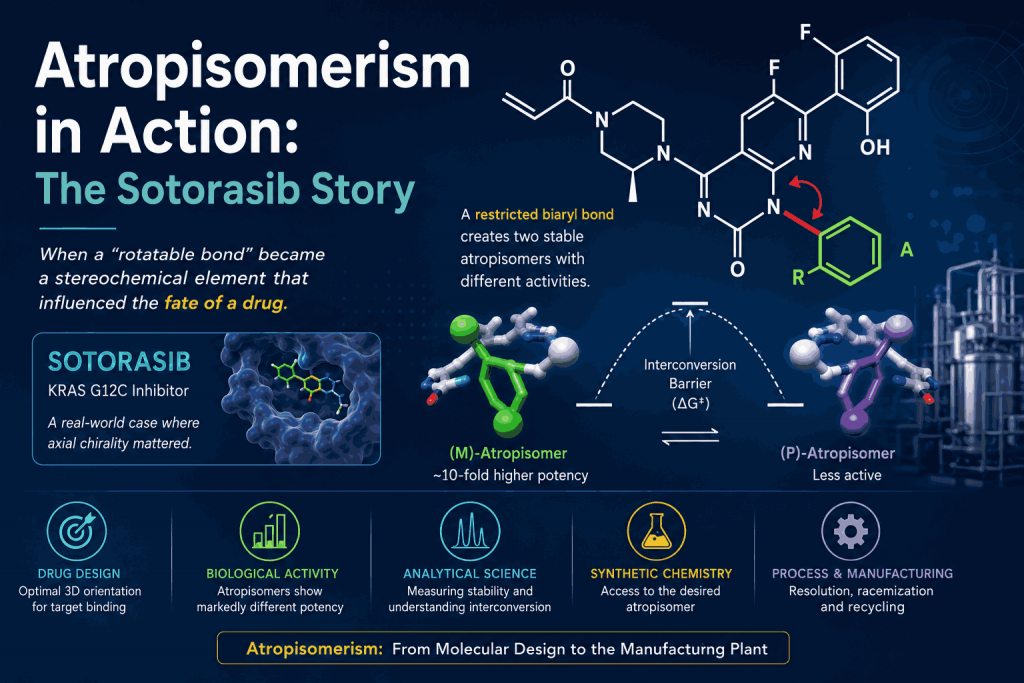
When a Biaryl Bond Became a Drug-Design Advantage—and a Development Challenge
Introduction: What if a “rotatable bond” could influence the fate of a drug?
I recently came across a fascinating perspective written by scientists directly involved in the development of sotorasib, a KRAS G12C inhibitor exhibiting atropisomerism. Their article, “Addressing Atropisomerism in the Development of Sotorasib, a Covalent Inhibitor of KRAS G12C: Structural, Analytical, and Synthetic Considerations,” published in Accounts of Chemical Research in 2022, offers a remarkable real-world account of how atropisomerism influenced the development of this drug.
What caught my attention was that atropisomerism in this molecule was far more than a stereochemical curiosity. It became intertwined with drug design, biological activity, analytical characterization, synthetic strategy, regulatory considerations, and ultimately large-scale manufacturing.
This makes sotorasib a remarkable real-world case study for understanding the prominence of atropisomerism in pharmaceutical development.
So, for researchers, students and fellow chiral enthusiasts, let us step beyond the textbook definition of atropisomerism and explore how axial chirality actually shaped the journey of a modern drug.
When does a biaryl bond stop being “just a rotatable bond” and become a stereochemical element that can influence the fate of a drug?
The sotorasib story provides a compelling answer.
1. Atropisomerism: More Than a Chiral Axis
Most familiar examples of chirality involve a stereogenic centre, often a tetrahedral carbon attached to four different substituents. Atropisomerism is different. Here, chirality arises because rotation about a bond is sufficiently restricted that two different spatial arrangements become configurationally stable.
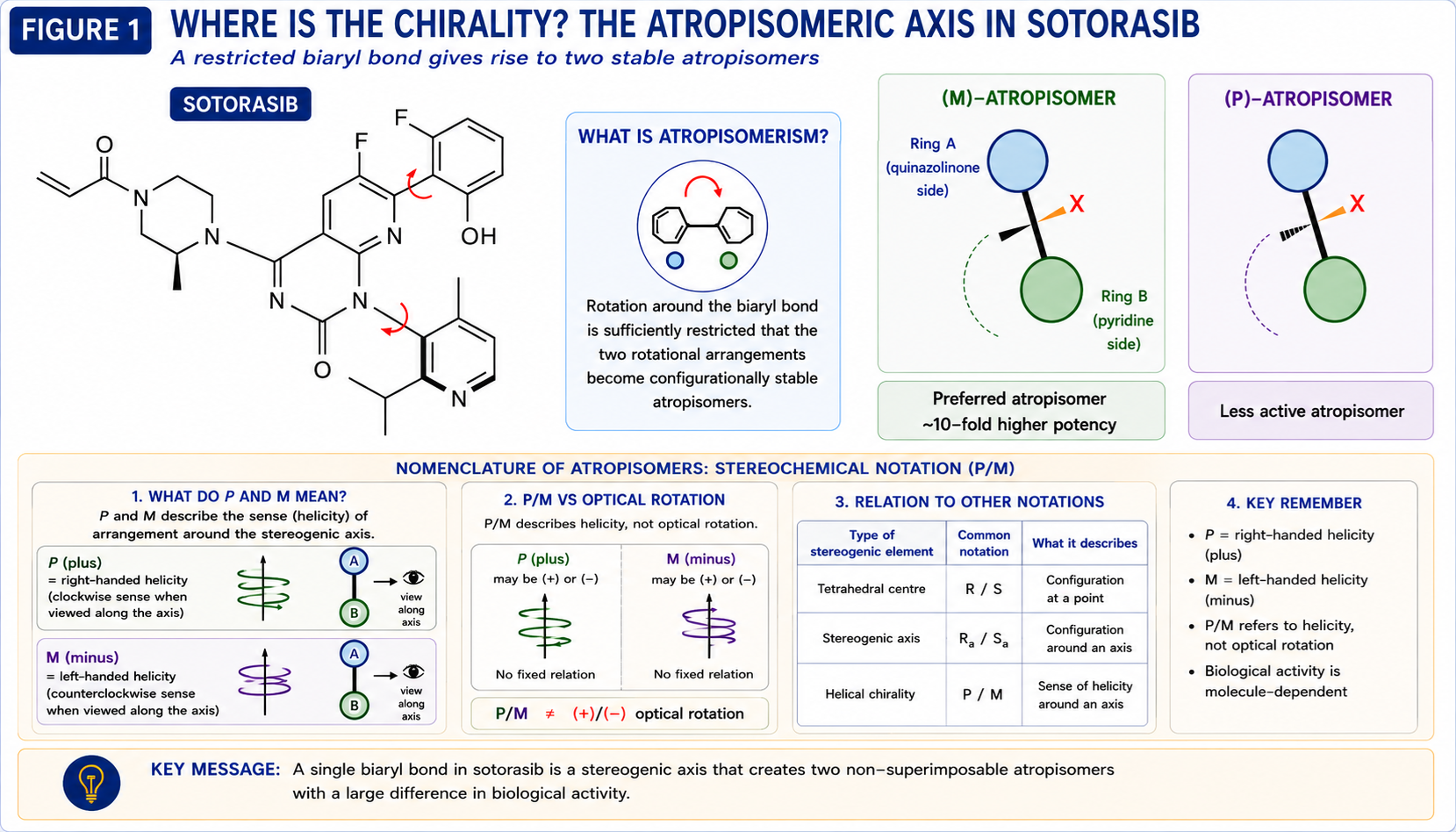
A simple way to think about it is:
Free rotation → conformational flexibility; Restricted rotation → potentially stable atropisomers
In a biaryl molecule, steric and electronic interactions near the bond connecting the two rings can raise the barrier to rotation. If that barrier becomes sufficiently high, the two rotational arrangements can behave as distinct stereoisomers.
But there is an important difference from conventional point chirality: atropisomeric interconversion can occur through rotation rather than bond breaking. Consequently, the rotational energy barrier—and the resulting rate of interconversion—becomes a critical property of the molecule.
This distinction is central to the sotorasib story.
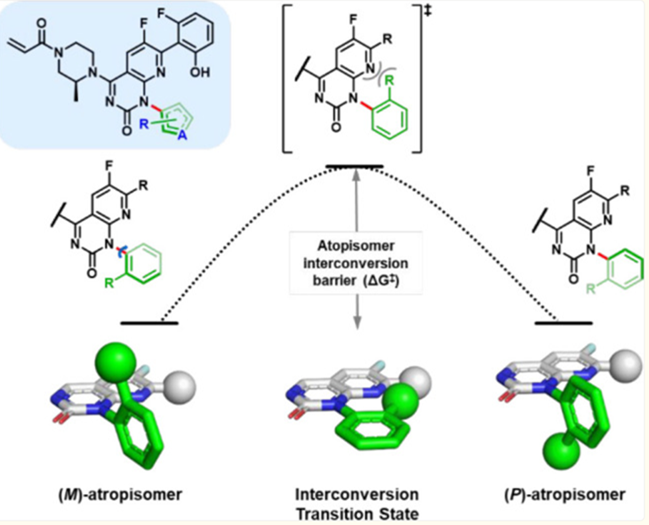
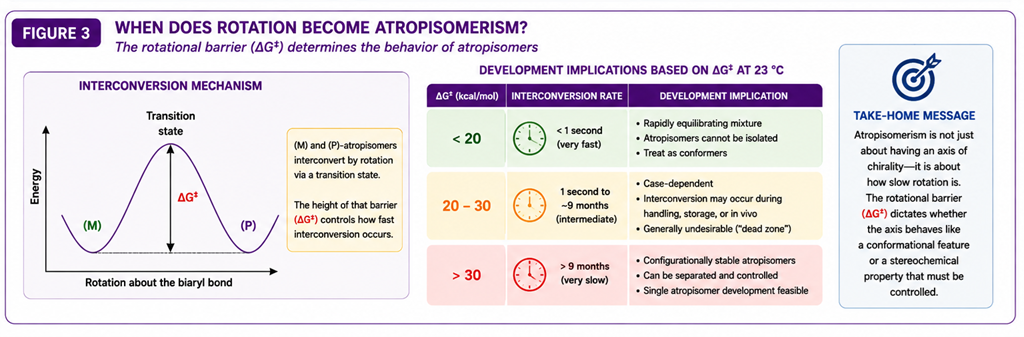
Interconversion of biaryl atropisomers. Rotation about the axially chiral biaryl bond (red) allows for (M)- and (P)-atropisomer interconversion. Intramolecular interactions (e.g., steric, electronic) in
the interconversion transition state lead to varying atropisomer interconversion barriers (ΔG⧧), whose magnitudes depend on the identity and substitution pattern of the rings of the biaryl system.
2. Why Did the Scientists Introduce an Atropisomeric Axis?
The first important lesson is that atropisomerism was not deliberately introduced simply to make the molecule chiral. It emerged from a medicinal-chemistry strategy to solve a three-dimensional binding problem.
During the discovery of KRAS G12C inhibitors, the researchers identified a previously inaccessible or “cryptic” pocket involving residues H95, Y96 and Q99. A biaryl linkage offered a synthetically accessible and readily diversified structural element capable of positioning a substituent into this pocket. An earlier indole lead used an atropisomeric linkage to achieve similar pocket engagement, but that compound suffered from metabolic instability. A related quinazolinone scaffold retained the useful spatial arrangement while providing improved metabolic stability and ultimately became the foundation for sotorasib.
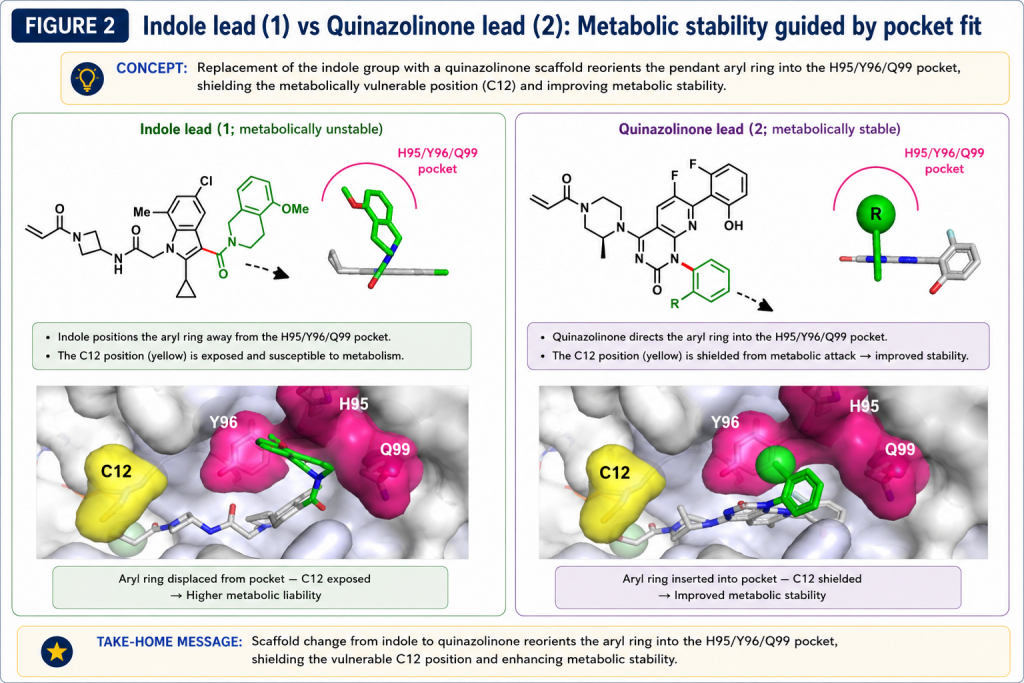
This leads to an important medicinal-chemistry principle:
Chirality can be used as a three-dimensional design tool—not merely as a property to be controlled after a molecule has been discovered.
In sotorasib, the stereochemical element was therefore part of the solution to a molecular-recognition problem.
3. The Stereochemical Question: Which Atropisomer?
Once rotation about the biaryl axis became sufficiently restricted, two atropisomeric forms—designated (M) and (P)—could exist. Now the question became much more important:
Are the two atropisomers biologically equivalent? They were not.
The development work showed approximately a 10-fold difference in potency between the atropisomers. This transformed atropisomerism from a structural observation into a drug-development issue. The relevant questions were now:
- Which atropisomer has the preferred biological activity?
- Can it be isolated?
- Will it remain intact?
- Does it interconvert under experimental or manufacturing conditions?
- Can it be produced consistently on scale?
The stereochemical problem had become a multidisciplinary problem.
4. The Crucial Property: Configurational Stability
For an atropisomeric drug candidate, identifying two structures is not enough. We need to know how rapidly they interconvert. The key parameter is the free energy of activation, ΔG‡, for atropisomeric interconversion. The paper presents a useful practical framework:
| Interconversion barrier | Approximate behaviour at 23 °C | Development implication |
|---|---|---|
| <20 kcal/mol | <1 second | Rapidly equilibrating system |
| 20–30 kcal/mol | 1 second to 9 months | Case-dependent; potentially problematic |
| 30 kcal/mol | 9 months | Single atropisomer becomes feasible |
The middle range is particularly troublesome because interconversion may occur on a timescale relevant to biological, manufacturing or other pharmaceutical processes. This gives us an important conceptual insight:
Not all atropisomerism is equally important. The rate of atropisomer interconversion determines whether it is merely a dynamic conformational feature or a genuine development-defining stereochemical property.
5. How Do You Measure Something That Is Constantly Moving?
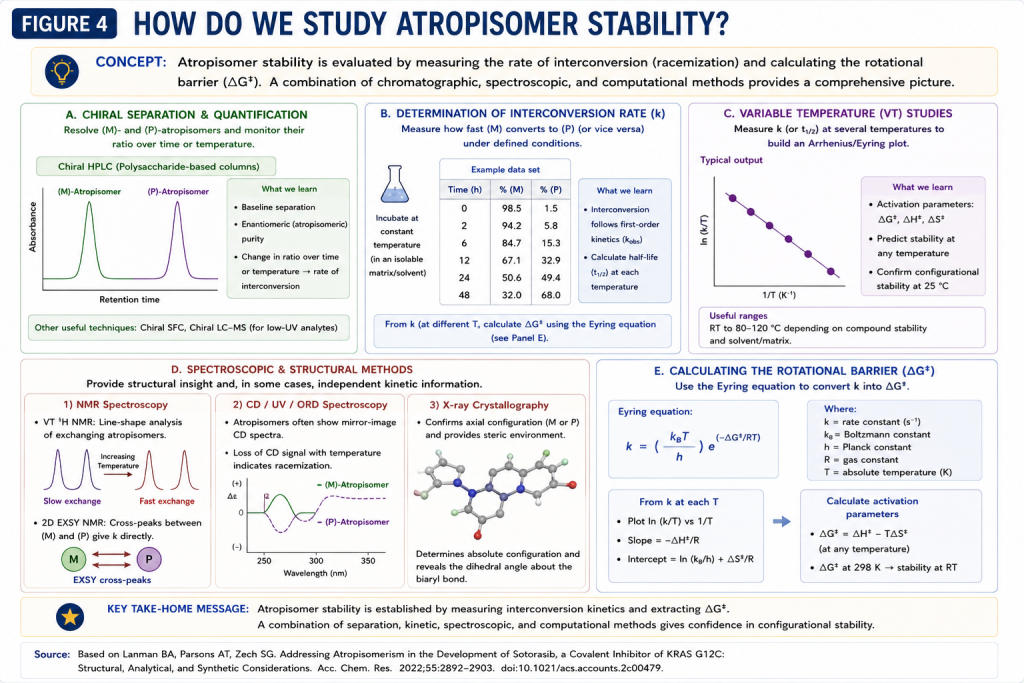
The sotorasib programme provides an excellent example of why analytical strategy must be matched to molecular dynamics.
Variable-temperature NMR
For relatively rapid interconversion, increasing the temperature accelerates rotation. NMR signals broaden and may eventually coalesce. These changes can be used to estimate exchange rates and activation parameters.
Time-course NMR
For slower processes, an atropisomer-enriched sample can be monitored over time. The researchers used this approach for more conformationally restricted intermediates, following the gradual conversion of one atropisomer into the other. One such compound showed a barrier of approximately 25.7 kcal/mol at 325 K—an intermediate regime that was considered undesirable for further development.
Chiral HPLC
When the two atropisomers are enantiomeric and cannot readily be distinguished by conventional NMR, chiral chromatography becomes particularly useful. A key precursor, for example, contained a single chiral axis and no additional stereocentre. Its two atropisomers could therefore be separated by chiral HPLC and their thermal racemization followed over time.
Computational chemistry
DFT calculations were also used to estimate rotational barriers. For the precursor examined in the paper, the calculated barrier was close to the experimentally measured value, illustrating how computation can complement experimental analysis. Thus, the analytical lesson is not simply “use chiral HPLC.”
It is: Choose the analytical technique according to the timescale of atropisomer interconversion.
6. From a Problematic Intermediate to Sotorasib
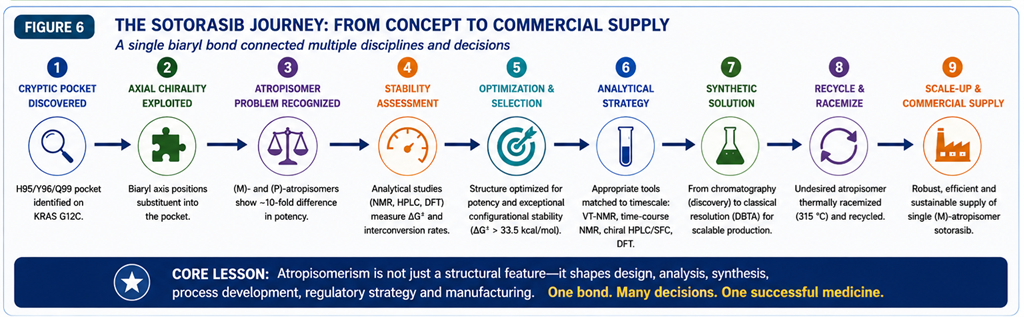
The development team did not simply accept whatever atropisomeric behaviour emerged. They deliberately optimized the biaryl system to balance productive target interactions and configurational stability. Some early analogues had barriers that were too low. Others entered the problematic intermediate range. The optimization ultimately led to sotorasib, whose atropisomeric system displayed exceptionally high configurational stability. The measured interconversion barrier was reported as >33.5 kcal/mol, corresponding to an estimated half-life of more than 1000 hours at 373 K. This is a particularly important distinction:
The objective was not simply to create an atropisomer. It was to obtain the right atropisomer with the right biological properties and sufficient configurational stability.
7. Discovery Solved—Manufacturing Problem Begins
Once the preferred atropisomer had been identified, a new question emerged:
How do you make kilograms—and ultimately very large quantities—of one atropisomer?
During discovery, chiral chromatography was an effective way to obtain material. For early clinical development, traditional chiral chromatography supplied approximately 2 kg of sotorasib drug substance. For a subsequent 10 kg delivery, simulated moving-bed chromatography was used, reducing processing time and solvent use compared with traditional chromatography. But a discovery-scale solution is not necessarily a commercial-scale solution. Large-scale chromatography brought disadvantages including solvent consumption, throughput limitations, processing time and operational complexity. The team therefore explored three broad approaches:
Asymmetric synthesis
Chiral chromatography
Classical resolution
The asymmetric approaches investigated did not meet the required yield and selectivity. Classical resolution ultimately emerged as the practical solution for large-scale production.
8. Classical Resolution: An “Old” Solution to a Modern Problem
Classical resolution separates stereoisomers by forming different crystalline complexes with a chiral resolving agent. In the sotorasib programme, extensive high-throughput experimentation was used to identify a suitable resolving agent and solvent system. After unsuccessful initial screening, (+)-2,3-dibenzoyl-D-tartaric acid (DBTA) provided the breakthrough. Optimization ultimately delivered the desired atropisomer with an M/P ratio >2000:1, corresponding to >99.9% de, in 42% yield on a scale exceeding 500 kg per batch. This is an excellent reminder that:
The most sophisticated synthetic strategy is not necessarily the best manufacturing strategy. Robustness, scalability, efficiency and practicality ultimately decide.
9. What Do We Do With the “Wrong” Atropisomer?
Classical resolution creates an obvious inefficiency:
Racemate → desired atropisomer + undesired atropisomer
If the undesired atropisomer is simply discarded, a significant amount of material is lost. The team therefore developed a clever solution:
Resolution → recover undesired atropisomer → thermal racemization → regenerate racemate → resolution again
The undesired atropisomer had a substantial interconversion barrier, so high temperatures were required to racemize it. After optimization, heating in anisole at 315 °C in a plug-flow reactor produced near-complete racemization in about 20 minutes, with the process demonstrated on kilogram scale.
The recovered material could then be returned to the resolution process. This transformed the process from a simple resolution into a resolution–racemization–recycling cycle. Importantly, optimization of this recovery and recycling strategy reduced the reported process mass intensity contribution from 336 to 141—a 58% reduction.
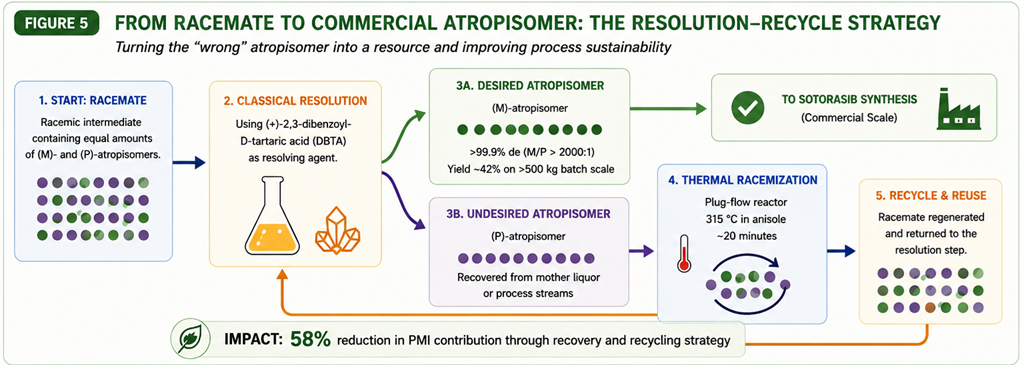
Thus, atropisomerism had now entered the domain of green and sustainable pharmaceutical manufacturing.
10. The Critical Perspective: What Does This Case Really Teach Us?
It would be tempting to conclude: “Sotorasib is successful because it is atropisomerically pure.”
That would be an oversimplification. The paper supports a more nuanced interpretation.
The axially chiral biaryl linkage was a central architectural element that helped achieve the desired three-dimensional interaction with KRAS G12C. The atropisomers differed in potency, making stereochemical control biologically relevant. At the same time, the exceptional configurational stability of the final system made development of a single atropisomer practical.
Therefore, the story is not simply:
Atropisomerism → better drug.
It is:
Structural requirement → axial chirality → altered three-dimensional recognition → different atropisomeric behaviour → need for stability assessment → stereochemical control → manufacturing strategy
That distinction is crucial.
11. What Should Medicinal Chemists Ask Early?
The sotorasib case suggests a practical checklist for any drug candidate containing a potentially atropisomeric bond.
Structure: Where is the potential stereogenic axis?
Dynamics: How rapidly do the atropisomers interconvert?
Stability: What is the ΔG‡ and what is the half-life under relevant conditions?
Biology: Do the atropisomers differ in potency, selectivity or other biological properties?
Analysis: Which method is appropriate—VT-NMR, time-course NMR, chiral HPLC/SFC or computational analysis?
Syntheis: Can the preferred atropisomer be prepared selectively?
Control: mCan atropisomeric purity be measured and controlled?
Manufacturing: Can the process deliver the desired atropisomer efficiently at scale?
Recovery: Can the undesired atropisomer be racemized and recycled?
These questions should ideally be considered during lead optimization, rather than after atropisomerism becomes a late-stage development problem.
12. The Take-Home Message
The sotorasib case is a powerful demonstration that atropisomerism can be much more than a stereochemical curiosity. A restricted biaryl bond helped solve a three-dimensional drug-design problem. The resulting atropisomers created a biological activity question.Their rotational barriers created an analytical and configurational-stability question. Selection of a single atropisomer created a synthetic and process-development challenge. And finally, recycling the undesired atropisomer transformed a potential waste stream into a valuable process resource.
In one molecule, atropisomerism connected:
Drug design → Biological activity → Stereochemical stability → Analytical science → Synthetic chemistry → Process chemistry → Manufacturing → Sustainability
That is what makes sotorasib such an instructive case study.
The broader lesson
Do not merely ask whether a molecule is chiral. Ask how its chirality behaves, how long it survives, whether its stereoisomers matter biologically—and what happens when you have to manufacture it.
Sometimes, a single biaryl bond can carry an extraordinary amount of stereochemical information.
Source Article
Lanman BA, Parsons AT, Zech SG. Addressing Atropisomerism in the Development of Sotorasib, a Covalent Inhibitor of KRAS G12C: Structural, Analytical, and Synthetic Considerations. Accounts of Chemical Research. 2022;55:2892–2903. DOI: 10.1021/acs.accounts.2c00479.
Basic References
Clayden J, Moran WJ, Edwards PJ, LaPlante SR. The challenge of atropisomerism in drug discovery. Angewandte Chemie International Edition. 2009;48(35):6398–6401. doi:10.1002/anie.200901719. A concise and highly relevant introduction to why atropisomerism matters in drug discovery.
LaPlante SR, Edwards PJ, Fader LD, Jakalian A, Hucke O. Revealing atropisomer axial chirality in drug discovery. ChemMedChem. 2011;6(3):505–513. doi:10.1002/cmdc.201000485.
Particularly useful for understanding identification, configurational stability and the significance of atropisomerism during drug discovery.
LaPlante SR, Fader LD, Fandrick KR, et al. Assessing atropisomer axial chirality in drug discovery and development. Journal of Medicinal Chemistry. 2011;54(20):7005–7022. doi:10.1021/jm200584g.
A more detailed reference for assessing axial chirality, interconversion and development implications.
Additional references
- Lanman BA, et al. Discovery of a Covalent Inhibitor of KRAS(G12C) (AMG 510) for the Treatment of Solid Tumors. Journal of Medicinal Chemistry. 2020;63:52–65.
- Parsons AT, Caille S, Caporini MA, et al. Axial Chirality in the Sotorasib Drug Substance, Part 1: Development of a Classical Resolution to Prepare an Atropisomerically Pure Sotorasib Intermediate. Organic Process Research & Development. 2022;26:2629–2635. The paper identifies this work as the source of the DBTA-mediated resolution and its >500 kg scale demonstration.
- Beaver MG, Brown DB, Campbell K, et al. Axial Chirality in the Sotorasib Drug Substance, Part 2: Leveraging a High-Temperature Thermal Racemization to Recycle the Classical Resolution Waste Stream. Organic Process Research & Development. 2022;26:2636–2645.
Further Reading
For readers who want to go beyond the tutorial:
- The discovery story: Lanman et al., Journal of Medicinal Chemistry (2020)—the structure-based discovery and optimization of AMG 510/sotorasib.
- The analytical and stereochemical story: Lanman, Parsons and Zech, Accounts of Chemical Research (2022)—the principal paper on which this Chiralpedia case study is based.
- The process-development story: Parsons et al., Organic Process Research & Development (2022)—development of the classical resolution of the key atropisomeric intermediate.
- The recycling story: Beaver et al., Organic Process Research & Development (2022)—thermal racemization and recycling of the undesired atropisomer.