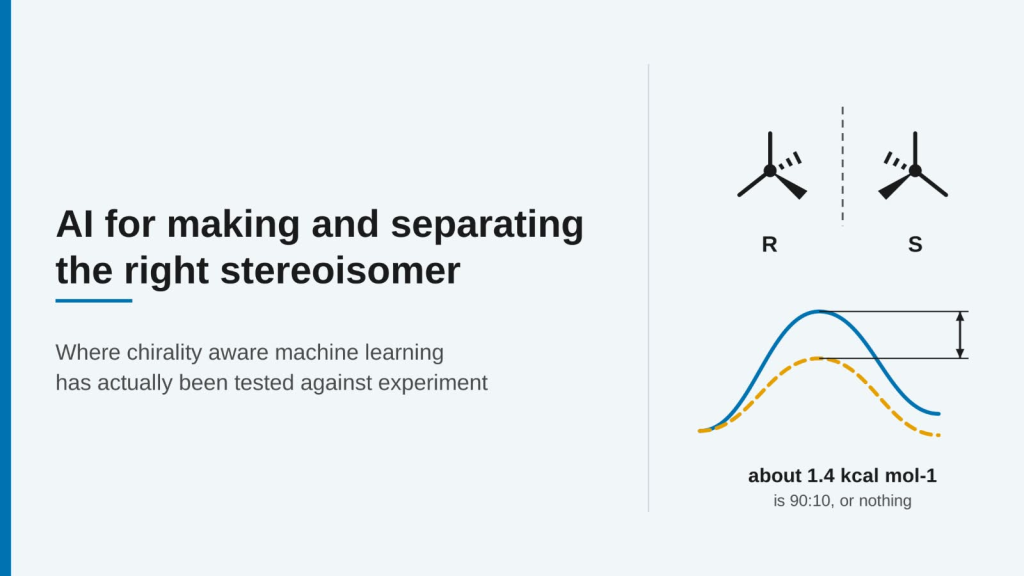
Where chirality aware machine learning has actually been tested against experiment
Summary
This is the part of the field with a genuine experimental track record. Models have proposed catalysts, enzyme variants, reactions and resolving agents that were then made and tested, and that worked. A model designed resolution screen resolved three of six previously unseen racemates in a single round; transfer learned reaction prediction guided a real fourteen step stereoselective synthesis; machine learning guided evolution produced enzyme variants selective for either enantiomer of a new to nature reaction. But the demonstrations are narrow, extrapolation beyond the training region remains the persistent failure mode, and at least one industrial study found the machine directed route did not produce the best variant. This article separates what has been prospectively demonstrated from what has been benchmarked.
Key takeaways
- Prospective evidence exists here and almost nowhere else in this series, across asymmetric catalysis, biocatalysis, reaction prediction and crystallisation based resolution.
- The energy window is brutally narrow. Roughly 1.4 kcal mol-1 separates a 90:10 outcome from a racemic one, which is at or below the error of routine quantum chemistry, the reason descriptor design matters so much.
- Extrapolation is the binding constraint. Models perform well within a catalyst family and degrade outside it; a purpose built industrial dataset was published partly to document this.
- Machine directed evolution does not always win. In one pharmaceutical campaign it produced a dramatically better library, but the best final variant came from conventional methods.
- Data release may matter more than architecture. The strongest prospective result in this series accompanied the publication of a previously proprietary dataset of over 6,000 resolution experiments.
Opening: from predicting consequences to controlling outcomes
Episode 3 ended somewhere uncomfortable. Predicting how two enantiomers differ in a patient is the question that motivates this whole field, and it is the question the evidence supports least well.
Making the one you want is different. Here the target is measurable, the feedback loop is short, and the outputs, a catalyst, a set of conditions, a resolving agent, are things a model can propose and a chemist can test next week. That combination has produced most of the field’s real experimental validation.
The central problem: predicting very small energy differences
Enantioselectivity is set by the difference in activation free energy between two competing diastereomeric transition states. The scale is unforgiving: a difference of about 1.4 kcal mol-1 gives roughly 90:10 er at room temperature, and about 2.7 kcal mol-1 gives roughly 99:1.
The entire useful range is therefore a couple of kilocalories per mole, comparable to, or smaller than, the typical error of routine density functional calculations. This is why the field did not simply scale up quantum chemistry. It is also why descriptor design has mattered more here than architecture, and why the first successes came from physical organic chemists rather than machine learning specialists.
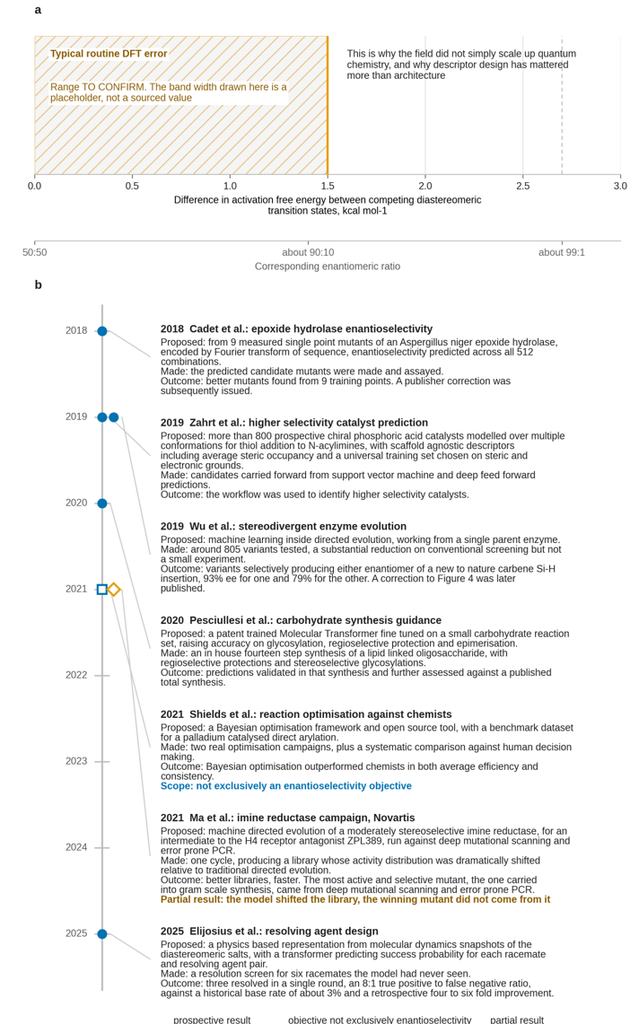
The density functional error band is drawn as a placeholder and marked TO CONFIRM, since no numeric range is cited in the text.
Descriptor based machine learning in asymmetric catalysis
Case study 1: the Denmark workflow, and its limits
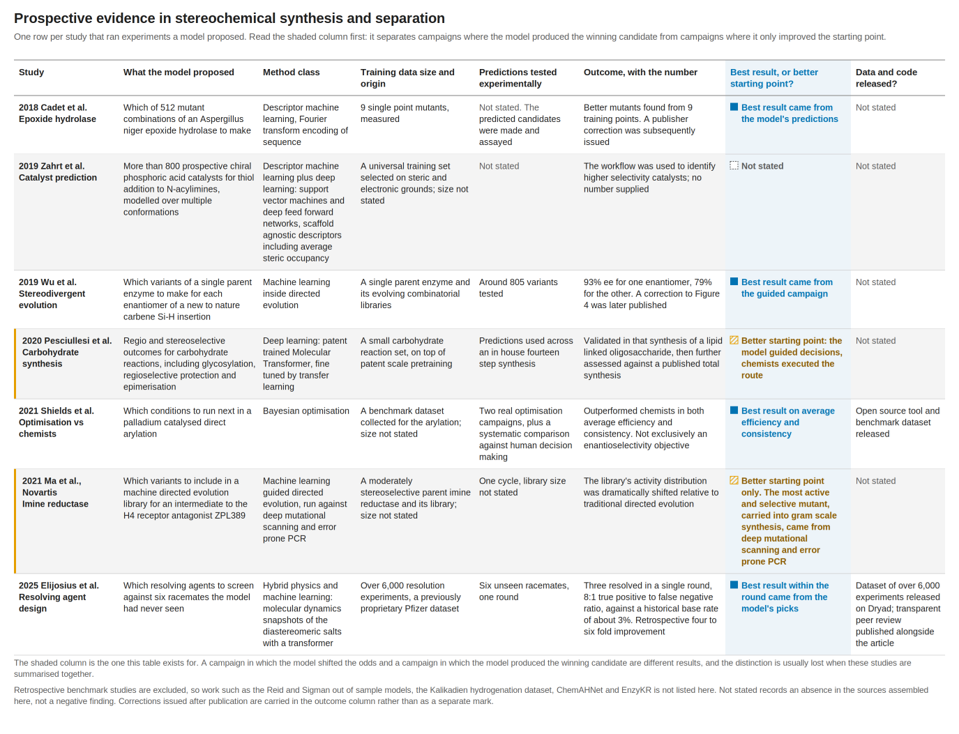
Zahrt et al. (2019) set the template. Working on the chiral phosphoric acid catalysed addition of thiols to N-acylimines, they modelled multiple conformations of more than 800 prospective catalysts and built descriptors including average steric occupancy, a grid-based measure of where atoms sit across the conformer ensemble deliberately designed to be agnostic to catalyst scaffold. Scaffold-agnostic descriptors allowed a universal training set to be selected on steric and electronic grounds rather than by chemical intuition. Support vector machines and deep feed-forward networks trained on a subset of experimental results then predicted selectivity across a broad range, and the workflow was used to identify higher-selectivity catalysts.
Reid and Sigman (2019) extended the idea in a different direction: rather than one reaction, they pooled published enantioselectivity datasets for BINOL-derived chiral phosphoric acids across a range of nucleophilic additions to imines, and built statistical models from one set of reactions that predicted out-of-sample reactions. Their own interpretation is worth keeping: the transferability suggests the transition-state features are fundamentally similar across these reactions which is a statement about that reaction family, not a general licence to transfer models.
The counterpoint. Kalikadien et al. (2024), working with Janssen, built a high-throughput experimentation dataset for rhodium-catalysed asymmetric olefin hydrogenation specifically designed for machine learning, together with an automated, reproducible framework for quantum-chemical featurisation of catalyst structures. They showcased its alignment with existing literature while addressing observed discrepancies and reported where models fail to extrapolate to new ligands. Fifty years after the first enantioselective hydrogenation, they note, selecting a ligand for a new prochiral olefin remains an empirical exercise. Publishing that finding, from an industrial collaboration, is more useful to a practitioner than another benchmark win.
Predicting which enantiomer, not just how much
Most selectivity models predict a magnitude. The chemically prior question is which enantiomer forms.
Cheng et al. (2026) address this with ChemAHNet, a deep learning model built around the mechanism of olefin asymmetric hydrogenation. Using three structure-aware modules, it predicts the absolute configuration of the major enantiomer across diverse catalysts and substrates, and handles olefins with two prochiral centres a case earlier models, largely restricted to single prochiral sites, could not treat. It operates on SMILES inputs alone while claiming to capture atomic-level spatial and electronic interactions, and the authors report it extends to other asymmetric catalytic reactions. Code is deposited on Zenodo.
This is recent, single group work without independent replication, and the claim that SMILES only inputs suffice sits in tension with Episode 1’s argument about representation, a tension worth watching rather than resolving prematurely.
Working with very little data
Published selectivity data are sparse and unevenly distributed. Three strategies dominate.
Meta-learning. Singh and Hernández-Lobato (2025) applied Bayesian meta-learning to few-shot reaction outcome prediction for asymmetric hydrogenation of olefins, explicitly targeting the modelling difficulty created by sparse literature datasets.
Bayesian optimisation. Shields et al. (2021) built a framework and open-source tool, collected a benchmark dataset for a palladium-catalysed direct arylation, and importantly ran a systematic comparison against human decision-making plus two real optimisation campaigns. Bayesian optimisation outperformed chemists in both average efficiency and consistency. This is prospective evidence, though not exclusively for enantioselectivity objectives.
Mechanistic models. As Episode 3 noted with racemisation prediction, a physically grounded model with a handful of parameters can beat a learned one when data are scarce. This is a real methodological competitor, not a historical footnote.
Biocatalysis: the strongest prospective record, and an honest defeat
Enzymes are where model-proposed changes have most often been made and measured.
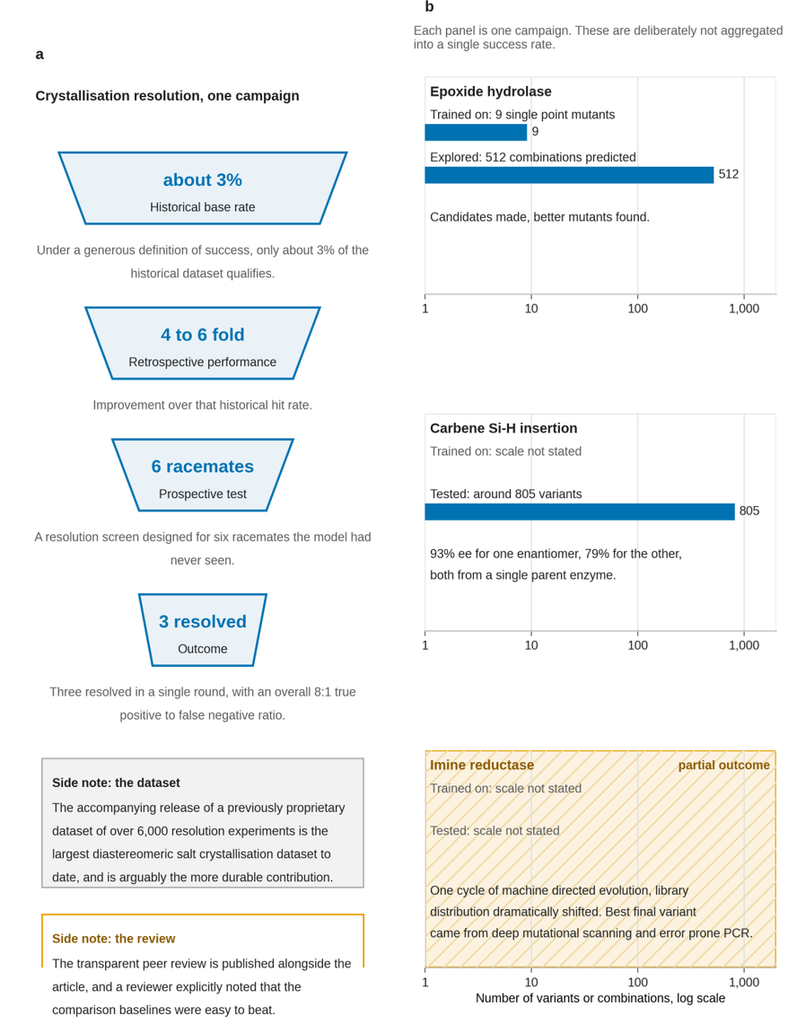
Cadet et al. (2018) trained on just nine single-point mutants of an Aspergillus niger epoxide hydrolase, using a Fourier-transform encoding of sequence, then predicted enantioselectivity across all 512 combinations. Predicted candidates were made, and better mutants were found. Nine training points is a striking demonstration of what mechanistic structure in the encoding can buy. (A publisher correction was subsequently issued.)
Wu et al. (2019) went further, using machine learning within directed evolution to achieve stereodivergence: evolving from a single parent enzyme, they obtained variants selectively producing either enantiomer of a new-to-nature carbene Si–H insertion, reaching 93% ee for one enantiomer and 79% for the other. Around 805 variants were tested in total a substantial reduction relative to conventional screening, but not a small experiment. (A correction to Figure 4 was later published.)
Then the honest defeat. Ma et al. (2021), a large Novartis team, evaluated machine-directed evolution against deep mutational scanning and error-prone PCR on a moderately stereoselective imine reductase, targeting an intermediate to the H4 receptor antagonist ZPL389. Within a single cycle, machine-directed evolution produced a library whose activity distribution was dramatically shifted relative to traditional directed evolution a real and useful result. But the most active and selective mutant, the one carried into gram-scale synthesis, was identified through deep mutational scanning and error-prone PCR.
Read carefully, that is not a failure of the method; it is a precise statement of what it delivered. Better libraries, faster. Not, in this campaign, the winning variant. Studies reporting this distinction are more valuable than studies that do not.
Ran et al. (2023), discussed in Episode 3, complements this on the selection side: predicting which hydrolase will resolve a given racemate rather than engineering one.
Reaction prediction with real synthetic validation
Pesciullesi et al. (2020) fine-tuned a general patent-trained Molecular Transformer on a small set of carbohydrate reactions, where regio- and stereoselectivity are notoriously hard to predict because outcomes depend on the surroundings of otherwise similar functional groups. Accuracy on glycosylation, regioselective protection and epimerisation rose substantially and the predictions were validated experimentally in an in-house fourteen-step synthesis of a lipid-linked oligosaccharide involving regioselective protections and stereoselective glycosylations, then further assessed against a published total synthesis.
This remains one of the clearest cases in the field of a stereochemical prediction model being used to guide real synthetic decisions rather than to score a test set.
Case study 2: prospective resolving-agent design
Diastereomeric salt resolution has been practised for over a century, and choosing the resolving agent has remained essentially trial and error. Elijošius et al. (2025) combined a physics-based representation derived from molecular dynamics snapshots of the diastereomeric salts and the differences between them with a transformer-based network to predict the probability of success for a racemate–resolving agent pair.
Retrospectively, this gave a four- to six-fold improvement over the historical hit rate. Prospectively, the model designed a resolution screen for six racemates it had never seen; three were resolved in a single round, with an overall 8:1 true-positive to false-negative ratio.
Two things make this the most instructive result in the episode. First, the baseline: under a generous definition of success, only about 3% of the historical dataset qualifies, which conveys how punishing the underlying screening problem is. Second, and unusually, the paper’s transparent peer review is published alongside it a reviewer explicitly noted the comparison baselines were easy to beat. Being able to read that exchange is a model for how this field should report itself.
The team also released a previously proprietary Pfizer dataset of over 6,000 resolution experiments, the largest diastereomeric salt crystallisation dataset to date. It is arguable that the dataset is the more durable contribution.
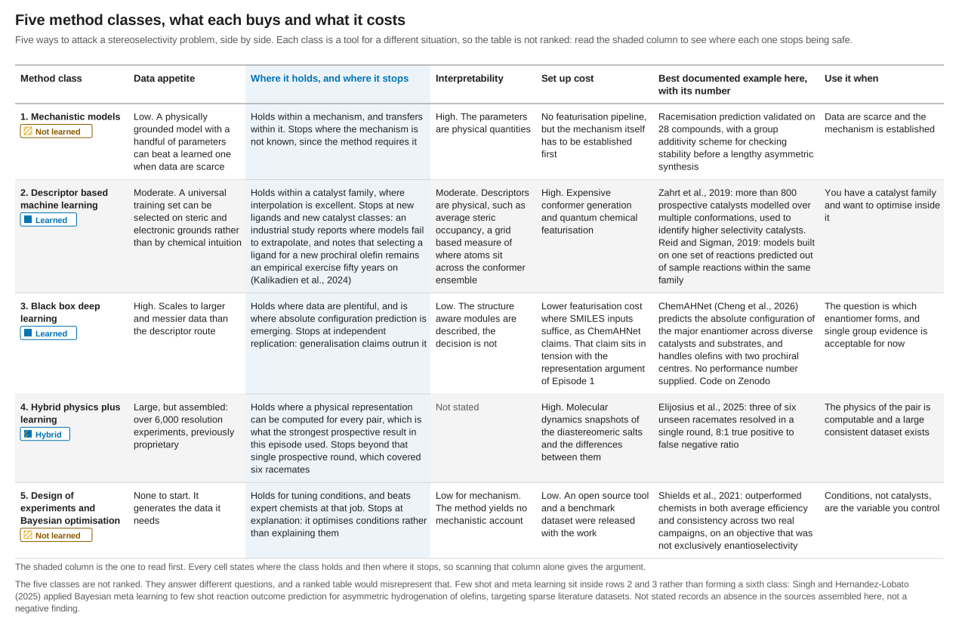
Mechanistic models are data-efficient, interpretable and transferable within a mechanism, but require the mechanism to be known. Descriptor-based ML dominates asymmetric catalysis, works well within a catalyst family, and depends on expensive conformer and quantum-chemical featurisation. Black-box deep learning scales to larger, messier data and is where absolute-configuration prediction is emerging, but generalisation claims outrun independent replication. Hybrid physics-plus-learning produced the strongest prospective result here, which is unlikely to be coincidence. Design of experiments and Bayesian optimisation optimise conditions rather than explaining them and beat expert chemists at that job.
Proposals that survive contact with a flask. Catalysts, variants, conditions and resolving agents that were predicted, made and worked.
Reduced screening burden, which for resolution and enzyme engineering is the dominant cost.
Datasets. The industrial releases accompanying this work Pfizer’s resolution data, the Janssen hydrogenation set will outlast the models trained on them.
Current Limitations and Evidence Gaps
- Extrapolation to new catalyst classes and substrate types remains unsolved, and is documented as such in industrial work.
- Prospective tests are small: six racemates, one synthesis, one enzyme campaign each.
- Negative results are systematically unpublished, which biases every model trained on the literature.
- Absolute-configuration prediction rests on single-group results.
- Scale-up and process development are barely represented. I did not search patent literature for this article, and process evidence may well sit there; claims here are correspondingly limited to the peer-reviewed record.
- Deracemization, preferential crystallisation and conglomerate prediction remain largely untouched by machine learning.
Implications for Drug Discovery and Development
For process chemistry, resolving-agent prediction is ready to trial, with a public dataset and a published prospective result treated as a screen designer, not an oracle.
For biocatalysis groups, machine-directed evolution reliably improves libraries; whether it delivers the final variant is campaign-dependent, and the Novartis result argues for running it alongside, not instead of, established methods.
For catalysis groups, expect strong interpolation and weak extrapolation. A model trained on your catalyst family will help you optimise within it and mislead you outside it.
Contribute failed experiments. The single most valuable thing an organisation can do here is release data on what did not work.
Everything in this episode is a component: a model that proposes, a chemist who executes, an instrument that measures. Episode 5 asks whether those components can be joined into a closed loop that designs stereochemically defined molecules, plans routes to them, runs the experiments, measures enantiomeric excess and decides what to do next and examines whether current generative and foundation models can specify stereochemistry reliably enough for that loop to be worth closing.
Cadet F, Fontaine N, Li G, Sanchis J, Ng Fuk Chong M, Pandjaitan R, Vetrivel I, Offmann B, Reetz MT. A machine learning approach for reliable prediction of amino acid interactions and its application in the directed evolution of enantioselective enzymes. Scientific Reports. 2018;8:16757. DOI: 10.1038/s41598-018-35033-y Publisher Correction: DOI: 10.1038/s41598-021-86884-x
Cheng L, Shao P-L, Lv J, Xiao H, Sun Y, Yang J, Xu Z, Lv M, Wang G, Zhao S, Li J, Jin Z, Tan X, Xing G, Zhang B. Chemistry-informed deep learning model for predicting stereoselectivity and absolute configuration in asymmetric hydrogenation. Nature Computational Science. 2026;6(2):145–155. DOI: 10.1038/s43588-025-00920-8 · PubMed 41350458
Elijošius R, King-Smith E, Faber FA, Bernier L, Berritt S, Farrell WP, Hou X, Klug-McLeod JL, Mustakis J, Sach NW, Yang Q, Howard RM, Lee AA. Predictive design of crystallographic chiral separation. Nature Communications. 2025;16(1):7977. DOI: 10.1038/s41467-025-62825-4
Kalikadien AV, Valsecchi C, van Putten R, Maes T, Muuronen M, Dyubankova N, Lefort L, Pidko EA. Probing machine learning models based on high throughput experimentation data for the discovery of asymmetric hydrogenation catalysts. Chemical Science. 2024;15. DOI: 10.1039/d4sc03647f
Ma EJ, Siirola E, Moore C, Kummer A, Stoeckli M, Faller M, Bouquet C, Eggimann F, Ligibel M, Huynh D, Cutler G, Siegrist L, Lewis RA, Acker A-C, Freund E, Koch E, Vogel M, Schlingensiepen H, Oakeley EJ, Snajdrova R. Machine-Directed Evolution of an Imine Reductase for Activity and Stereoselectivity. ACS Catalysis. 2021;11(20):12433–12445. DOI: 10.1021/acscatal.1c02786
Pesciullesi G, Schwaller P, Laino T, Reymond J-L. Transfer learning enables the molecular transformer to predict regio- and stereoselective reactions on carbohydrates. Nature Communications. 2020;11:4874. DOI: 10.1038/s41467-020-18671-7
Ran X, Jiang Y, Shao Q, Yang ZJ. EnzyKR: a chirality-aware deep learning model for predicting the outcomes of the hydrolase-catalyzed kinetic resolution. Chemical Science. 2023;14(43):12073–12082. DOI: 10.1039/d3sc02752j
Reid JP, Sigman MS. Holistic prediction of enantioselectivity in asymmetric catalysis. Nature. 2019;571(7765):343–348. DOI: 10.1038/s41586-019-1384-z
Shields BJ, Stevens J, Li J, Parasram M, Damani F, Martinez Alvarado JI, Janey JM, Adams RP, Doyle AG. Bayesian reaction optimization as a tool for chemical synthesis. Nature. 2021;590(7844):89–96. DOI: 10.1038/s41586-021-03213-y
Singh S, Hernández-Lobato JM. Bayesian Meta-Learning for Few-Shot Reaction Outcome Prediction of Asymmetric Hydrogenation of Olefins. Angewandte Chemie International Edition. 2025:e202503821. DOI: 10.1002/anie.202503821
Wu Z, Kan SBJ, Lewis RD, Wittmann BJ, Arnold FH. Machine learning-assisted directed protein evolution with combinatorial libraries. Proceedings of the National Academy of Sciences USA. 2019;116(18):8852–8858. DOI: 10.1073/pnas.1901979116 · PubMed 30979809 Correction (Figure 4): PNAS. 2020;117(1):788–789. DOI: 10.1073/pnas.1921770117
Zahrt AF, Henle JJ, Rose BT, Wang Y, Darrow WT, Denmark SE. Prediction of higher-selectivity catalysts by computer-driven workflow and machine learning. Science. 2019;363(6424):eaau5631. DOI: 10.1126/science.aau5631 · PubMed 30655414
Datasets, software and technical resources
Diastereomeric salt resolution dataset (>6,000 experiments) accompanying Elijošius et al. (2025), Dryad: DOI 10.5061/dryad.d2547d89c
ChemAHNet code and data, Zenodo: DOI 10.5281/zenodo.17346605
Transparent peer review file for Elijošius et al. (2025), published alongside the article.
No preprints are cited in this episode; all sources are peer-reviewed.