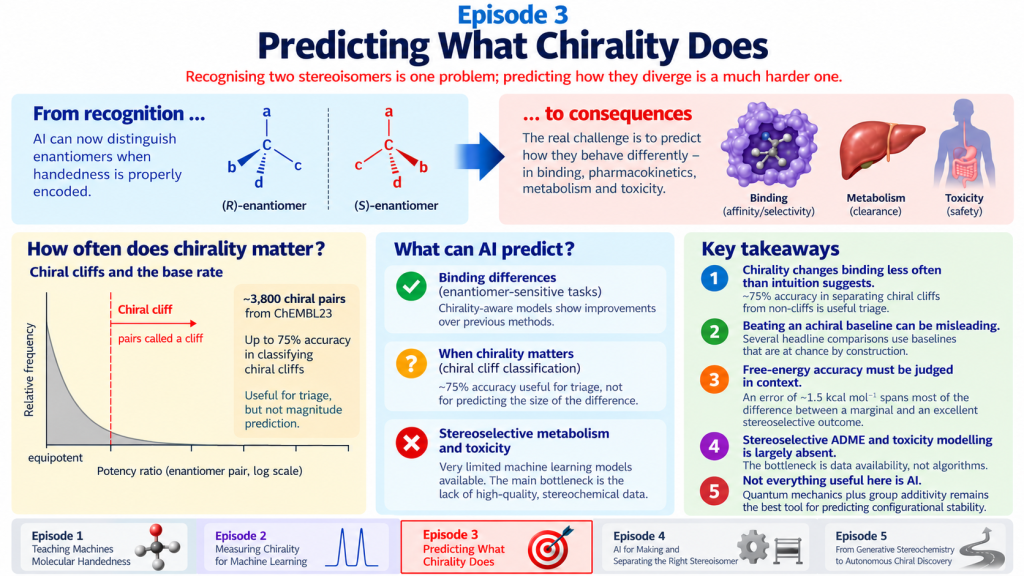
Recognising two stereoisomers is one problem; predicting how they diverge is a much harder one
Summary
The reason to build chirality-aware models is not to classify stereocentres but to predict consequences: which enantiomer binds, which is cleared faster, which carries the toxicity. This is where the evidence base is thinnest. Chirality-aware architectures win on benchmark tasks, but several of those tasks are ones an achiral model must fail by construction, which makes the comparison less informative than it appears. Stereoselective metabolism and toxicity arguably the questions of greatest practical consequence have almost no dedicated machine learning, and a recent systematic review identifies missing data rather than missing algorithms as the obstacle. This article examines what has been shown, what has been assumed, and why evaluation design deserves more scrutiny here than anywhere else in the series.
Key takeaways
- Chirality changes binding less often than intuition suggests, and models can partly predict when. Roughly 75% accuracy in separating chiral cliffs from non-cliffs across about 3,800 pairs is useful triage, not magnitude prediction.
- Beating an achiral baseline is a weak result when that baseline is at chance by construction. Several headline comparisons in this area have this structure.
- Free-energy accuracy has to be judged against the free-energy window that matters. An error of ~1.5 kcal mol⁻¹ spans most of the difference between a marginal and an excellent stereoselective outcome.
- Stereoselective ADME and toxicity modelling is largely absent, and the bottleneck is data availability, not method development.
- Not everything useful here is AI. The best available tool for predicting configurational stability is quantum mechanics plus group additivity, and it works well.
Opening: from labels to consequences
Episode 1 established that handedness must be encoded before a model can see it. Episode 2 showed how the labels themselves are measured, and how machine learning is compressing that measurement. Both are enabling steps. Neither is the reason anyone cares.
The reason is that two enantiomers can behave as different drugs. Predicting how they will differ, before making both, is the payoff and it is where the evidence gets uncomfortable.
The central problem: predicting a difference, not a property
Standard molecular property prediction asks: given this structure, what is this property? Stereochemical prediction asks something harder: given two structures with identical composition, connectivity and physicochemical descriptors, what is the difference between them?
Three things make this difficult. The difference is often small relative to assay noise, so the signal a model must learn can sit below the reproducibility of the training data. The difference is frequently zero, meaning a model that always predicts “no difference” can score well. And when the difference is large, it is often large for reasons a specific contact in a specific pocket that generalise poorly to other targets.
How often does chirality actually matter?
Case study 1: chiral cliffs and the base rate
Schneider et al. (2018) asked the question directly. Working from about 3,800 chiral pairs extracted from ChEMBL23, they developed novel 2D descriptors intended to capture the general features of a chiral centre, and trained machine learning models to classify pairs as chiral cliffs where configuration substantially changes binding or not. They reached accuracy of up to 75%, and released their dataset, descriptors and code.
The framing of their conclusion is more valuable than the accuracy figure. They derived guidance on when a racemate can reasonably be used in an assay and when an enantiopure compound is required. That is a triage decision a project team actually faces, and 75% accuracy is enough to inform it while remaining clearly insufficient to replace measurement.
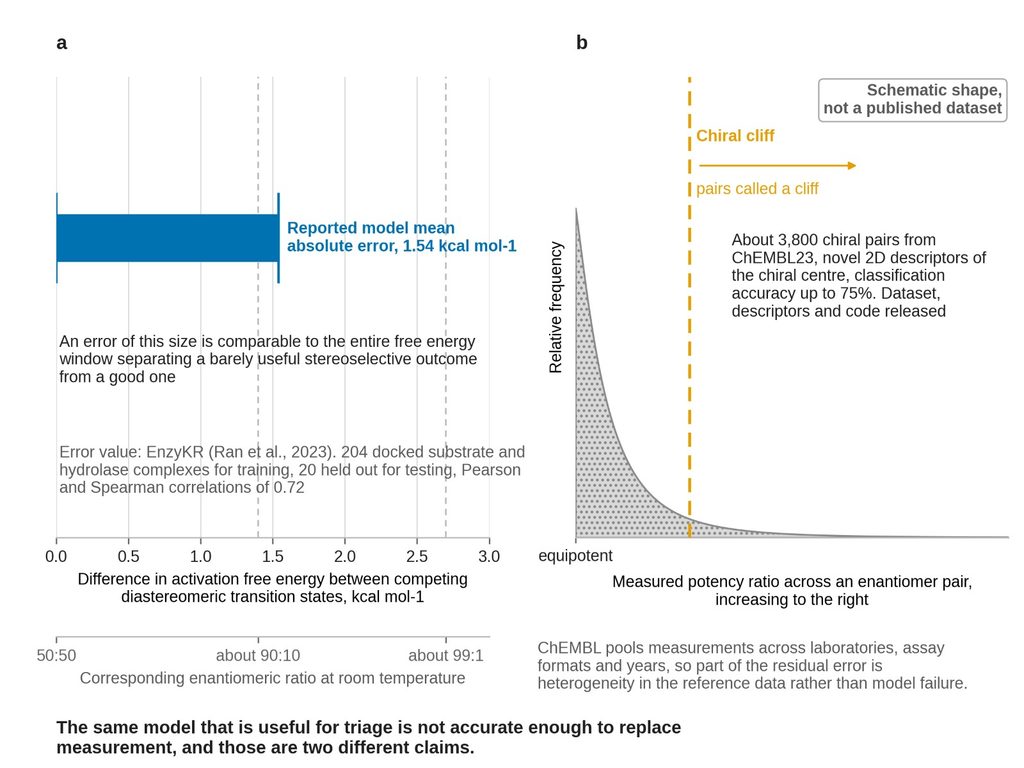
Two limitations deserve emphasis. The descriptors are two-dimensional, capturing the environment of the stereocentre rather than its three-dimensional consequences. And ChEMBL pools measurements across laboratories, assay formats and years, so some of the residual 25% is heterogeneity in the reference data rather than model failure.
Binding: strong benchmark results, weak external evidence
The chirality-aware architectures from Episode 1 are typically evaluated in part on enantiomer-sensitive binding tasks. Adams et al. (2022) included ranking enantiomers by docking score in an enantiosensitive protein pocket among ChIRo’s four benchmarks; Gaiński et al. (2023) evaluated ChiENN on chiral-sensitive property prediction and reported improvements over prior chirality-aware methods.
Both results are real. Both should be read with a specific caution. On a task that requires distinguishing enantiomers, an achiral model cannot do better than chance not because it is a poor model, but because the two inputs are identical to it. Reporting that a chirality-aware model beats it establishes that the architecture works as designed. It does not establish that the model predicts binding differences accurately, only that it predicts them at all. The informative comparison is against another chirality-aware method, and against measured affinities rather than docking scores.
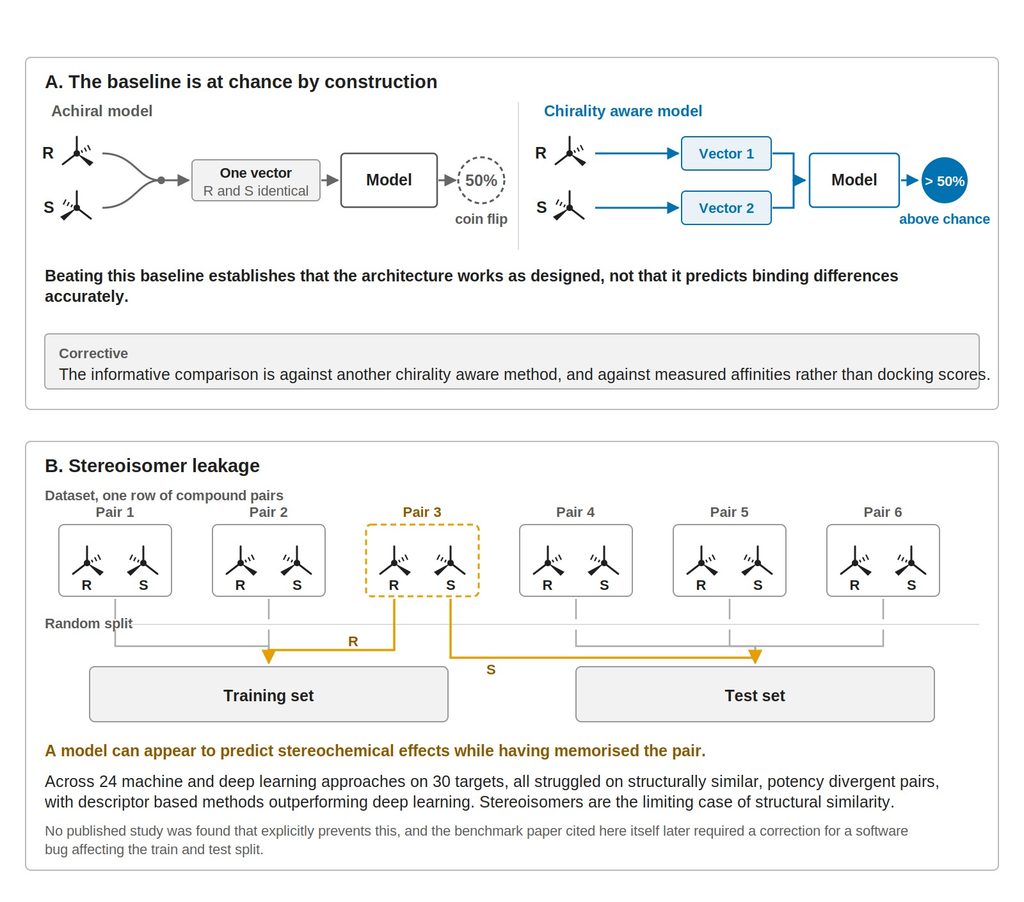
Docking scores are the other caveat. They are a computational proxy, and a model trained to rank them has learned to reproduce a scoring function, not experimental potency.
Chiral recognition beyond proteins
Enantioselective recognition is not confined to protein pockets, and host–guest systems offer cleaner, better-controlled data. Tahıl et al. (2024) came to stereochemical representation through exactly this route: their original objective was predicting the association constant between a cyclodextrin and a guest molecule, and the representational failure they documented that widely used embeddings cannot separate stereoisomers emerged as an obstacle to that task rather than as an abstract concern.
This is worth noting because supramolecular chiral recognition underpins both chiral chromatography (Episode 2) and chiral sensing, and it produces data under more consistent conditions than pooled bioactivity databases.
Disposition, metabolism and configurational stability
Here the picture changes sharply.
Okunlola and Aleku (2026), in a systematic review of stereoselective biotransformation, note that although the importance of stereochemistry in drug efficacy is well established, its role in metabolism and disposition remains comparatively underexplored despite drug-metabolising enzymes being inherently stereoselective, and despite the high prevalence of chiral drugs among newly approved medicines. They identify stereoselectivity prediction as a shared challenge for both DMPK and biocatalysis communities, and importantly for the argument of this series locate the obstacle in data availability. Making metabolism datasets accessible, whether through industry–academic collaboration or public release, is presented as the prerequisite for developing AI models of stereoselective biotransformation.
That is a review-level judgement, and I am citing it as such rather than as evidence for a specific experimental result. But it aligns with what I could and could not find: mainstream ADMET prediction tools remain stereochemistry-agnostic, and I located no chirality-aware model for clearance, transporter interaction or toxicity validated on enantiomer pairs.
One adjacent problem has been solved well, and it illustrates a distinction this series keeps returning to. Ballard et al. (2018) addressed configurational stability: will a stereocentre survive in aqueous conditions, or racemise? They measured racemisation kinetics for 28 compounds using circular dichroism and ¹H NMR, then showed that rate constants correlate well with deprotonation energies from quantum mechanical calculations, and built a group-additivity scheme allowing chemists to check configurational stability before committing to a lengthy asymmetric synthesis.
This is a genuinely useful predictive tool and it is not machine learning. It is physical organic chemistry plus quantum mechanics plus a group-contribution model. Describing it as AI would be exactly the category error the series is trying to avoid, and it is a reminder that in low-data regimes a mechanistic model can outperform a learned one.
Enzyme stereoselectivity: the informative exception
Case study 2: EnzyKR, and reading free-energy errors correctly
Ran et al. (2023) built EnzyKR to predict which hydrolase will resolve a given racemate. Its architecture is deliberately chirality-aware: a classifier first identifies the reactive binding conformer of a substrate–hydrolase complex, then a regressor predicts its activation free energy, with a structure-based encoding designed to represent the chiral interactions between enzyme and enantiomer. This distinguishes it from models trained on protein sequences and substrate SMILES, which face the representational problem of Episode 1.
Training used 204 substrate–hydrolase complexes constructed by docking; testing used a held-out set of 20. On activation free energy the model achieved Pearson and Spearman correlations of 0.72 and a mean absolute error of 1.54 kcal mol⁻¹.
That error figure needs context to be meaningful. A difference in activation free energy of roughly 1.4 kcal mol⁻¹ corresponds to an enantiomeric ratio of about 90:10 at room temperature. An error of 1.54 kcal mol⁻¹ on individual complexes is therefore comparable to the entire free-energy window separating a barely useful stereoselective reaction from a good one. This is why the model’s other result is the more meaningful one: on 28 enantiomeric pairs, EnzyKR correctly predicted the favoured enantiomer and outperformed the DLKcat baseline in 18 cases 64% of the test set. Predicting which enantiomer, with a genuine comparator, on a modest margin, is an honest and interpretable claim. It is also a small test set built from docked rather than experimental structures.
The evaluation problem
This is where I would concentrate scepticism.
Random splits inflate performance on close analogues. The general result is established: van Tilborg et al. (2022) benchmarked 24 machine and deep learning approaches across 30 targets and found that all struggled on structurally similar, potency-divergent pairs, with descriptor-based methods outperforming deep learning. Stereoisomers are the limiting case of structural similarity, so the effect should be at least as strong.
Stereoisomer leakage is not controlled for. If (R)- and (S)- forms of the same compound land on opposite sides of a split, a model can appear to predict stereochemical effects while having memorised the pair. I found no published study that explicitly prevents this.
Splitting errors are easy to miss. The van Tilborg paper itself later required a correction for a software bug affecting the train–test split. The authors report the conclusions were unchanged; the episode is instructive precisely because this was a careful, methodologically self-aware team.
Chiral materials, sensing and spin selectivity
What AI Adds
Triage. Predicting whether configuration will matter, before spending on enantiopure synthesis and separate assays, is a decision-relevant output that Schneider et al. showed is partly learnable.
Enantiomer ranking where mechanism is inaccessible. EnzyKR predicts which enantiomer a hydrolase will favour without a transition-state calculation per complex.
Making an absence visible. The most useful contribution of chirality-aware modelling to DMPK so far has been to demonstrate that the data to support it do not yet exist.
Current Limitations and Evidence Gaps
- No chirality-aware ADME, clearance or toxicity model validated on enantiomer pairs. This is the single largest gap in the series.
- Benchmarks are dominated by docking scores and computed labels, not measured differential potency.
- Achiral baselines are frequently uninformative because they are at chance by construction.
- No stereoisomer-aware splitting protocol exists, so reported performance on chirality tasks cannot yet be cleanly interpreted.
- Free-energy errors are often reported without reference to the selectivity window they need to resolve.
- CISS prediction is aspirational, with computed rather than experimental ground truth.
Implications for Drug Discovery and Development
Three practical positions follow.
Use models to decide where to spend, not what to conclude. Chiral-cliff-style triage can rationally inform whether to progress a racemate or invest in single enantiomers, provided the output is treated as a prior rather than a result.
Do not expect stereoselective DMPK predictions to be available soon, and treat any tool claiming them with scrutiny about its training data. Configurational stability is the exception there is a well-validated approach, and it is mechanistic.
If your organisation holds enantiomer-paired ADME data, its scientific value is disproportionate. The reviewed literature identifies exactly this data type as the missing foundation. Contributing it, even in aggregate, would do more for the field than another architecture.
What Comes Next
Prediction of consequences is the weak link. Making the preferred stereoisomer is not. Episode 4 turns to asymmetric synthesis, catalysis, biocatalysis and separation the part of this field where models have moved beyond retrospective benchmarking into prospective, experimentally confirmed contribution, including reactions run because a model proposed them and resolving agents that worked on racemates no model had seen.
References
Adams K, Pattanaik L, Coley CW. Learning 3D Representations of Molecular Chirality with Invariance to Bond Rotations. Proceedings of the Tenth International Conference on Learning Representations (ICLR). 2022. Conference paper, no DOI assigned. Preprint: arXiv:2110.04383
Ballard A, Ahmad HO, Narduolo S, Rosa L, Chand N, Cosgrove DA, Varkonyi P, Asaad N, Tomasi S, Buurma NJ, Leach AG. Quantitative Prediction of Rate Constants for Aqueous Racemization To Avoid Pointless Stereoselective Syntheses. Angewandte Chemie International Edition. 2018;57(4):982–985. DOI: 10.1002/anie.201709163 · PubMed 29072355
Gaiński P, Koziarski M, Tabor J, Śmieja M. ChiENN: Embracing Molecular Chirality with Graph Neural Networks. In: Machine Learning and Knowledge Discovery in Databases: Research Track (ECML PKDD 2023). Lecture Notes in Computer Science, vol 14171. Springer, Cham; 2023:36–52. DOI: 10.1007/978-3-031-43418-1_3
Ran X, Jiang Y, Shao Q, Yang ZJ. EnzyKR: a chirality-aware deep learning model for predicting the outcomes of the hydrolase-catalyzed kinetic resolution. Chemical Science. 2023;14(43):12073–12082. DOI: 10.1039/d3sc02752j · PubMed 37969577
Schneider N, Lewis RA, Fechner N, Ertl P. Chiral Cliffs: Investigating the Influence of Chirality on Binding Affinity. ChemMedChem. 2018;13(13):1315–1324. DOI: 10.1002/cmdc.201700798 · PubMed 29749719
Tahıl G, Delorme F, Le Berre D, Monflier É, Sayede A, Tilloy S. Stereoisomers Are Not Machine Learning’s Best Friends. Journal of Chemical Information and Modeling. 2024;64(14):5451–5469. DOI: 10.1021/acs.jcim.4c00318 · PubMed 38949069
van Tilborg D, Alenicheva A, Grisoni F. Exposing the Limitations of Molecular Machine Learning with Activity Cliffs. Journal of Chemical Information and Modeling. 2022;62(23):5938–5951. DOI: 10.1021/acs.jcim.2c01073 · PubMed 36456532 Corrections published, cited for transparency; authors state conclusions unchanged: DOI: 10.1021/acs.jcim.3c00423 and DOI: 10.1021/acs.jcim.3c01576 (software bug affecting train/test splitting).
Reviews and perspectives
Gupta R, Balo A, Garg R, Mondal AK, Banerjee Ghosh K, Mondal PC. The chirality-induced spin selectivity effect in asymmetric spin transport: from solution to device applications. Chemical Science. 2024;15(45):18751–18771. DOI: 10.1039/d4sc05736h
Okunlola GA, Aleku GA. Stereoselective Biotransformation: Transfer of Learning to Advance Drug Metabolism and Biocatalysis. Angewandte Chemie International Edition. 2026:e202526152. DOI: 10.1002/anie.202526152
Datasets, software and technical resources
Chiral cliffs dataset, descriptors and Python code accompanying Schneider et al. (2018), provided with the publication.
MoleculeACE benchmarking platform (activity cliff evaluation): https://github.com/molML/MoleculeACE