How chirality and geometric isomerism shape the biology, sourcing and value of a remarkable carotenoid
Introduction
What if a molecule could exist in several distinct forms, all having the same molecular formula but differing in their three-dimensional arrangement and geometry?
Astaxanthin is a naturally occurring xanthophyll carotenoid known for its characteristic red-orange colour and antioxidant properties. It occurs naturally in selected microalgae, yeast, bacteria and other organisms, and has attracted considerable interest in food, aquaculture, nutraceutical and other applications [1,2]. But astaxanthin is more than a colourful antioxidant. Its molecular structure contains two stereogenic centres and an extended system of conjugated double bonds. These structural features give rise to two important dimensions of isomerism: configurational (optical) isomerism and geometrical isomerism [1,3].
The three configurational forms, together with four principal geometrical forms—all-trans, 9-cis, 13-cis and 15-cis—provide the basis for the fascinating “Tale of 7 Isomers.” [1,3,4]. This makes astaxanthin an excellent example of a central principle of chiral science:
The molecular formula alone does not tell the whole story; molecular three-dimensional structure matters.
A Colourful Molecule with a Chiral Identity
Astaxanthin has the molecular formula C₄₀H₅₂O₄ and possesses a carotenoid backbone containing an extended conjugated polyene system. Chemically, it is described as 3,3′-dihydroxy-β,β-carotene-4,4′-dione [1].
The molecule contains two stereogenic centres at positions 3 and 3′, located on the terminal rings at either end of the molecule. These centres are responsible for its configurational stereoisomerism [1]. The name itself has an interesting connection with nature. The prefix “Asta” is associated with Astacus, the lobster genus, while “xanthin” derives from the Greek word associated with yellow. Astaxanthin, however, can contribute to striking yellow, orange and red colours in nature.
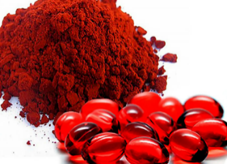
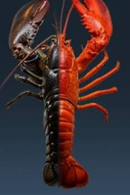
Astaxanthin is produced naturally by a limited number of microorganisms and plants, where it is associated with protection against light-induced stress [1,2]. Its molecular architecture therefore provides the starting point for understanding its remarkable isomeric diversity.
The First Three: Configurational Isomers
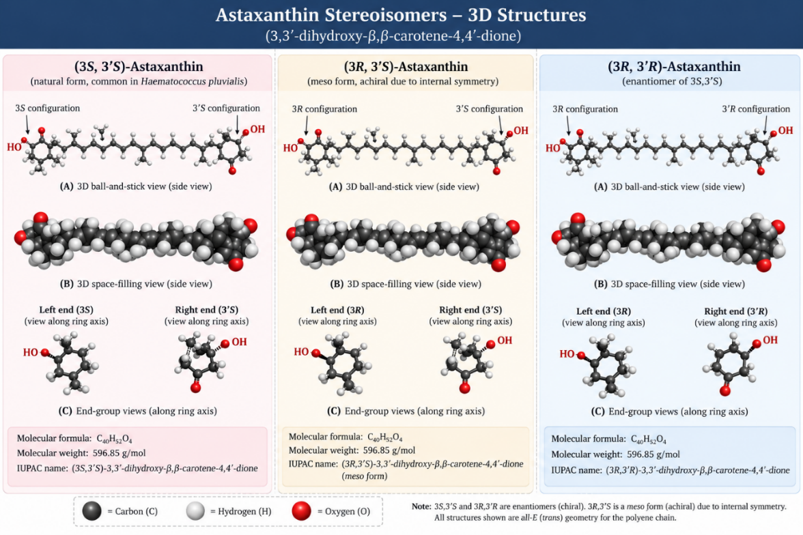
The two stereogenic centres of astaxanthin give rise to three configurational stereoisomers:
- (3S,3′S)-astaxanthin
- (3R,3′R)-astaxanthin
- (3R,3′S)-astaxanthin — the meso form [1]
The (3S,3′S) and (3R,3′R) forms are enantiomers—non-superimposable mirror images of one another. The (3R,3′S) form is a meso form because of its internal symmetry and is therefore optically inactive [1]. This provides a particularly elegant example of stereochemistry. The molecules have the same molecular formula and the same connectivity of atoms, yet their three-dimensional arrangements are different.
Nature chooses its stereoisomer
The stereochemical composition of astaxanthin depends strongly on its biological source. The microalga Haematococcus pluvialis predominantly produces the (3S,3′S) configuration, whereas the yeast Phaffia rhodozyma produces the (3R,3′R) configuration [1,5]. By contrast, chemically synthesized astaxanthin contains a mixture of the three configurational forms, reported approximately in a 1:2:1 ratio for (3S,3′S), meso (3R,3′S) and (3R,3′R), respectively [1].
Thus, the phrase “astaxanthin” does not necessarily describe a single stereochemical entity.
The Next Four: Geometrical Isomers
The stereochemical story does not end with the two chiral centres.
Astaxanthin also contains a long chain of conjugated double bonds. These double bonds can adopt different geometrical configurations, producing trans (E) and cis (Z) isomers [1,3].
Four principal geometrical forms highlighted in this context are:
- All-trans astaxanthin
- 9-cis astaxanthin
- 13-cis astaxanthin
- 15-cis astaxanthin [1,3,4]
All-trans: the extended form
In all-trans astaxanthin, the conjugated chain adopts a relatively extended geometry. The molecules can pack efficiently and tend to form ordered structures, properties that can be relevant to stability and processing [1].
Importantly, all-trans astaxanthin is one of the seven forms and should not be regarded simply as an inactive isomer. It is a major form found in astaxanthin preparations and has well-established biological and antioxidant activity [1,3].
Cis isomers: introducing a bend
When one or more double bonds adopt the cis configuration, the molecular chain becomes more bent.
The 9-cis, 13-cis and 15-cis forms therefore differ from all-trans astaxanthin not in molecular formula or connectivity, but in the geometry around specific double bonds.
A study of H. pluvialis extracts demonstrated the presence of several such forms, including (3S,3′S)-trans-, (3S,3′S)-9-cis-, (3S,3′S)-13-cis- and (3R,3′R)-trans-astaxanthin, together with a small amount of (3S,3′S)-15-cis-astaxanthin [4].
Why Does the Isomer Matter?
This is where astaxanthin moves from structural chemistry into biology.
Different isomers can have different molecular shapes, physicochemical properties, stability, bioavailability and biological behaviour [1,3].
Several studies have reported that certain cis isomers, particularly 9-cis astaxanthin, can display greater antioxidant activity than the all-trans form in specific experimental systems [1]. Other studies have investigated differences in absorption, metabolism and bioavailability among astaxanthin isomers [6].
However, these findings need to be interpreted in context.
It would be too simplistic to describe one particular isomer as universally “the active form.” Biological activity depends on the experimental system, concentration, formulation, absorption, metabolism and the biological endpoint being measured [3,6].
Thus, a more meaningful question is not:
Which isomer is active?
but rather:
How does each isomer behave under a particular biological or physicochemical condition?
This distinction is important when discussing the biological significance of astaxanthin isomerism.
Nature Versus Synthesis: Stereochemistry Makes a Difference
Astaxanthin provides an excellent illustration of the difference between chemical synthesis and biosynthesis.
Chemical synthesis
Chemical synthesis produces a mixture of configurational stereoisomers rather than selectively producing only one configuration [1]. This is a consequence of the absence of the highly stereoselective enzymatic environment found in biological systems.
Algal production
The microalga Haematococcus pluvialis is particularly important because it predominantly produces the (3S,3′S) configuration [1,5]. This stereochemical selectivity contributes to the distinctive composition of naturally sourced astaxanthin.
Yeast production
The yeast Phaffia rhodozyma, on the other hand, produces predominantly the (3R,3′R) configuration [5]. The contrast between these two organisms provides a striking demonstration of nature’s ability to construct the same constitutional molecule with different stereochemical identities.
Nature is, in effect, a highly selective chiral chemist.
Isomerism Can Change During Processing
Astaxanthin’s isomeric composition is not necessarily fixed after biosynthesis. The extended conjugated double-bond system can undergo E/Z isomerization under suitable conditions. Heat, light, solvents and other processing conditions can influence the formation of cis isomers [1,3]. This has important implications for the extraction, purification, formulation and storage of astaxanthin-containing products. A preparation that initially contains predominantly all-trans astaxanthin may develop a different geometrical profile during processing or storage.
Consequently, isomer analysis becomes an important part of astaxanthin characterization.
Chromatographic techniques such as HPLC, together with spectroscopic and other analytical approaches, have been used to identify and quantify astaxanthin isomers [3,4]. The recent review by Liu and colleagues provides a comprehensive discussion of methods for analysing astaxanthin isomers and studying their isomerization behaviour [3].
From Molecular Structure to Commercial Value
The isomeric composition of astaxanthin has implications beyond the chemistry laboratory. Different production routes can yield different stereochemical profiles. Processing can alter the geometrical composition. Analytical methods are required to determine the forms actually present. And differences among isomers may influence their physicochemical and biological properties. The original write-up captures this relationship well: the source of astaxanthin, its isomeric composition and its commercial value are closely interconnected. Natural algal astaxanthin, particularly that obtained from H. pluvialis, has therefore attracted considerable commercial interest [2].
The broader lesson is important:
The commercial identity of a molecule is not always determined simply by its chemical formula. Sometimes, the form matters.
The Seven Faces of Astaxanthin
Astaxanthin provides a compact lesson in two fundamental forms of stereochemical diversity.
Three configurational isomers
(3S,3′S)
(3R,3′R)
(3R,3′S) — mesoFour principal geometrical isomers
All-trans
9-cis
13-cis
15-cisTogether, these provide the seven isomeric forms highlighted in this article. The three configurational forms demonstrate chirality and optical isomerism, while the four geometrical forms demonstrate how changes around double bonds can alter molecular shape. And the different biological sources demonstrate something even more fascinating: living systems can exercise remarkable stereochemical selectivity.
The Bigger Lesson from Astaxanthin
Astaxanthin may initially appear to be simply a naturally occurring red-orange antioxidant. Look more closely, however, and it becomes a remarkable lesson in chirality, geometrical isomerism, biosynthesis, analytical chemistry and commercial science.
Its story demonstrates why stereochemistry matters. Two molecules may contain exactly the same atoms and have the same molecular formula, yet differ in their three-dimensional arrangement. A change in the configuration of a single double bond can also alter molecular shape and potentially influence biological behaviour. Astaxanthin therefore reminds us that when studying a biologically relevant molecule, asking “What molecule is this?” may only be the beginning.
A more revealing question is:
“Which form of the molecule are we talking about?”
That is where the fascinating world of chiral science begins.
References
1. Brotosudarmo THP, Limantara L, Setiyono E, Heriyanto. Structures of Astaxanthin and Their Consequences for Therapeutic Application. International Journal of Food Science. 2020;2020:2156582. doi:10.1155/2020/2156582.
2. Ambati RR, Phang SM, Ravi S, Aswathanarayana RG. Astaxanthin: Sources, Extraction, Stability, Biological Activities and Its Commercial Applications—A Review. Marine Drugs. 2014;12(1):128–152. doi:10.3390/md12010128.
3. Liu X, Zhou L, Xie J, Zhang J, Chen Z, Xiao J, Cao Y, Xiao H. Astaxanthin Isomers: A Comprehensive Review of Isomerization Methods and Analytic Techniques. Journal of Agricultural and Food Chemistry. 2023;71(50):19920–19934. doi:10.1021/acs.jafc.3c06863.
4. Renstrøm B, et al. Chromatographic Separation and Purification of trans-Astaxanthin from the Extracts of Haematococcus pluvialis. Journal of Agricultural and Food Chemistry. 1998;46(8):3371–3375. doi:10.1021/jf980039b.
5. Andrewes AG, Starr MP. (3R,3′R)-Astaxanthin from the Yeast Phaffia rhodozyma. Phytochemistry. 1976;15(6):1009–1011. doi:10.1016/S0031-9422(00)84391-5.
6. Liu X, Xie J, Zhou L, Zhang J, Chen Z, Xiao J, Cao Y, Xiao H. Recent advances in health benefits and bioavailability of dietary astaxanthin and its isomers. Food Chemistry. 2023;404(Pt B):134605. doi:10.1016/j.foodchem.2022.134605.
