🌱When Molecular Handedness Determines Fungal Control for a More Sustainable Future. 🍄
Introduction
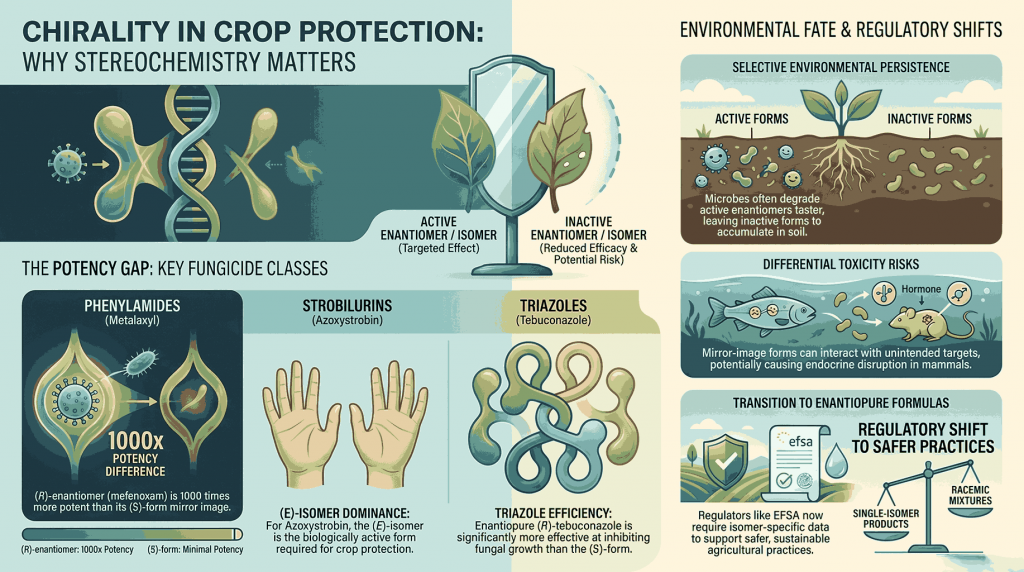
Fungal infections cause devastating losses in agriculture, threatening global food security. Fungicides are therefore essential tools in crop protection. Many fungicides are chiral, and their enantiomers can differ significantly in fungicidal potency, environmental behavior, and toxicity to non-target organisms. The stereochemistry of fungicides not only influences their efficacy but also determines their environmental footprint and sustainability.
This episode explores the role of chirality in fungicides, highlighting how stereochemistry affects their mode of action, degradation, and safety profiles, with examples from triazoles, strobilurins, and phenylamides.
Triazole Fungicides
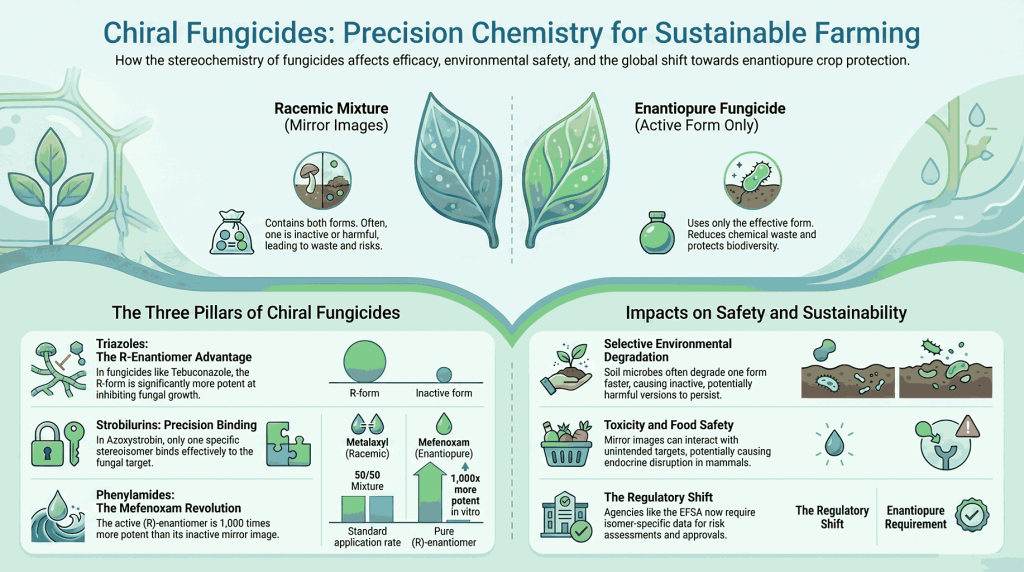
Triazoles represent one of the largest classes of fungicides, targeting sterol 14α-demethylase, an enzyme critical for fungal cell membrane synthesis. Many triazoles are chiral, with enantiomers displaying different antifungal activities. These enantioselective differences matter because triazoles are applied globally at large scales. Using racemic mixtures increases environmental chemical loads, while only one enantiomer contributes significantly to efficacy.
Strobilurin Fungicides
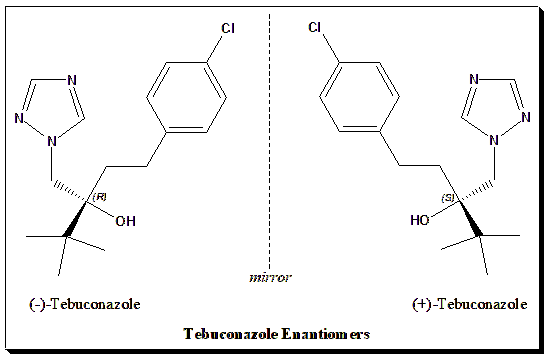
Azoxystrobin is a broad-spectrum, systemic fungicide widely used in agriculture and landscaping to protect crops and turfgrass from fungal diseases. It exhibits geometric (E/Z) isomerism due to the configuration of its β-methoxyacrylate group. The (E)-isomer, where key groups lie on opposite sides of the double bond, is the dominant and biologically active form used in commercial fungicide formulations. The less active (Z)-isomer may form as a minor manufacturing impurity or through sunlight-induced photoisomerization in the environment, which can influence the fungicide’s stability, persistence, and overall performance in agricultural applications.
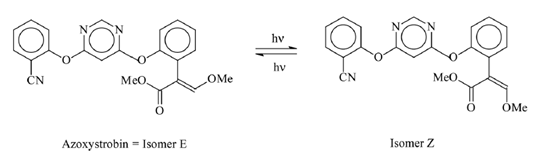
Source: Photochem. Photobiol. Sci., 2013, 12, 2076–2083; DOI: 10.1039/c3pp50241d
Azoxystrobin is a widely used broad-spectrum QoI fungicide known for its effective disease control in crops. It has low water solubility and low volatility, but under certain conditions it may persist in soil and water and potentially leach into groundwater. While it shows low toxicity to mammals, it can pose moderate risks to aquatic organisms, birds, honeybees, and earthworms, and may also cause mild skin and eye irritation.
Phenylamide Fungicides
Metalaxyl is a chiral fungicide widely used to protect crops against Oomycete pathogens. It is a classic example of a chiral fungicide with enantioselective activity.Its effectiveness comes almost entirely from the biologically active (R)-enantiomer, known as mefenoxam/metalaxyl-M. This form interferes with ribosomal RNA synthesis and is 1000 times more potent in vitro than the inactive (S)-enantiomer (Yamamoto et al., 1987).. This reduces overall application rates and lowers the environmental burden without compromising crop protection.
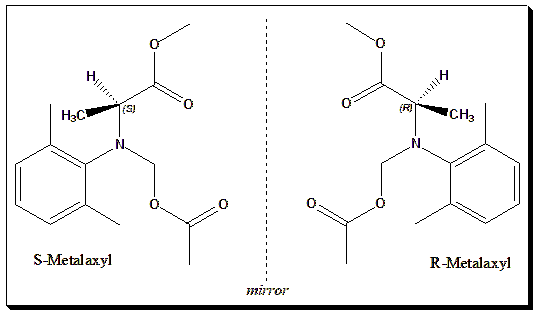
Metalaxyl is a phenylamide fungicide with a fascinating twist—it’s a chiral compound, that contains an asymmetrically substituted (chiral) carbon atom in its alkyl portion. Meaning it exists in mirror‑image forms. Farmers and growers encounter it both as a racemic mixture and in its pure R‑form, sold under names like mefenoxam and Ridomil. Manufactured by Syngenta, it’s applied in several ways: as a seed treatment, through soil application (banded or broadcast), or sprayed on foliage, often alongside protectant fungicides such as copper or folpet.
Its strength lies in combating fungi of the order Peronosporales, notorious for causing late blight, downy mildew, damping‑off, and destructive stem and fruit rots. Once applied, metalaxyl is absorbed by roots, leaves, stems, and shoots, then moves upward through the plant. Inside, it halts fungal growth by blocking protein synthesis, effectively cutting off the pathogen’s ability to spread.
The metalaxyl case illustrates how adopting enantiopure fungicides can improve sustainability while reducing the risks associated with inactive or persistent enantiomers. Metalaxyl contains an asymmetrically substituted (chiral) carbon atom in its alkyl portion.
Environmental Fate of Chiral Fungicides
Enantiomers often behave differently in soil and water. Microbial metabolism tends to degrade one enantiomer preferentially, leading to selective enrichment of the other (Garrison et al., 1996). For example, the enantioselective degradation of triazoles has been reported in agricultural soils, with the less active enantiomer sometimes persisting longer (Zhou et al., 2010).
Such persistence complicates risk assessment, since inactive enantiomers can accumulate, alter ecological balances, and potentially affect non-target organisms. Enantiomer-specific monitoring is therefore essential for accurate environmental evaluation.
Toxicity and Food Safety
The toxicity of fungicide enantiomers can differ significantly. While one enantiomer may act selectively on the fungal pathogen, the mirror image can interact with unintended biological targets in plants, animals, or humans. For instance, certain triazole enantiomers show differences in endocrine-disrupting potential when tested in mammalian systems (EFSA, 2019).
Food safety concerns arise when residues of inactive or toxic enantiomers persist on harvested crops. This highlights the importance of enantioselective residue analysis in regulatory frameworks.
Regulatory Developments
Regulatory agencies increasingly recognize the importance of chirality in fungicides. The European Food Safety Authority (EFSA) has issued guidance requiring stereoisomer-specific information for pesticides, including fungicides, during risk assessments (EFSA, 2019). Similar trends are seen in the United States and Asia.
These regulatory shifts encourage the agrochemical industry to adopt asymmetric synthesis, biocatalysis, or separation technologies to deliver enantiopure fungicides. While this requires investment, it supports the transition to safer, more sustainable agricultural practices.
Future Perspectives
The future of fungicide development will likely emphasize enantioselectivity. Advances in asymmetric synthesis, computational chemistry, and structural biology now allow researchers to design enantiomers that maximize activity and minimize off-target effects. Integration of enantiopure fungicides into integrated pest management (IPM) systems could help reduce resistance, lower application rates, and protect biodiversity.
Conclusion
Chirality plays a decisive role in fungicides, shaping their biological activity, environmental fate, and toxicity. Triazoles, strobilurins, and phenylamides all demonstrate how stereochemistry can determine the difference between success and failure in fungal control. Moving toward enantiopure fungicides not only improves efficacy but also reduces environmental burden and supports sustainable agriculture.
In the next episode, we will turn to natural products as chiral templates for crop protection.
References
Ariëns E.J. (1984). Stereochemistry, a basis for sophisticated nonsense in pharmacokinetics and clinical pharmacology. Eur J Clin Pharmacol. 26(6): 663–668.
https://sitem.herts.ac.uk/aeru/ppdb/en/Reports/54.htm
Marczewska P, Płonka M, Rolnik J, Sajewicz M. Determination of azoxystrobin and its impurity in pesticide formulations by liquid chromatography. J Environ Sci Health B. 2020;55(7):599-603. doi: 10.1080/03601234.2020.1746572.
European Food Safety Authority (EFSA); Bura L, Friel A, Magrans JO, Parra-Morte JM, Szentes C. (2019). Guidance of EFSA on risk assessments for active substances of plant protection products that have stereoisomers as components or impurities and for transformation products of active substances that may have stereoisomers. EFSA J. 26;17(8):e05804. doi: 10.2903/j.efsa.2019.5804.
Garrison A.W., Avants J.K., Jones W.J. (1996). Enantiomeric selectivity in the environmental degradation of pesticides. Environ Sci Technol. 30(8): 2449–2455.
Müller T., Kohler H.P.E. (2004). Chirality of pesticides: stereoselectivity of enzymatic reactions. J Environ Qual. 33(2): 556–564.
Yamamoto H., Miyake T., Ohkawa H. (1987). Enantioselective activity of metalaxyl enantiomers against plant pathogens. Pestic Biochem Physiol. 28(2): 163–171.
Xue Diao, Yiye Han, Chenglan Liu (2018). The Fungicidal Activity of Tebuconazole Enantiomers against Fusarium graminearum and Its Selective Effect on DON Production under Different Conditions. J. Agric. Food Chem. 2018, 66, 14, 3637–3643. https://doi.org/10.1021/acs.jafc.7b05483
Jeoffrey Chastain, Alexandra ter Halle, Pascal de Sainte Claire, Guillaume Voyard, Mounir Traikïad and Claire Richard (2013). Phototransformation of azoxystrobin fungicide in organic solvents. Photoisomerization vs. photodegradation. Photochemical &
Photobiological Sciences. 12, 2076–2083. DOI: 10.1039/c3pp50241d
Shen Y, Yao X, Jin S, Yang F. (2021). Enantiomer/stereoisomer-specific residues of metalaxyl, napropamide, triticonazole, and metconazole in agricultural soils across China. Environ Monit Assess. 2021 Nov 5;193(12):773. doi: 10.1007/s10661-021-09562-5.
Monkiedje, A.; Spiteller, M. (2005). Degradation of Metalaxyl and Mefenoxam and Effects on the Microbiological Properties of Tropical and Temperate Soils. Int. J. Environ. Res. Public Health, 2, 272-285. https://doi.org/10.3390/ijerph2005020011
Virginia Pérez-Fernández, Maria Ángeles García, Maria Luisa Marina. (2011). Chiral separation of metalaxyl and benalaxyl fungicides by electrokinetic chromatography and determination of enantiomeric impurities. Journal of Chromatography A. 10.1016/j.chroma.2010.12.116
Tomás M. Mac Loughlin, Marcos Navarro, Ricardo Andrés Rosero Garces, Marianela Ramos, Amalia Salimbeni, Ma Leticia Peluso. (2025). From degradation to detection: Assessing enantioselective behavior of chiral triazole fungicides in horticultural stream waters. Chemosphere, https://doi.org/10.1016/j.chemosphere.2025.144486
Zhou Q., Wang Y., Zhang H., Xie X. (2010). Enantioselective toxicology of chiral pesticides. J Environ Sci Health Part B. 45(1): 1–26.
Jeschke P. (2025). The continuing significance of chiral agrochemicals. Pest Manag Sci. Apr;81(4):1697-1716. doi: 10.1002/ps.8655.
Peter Jeschke. (2024). New Active Ingredients for Sustainable Modern Chemical Crop Protection in Agriculture, 2024. https://doi.org/10.1002/cssc.202401042,
Vashistha VK, Sethi S, Mittal A, Das DK, Pullabhotla RVSR, Bala R, Yadav S. (2024). Stereoselective analysis of chiral pesticides: a review. Environ Monit Assess. Jan 16;196(2):153. doi:10.1007/s10661-024-12310-0.
García-Cansino L, Marina ML, García MÁ. Chiral Analysis of Pesticides and Emerging Contaminants by Capillary Electrophoresis-Application to Toxicity Evaluation. Toxics. 2024 Feb 28;12(3):185. doi: 10.3390/toxics12030185
Peter Jeschke (2018) Current status of chirality in agrochemicals. https://doi.org/10.1002/ps.5052
Garrison, A. W. (2011). An introduction to pesticide chirality and the consequences of stereoselectivity. In H. Ohkawa, H. Miyagawa, & P. W. Lee (Eds.), Chiral pesticides: Stereoselectivity and its consequences (ACS Symposium Series, Vol. 1085, pp. 1–7). American Chemical Society. https://doi.org/10.1021/bk-2011-1085.ch001
Williams, A. (1996), Opportunities for chiral agrochemicals. Pestic. Sci., 46: 3-9. https://doi.org/10.1002/(SICI)1096-9063(199601)46:1<3::AID-PS337>3.0.CO;2-J
Donald G. Crosby (1973). The Fate of Pesticides in the Environment, Annual Review of Plant Physiology 24(1):467-492. DOI:10.1146/annurev.pp.24.060173.002343
Crosby D.G. (1995). Environmental fate of pesticides: stereochemistry as a factor in transformation and degradation. Pure Appl Chem. 67(3): 407–412.
Liu W, Gan J, Schlenk D, Jury WA. (2005). Enantioselectivity in environmental safety of current chiral insecticides. Proc Natl Acad Sci U S A. 18;102(3):701-6. doi: 10.1073/pnas.0408847102.
Yamamoto H., Miyake T., Ohkawa H. (1987). Enantioselective activity of metalaxyl enantiomers against plant pathogens. Pestic Biochem Physiol. 28(2): 163–171.
Ye J, Zhao M, Niu L, Liu W. (2015). Enantioselective environmental toxicology of chiral pesticides. Chem Res Toxicol. 16;28(3):325-38. doi: 10.1021/tx500481n.
Yandi Fu, Francesc Borrull, Rosa Maria Marcé, Núria Fontanals. (2021). Enantiomeric fraction determination of chiral drugs in environmental samples using chiral liquid chromatography and mass spectrometry, Trends in Environmental Analytical Chemistry.
https://doi.org/10.1016/j.teac.2021.e00115.
Further Reading


An excellent and insightful article highlighting how stereochemistry influences fungicide efficacy, environmental fate, and sustainability in modern agriculture. Appreciation to the author for presenting such a complex scientific concept with remarkable clarity and real-world relevance.