Introduction
The development and use of chiral agrochemicals are not governed by science alone. Policy frameworks, regulatory guidance, and industrial strategy all play decisive roles in shaping how stereochemistry is addressed in crop protection. Over the past three decades, regulators have recognized that enantiomers can differ dramatically in efficacy, toxicity, and environmental fate. This recognition has led to increasing demands for enantiomer-specific data in pesticide approvals.
For industry, chirality presents both challenges and opportunities. The challenges include higher costs of asymmetric synthesis or chiral separation, as well as the complexity of proving safety and efficacy for individual enantiomers. The opportunities lie in improved product performance, reduced application rates, and alignment with sustainability and food safety goals.
Evolution of Regulatory Perspectives
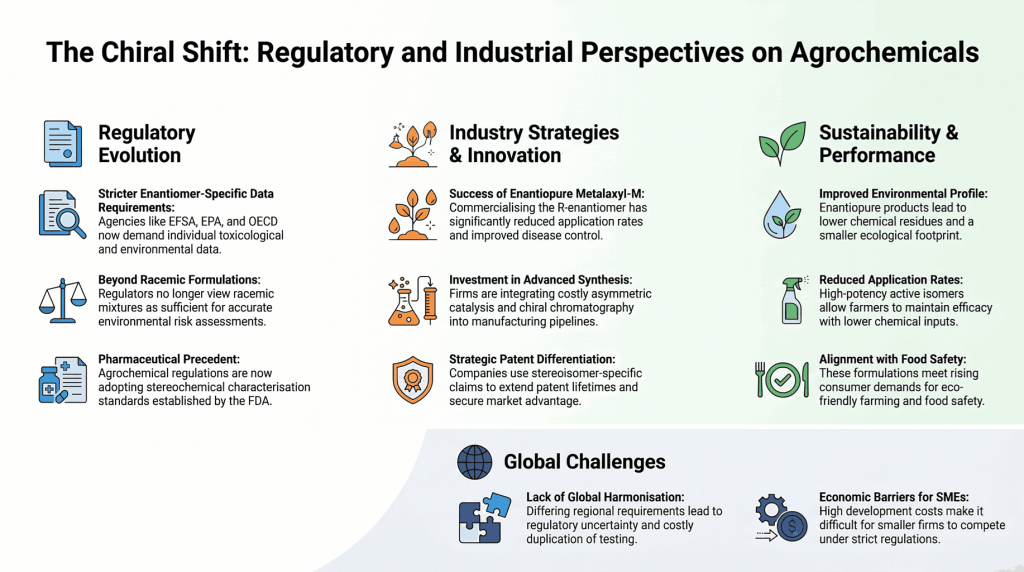
The pharmaceutical sector set the precedent in the early 1990s, when the U.S. Food and Drug Administration (FDA) issued guidance requiring stereochemical characterization of drugs. Agrochemicals soon followed, albeit more slowly.
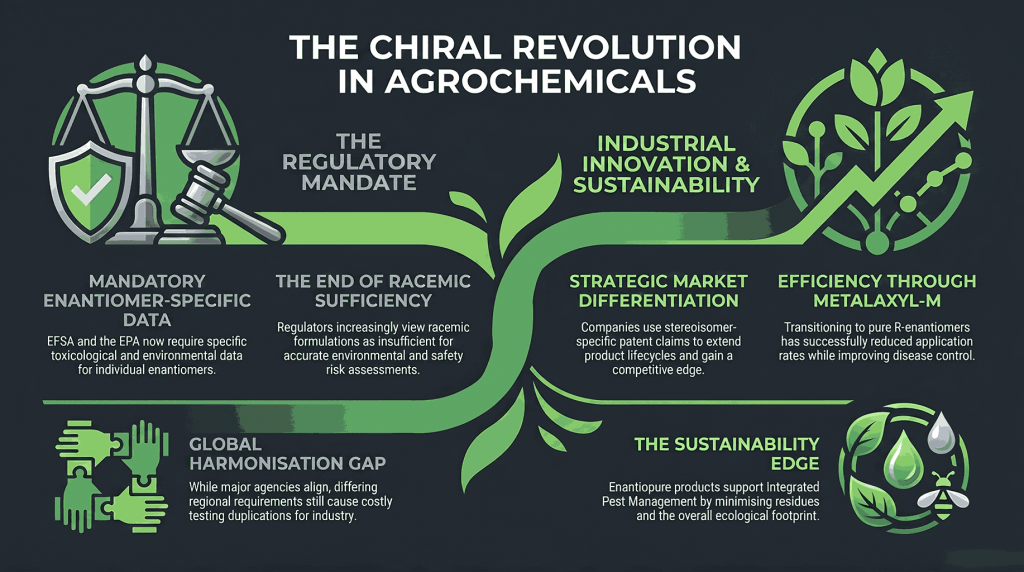
The European Food Safety Authority (EFSA, 2019) now explicitly requires enantiomer-specific data for pesticides, including toxicological and environmental fate studies. The U.S. Environmental Protection Agency (EPA) has issued similar requests, noting that risk assessments must account for stereoselective differences in persistence and toxicity. The Organisation for Economic Co-operation and Development (OECD) has also supported harmonized approaches for evaluating stereoisomers in agrochemicals.
This regulatory shift reflects a growing consensus: racemic formulations may no longer be sufficient for accurate risk assessment.
Industry Strategies for Compliance
Agrochemical companies have responded to these evolving requirements in several ways:
- Development of Enantiopure Products
- A prominent example is metalaxyl-M, the R-enantiomer of metalaxyl, which is now commercialized globally. This shift reduced the application rate and improved disease control efficacy.
- Similar trends are emerging with pyrethroid insecticides, where companies are moving toward formulations enriched with the most active stereoisomers.
- Investment in Asymmetric Synthesis and Separation
- Advances in asymmetric catalysis, enzymatic biocatalysis, and chiral chromatography are being integrated into industrial manufacturing pipelines.
- These technologies, while costly, are increasingly justified by regulatory requirements and market positioning.
- Patent Strategies
- Enantiopure products allow companies to extend patent lifetimes by filing for stereoisomer-specific claims. This provides both commercial advantage and differentiation in competitive markets.
Sustainability and Market Differentiation
The industrial move toward enantiopure agrochemicals also supports sustainability narratives. By promoting reduced application rates, lower residues, and minimized ecological footprint, companies can position themselves as leaders in sustainable crop protection.
This approach also aligns with integrated pest management (IPM) frameworks, which prioritize minimizing chemical inputs while maintaining efficacy. As consumers increasingly demand food safety and eco-friendly farming practices, enantiopure formulations provide a marketing edge as well as a regulatory advantage.
Global Challenges
Despite progress, global harmonization remains incomplete. Regulatory requirements differ between regions, leading to uncertainty and duplication of testing. In some emerging economies, pesticides are still evaluated without stereochemical differentiation, allowing racemic formulations to dominate.
The cost of developing enantiopure products also remains a barrier. While large multinational agrochemical companies can invest in chiral technologies, smaller firms may struggle to compete under stricter regulations.
Future Directions
The trajectory points toward increasing regulatory stringency. Future dossiers for pesticide approvals are likely to require comprehensive enantioselective data, including:
- toxicological evaluations for each enantiomer
- environmental fate studies showing stereoselective degradation and persistence
- enantioselective residue analyses in crops and food products
Industrially, advances in green chemistry and computational design will reduce the costs of enantiopure agrochemical production. Regulatory pressure, market demand, and sustainability goals will converge, making stereochemistry a defining factor in next-generation crop protection.
Conclusion
Chirality has moved from a scientific curiosity to a regulatory and industrial priority in agrochemistry. Regulatory agencies now expect enantiomer-specific data to ensure accurate risk assessments. Agrochemical companies are adapting through enantiopure formulations, investment in asymmetric synthesis, and stereochemistry-driven patents.
The balance between compliance costs and sustainability benefits will shape the future of the agrochemical industry. As global agriculture adapts to feed a growing population under environmental constraints, chirality offers both a regulatory challenge and an industrial opportunity.
The final episode of this series will examine future directions in chiral agrochemistry, highlighting innovations in synthesis, biocatalysis, and green crop protection.
References
Bartlett DW, Clough JM, Godwin JR, Hall AA, Hamer M, Parr-Dobrzanski B.(2002). The strobilurin fungicides. Pest Manag Sci. 58(7):649-62. doi: 10.1002/ps.520. Erratum in: Pest Manag Sci. 2004 Mar;60(3):309. PMID: 12146165.
Buser H.R., Müller M.D., Rappe C. (1992). Enantioselective determination of chiral phenoxy herbicides and their environmental behavior. Anal Chem. 64(13): 1461–1467.
Crosby D.G. (1995). Environmental fate of pesticides: stereochemistry as a factor in transformation and degradation. Pure Appl Chem. 67(3): 407–412.
Aktar MW, Sengupta D, Chowdhury A. Impact of pesticides use in agriculture: their benefits and hazards. Interdiscip Toxicol. 2009 Mar;2(1):1-12. doi: 10.2478/v10102-009-0001-7.
Dayan FE, Cantrell CL, Duke SO. Natural products in crop protection. Bioorg Med Chem. 2009 Jun 15;17(12):4022-34. doi: 10.1016/j.bmc.2009.01.046.
European Food Safety Authority (EFSA); Bura L, Friel A, Magrans JO, Parra-Morte JM, Szentes C. (2019). Guidance of EFSA on risk assessments for active substances of plant protection products that have stereoisomers as components or impurities and for transformation products of active substances that may have stereoisomers. EFSA J. 26;17(8):e05804. doi: 10.2903/j.efsa.2019.5804.
Müller T., Kohler H.P.E. (2004). Chirality of pesticides: stereoselectivity of enzymatic reactions. J Environ Qual. 33(2): 556–564.
Williams A. (1996). Opportunities for chiral agrochemicals. Pestic Sci. 46(1): 3–9.
Yamamoto H., Miyake T., Ohkawa H. (1987). Enantioselective activity of metalaxyl enantiomers against plant pathogens. Pestic Biochem Physiol. 28(2): 163–171.
Further Reading