What happens when 𝒄𝒉𝒊𝒓𝒂𝒍𝒊𝒕𝒚 𝒎𝒆𝒆𝒕𝒔 𝒄𝒓𝒐𝒑 𝒔𝒄𝒊𝒆𝒏𝒄𝒆?
Introduction
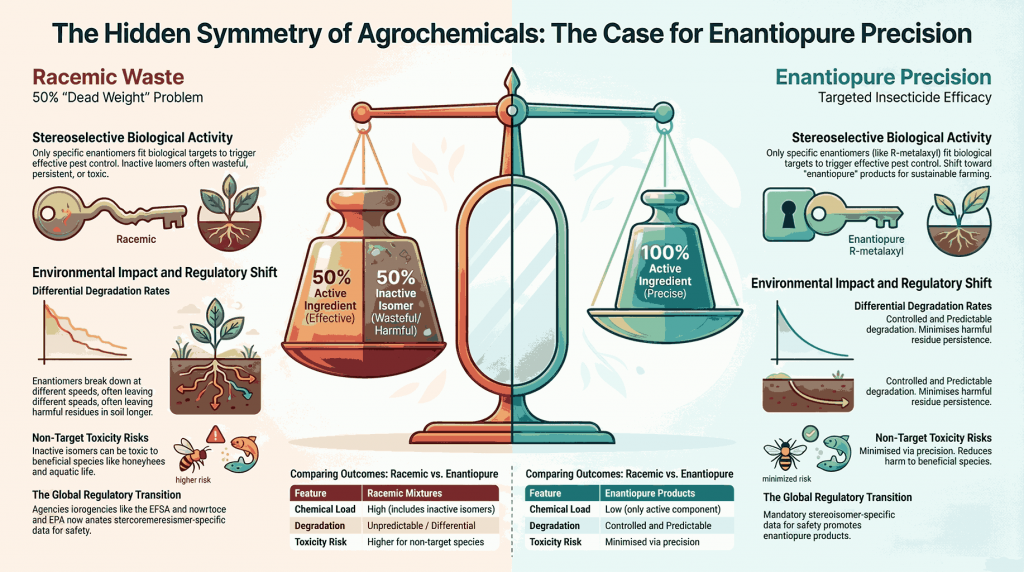
Chirality, the property of a molecule that makes it non-superimposable on its mirror image, is a crucial consideration in agrochemistry. Agrochemicals such as pesticides, herbicides, and fungicides often contain one or more stereogenic centers. The two enantiomers of a chiral molecule can behave very differently in biological systems, leading to differences in efficacy, toxicity, and environmental persistence. In agriculture, where large amounts of chemicals are released into the environment, these differences have far-reaching implications for crop protection, food safety, and sustainability.
Most agrochemicals are designed to interact with specific biological targets such as insect receptors, plant enzymes, or fungal proteins. Since these macromolecules are themselves chiral, the interaction is stereoselective. One enantiomer may fit well into the active site and provide strong activity, while the other may have weak or no effect, or in some cases cause unintended toxicity. Despite this, many agrochemicals are still commercialized as racemic mixtures because of cost considerations in synthesis and formulation.
This blog introduces the importance of chirality in agrochemicals and sets the stage for the series by discussing its role in biological activity, toxicity, and environmental impact.
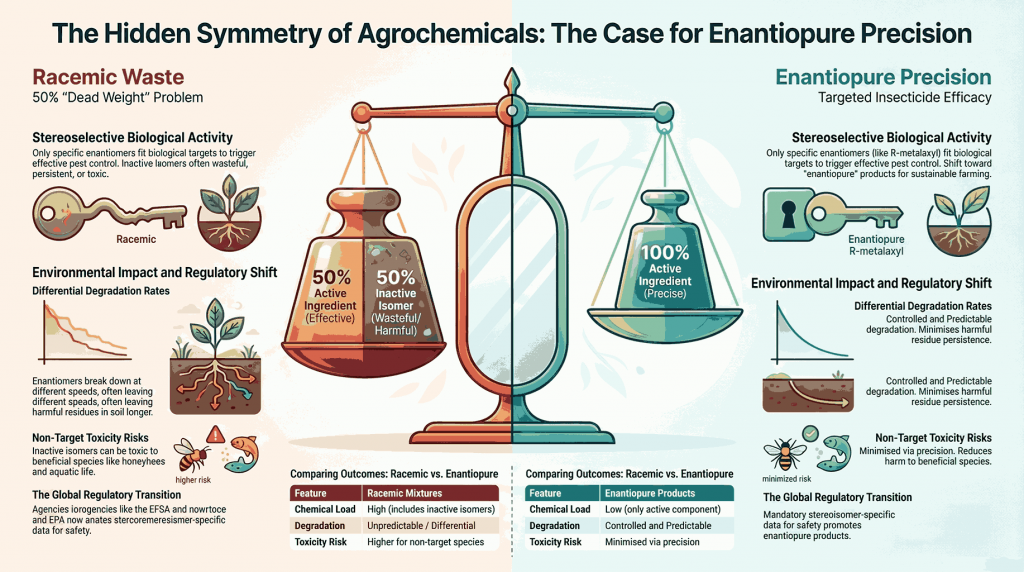
🧪🌾 Infographic: Understanding Chirality in Agrochemicals
Why Two Mirror-Image Molecules Can Produce Vastly Different Effects in Agriculture and the Environment
Stereoselectivity in Biological Targets
The principle of stereoselectivity arises from the three-dimensional structure of biological macromolecules. For example, the fungicide metalaxyl exists as R- and S-enantiomers, but only the R-enantiomer is biologically active against oomycete fungi. Similarly, pyrethroid insecticides such as permethrin display strong enantioselectivity, with certain stereoisomers being much more effective against insect pests. The inactive isomer may still persist in the environment and contribute to unwanted exposure.
Racemic Mixtures and Agricultural Practice
The use of racemic mixtures in agriculture has been widespread. However, when only one enantiomer is active, applying the racemate means that half of the chemical load provides no benefit to crop protection. This inefficiency increases the total volume of chemicals applied, raising production costs and environmental risks. Moving toward enantiopure formulations can improve efficacy and reduce collateral exposure to non-target organisms.
Environmental Impact
Chirality not only governs biological activity but also influences degradation pathways in soil, water, and air. Enantiomers often degrade at different rates, leading to changes in the ratio of R- and S-enantiomers in the environment. For instance, the herbicide dichlorprop has been shown to undergo enantioselective degradation, with the R-form breaking down more quickly in soil than the S-form. Such differences can result in prolonged persistence of one enantiomer, altering ecological exposure profiles and potentially increasing the risk to non-target species.
Microbial degradation processes are particularly enantioselective. Soil bacteria often metabolize one enantiomer preferentially, which can influence both environmental fate and the development of resistance in pests and pathogens.
Toxicity and Food Safety
One of the most critical issues in chiral agrochemistry is toxicity. The active enantiomer may act selectively on the intended pest, while the mirror image may exert toxicity on beneficial insects, wildlife, or even humans. For example, enantiomers of the insecticide fipronil differ in toxicity toward non-target organisms such as aquatic species and honeybees. Food safety concerns are heightened when residues of the less studied or inactive enantiomer accumulate on crops. This underscores the importance of enantiomer-specific residue analysis in regulatory evaluations.
Regulatory Outlook
While the pharmaceutical industry moved toward enantiomer-specific evaluation in the 1990s, agrochemical regulation is only now following this trend. Agencies such as the European Food Safety Authority (EFSA) and the US Environmental Protection Agency (EPA) increasingly request stereoisomer-specific data on efficacy, environmental fate, and toxicology. This regulatory shift encourages the development of enantiopure products, aligning agricultural practice with broader sustainability goals.
Toward Sustainable Crop Protection
The concept of sustainability in agriculture is closely linked to efficient and safe use of agrochemicals. Chiral agrochemicals represent both a challenge and an opportunity. By focusing on enantioselective synthesis and formulation, it is possible to enhance pest control while reducing chemical input and minimizing environmental burden. Advances in asymmetric synthesis and biocatalysis are already making such developments feasible on an industrial scale.
Conclusion
Chirality in agrochemicals is not an academic curiosity but a practical determinant of efficacy, toxicity, and environmental impact. The move toward enantiopure agrochemicals promises not only better pest management but also safer and more sustainable agriculture. This introductory article frames the discussion for the series ahead, where we will examine pesticides, herbicides, fungicides, natural compounds, and regulatory perspectives in greater detail.
References
Jeschke P. (2025). The continuing significance of chiral agrochemicals. Pest Manag Sci. Apr;81(4):1697-1716. doi: 10.1002/ps.8655.
Peter Jeschke. (2024). New Active Ingredients for Sustainable Modern Chemical Crop Protection in Agriculture, 2024. https://doi.org/10.1002/cssc.202401042,
Vashistha VK, Sethi S, Mittal A, Das DK, Pullabhotla RVSR, Bala R, Yadav S. (2024). Stereoselective analysis of chiral pesticides: a review. Environ Monit Assess. Jan 16;196(2):153. doi:10.1007/s10661-024-12310-0.
García-Cansino L, Marina ML, García MÁ. Chiral Analysis of Pesticides and Emerging Contaminants by Capillary Electrophoresis-Application to Toxicity Evaluation. Toxics. 2024 Feb 28;12(3):185. doi: 10.3390/toxics12030185
Peter Jeschke (2018) Current status of chirality in agrochemicals. https://doi.org/10.1002/ps.5052
Garrison, A. W. (2011). An introduction to pesticide chirality and the consequences of stereoselectivity. In H. Ohkawa, H. Miyagawa, & P. W. Lee (Eds.), Chiral pesticides: Stereoselectivity and its consequences (ACS Symposium Series, Vol. 1085, pp. 1–7). American Chemical Society. https://doi.org/10.1021/bk-2011-1085.ch001
Williams, A. (1996), Opportunities for chiral agrochemicals. Pestic. Sci., 46: 3-9. https://doi.org/10.1002/(SICI)1096-9063(199601)46:1<3::AID-PS337>3.0.CO;2-J
Ariëns E.J. (1984). Stereochemistry, a basis for sophisticated nonsense in pharmacokinetics and clinical pharmacology. Eur J Clin Pharmacol. 26(6): 663–668.
Buser H.R., Müller M.D., Rappe C. (1992). Enantioselective determination of chiral phenoxy herbicides and their environmental behavior. Anal Chem. 64(13): 1461–1467.
Donald G. Crosby (1973). The Fate of Pesticides in the Environment, Annual Review of Plant Physiology 24(1):467-492. DOI:10.1146/annurev.pp.24.060173.002343
Crosby D.G. (1995). Environmental fate of pesticides: stereochemistry as a factor in transformation and degradation. Pure Appl Chem. 67(3): 407–412.
EFSA (European Food Safety Authority). (2019). Guidance on the assessment of the safety of pesticides with stereoisomers. EFSA Journal. 17(6): e05760.
Liu W, Gan J, Schlenk D, Jury WA. (2005). Enantioselectivity in environmental safety of current chiral insecticides. Proc Natl Acad Sci U S A. 18;102(3):701-6. doi: 10.1073/pnas.0408847102.
Garrison A.W., Avants J.K., Jones W.J. (1996). Enantiomeric selectivity in the environmental degradation of pesticides. Environ Sci Technol. 30(8): 2449–2455.
Yamamoto H., Miyake T., Ohkawa H. (1987). Enantioselective activity of metalaxyl enantiomers against plant pathogens. Pestic Biochem Physiol. 28(2): 163–171.
European Food Safety Authority (EFSA); Bura L, Friel A, Magrans JO, Parra-Morte JM, Szentes C. (2019). Guidance of EFSA on risk assessments for active substances of plant protection products that have stereoisomers as components or impurities and for transformation products of active substances that may have stereoisomers. EFSA J. 26;17(8):e05804. doi: 10.2903/j.efsa.2019.5804.
Zhang Y, Liu D, Diao J, He Z, Zhou Z, Wang P, Li X. (2010). Enantioselective environmental behavior of the chiral herbicide fenoxaprop-ethyl and its chiral metabolite fenoxaprop in soil. J Agric Food Chem. 22;58(24):12878-84. doi: 10.1021/jf103537a.
Liu W, Gan J, Schlenk D, Jury WA. (2005). Enantioselectivity in environmental safety of current chiral insecticides. Proc Natl Acad Sci U S A. 18;102(3):701-6. doi: 10.1073/pnas.0408847102.
Ye J, Zhao M, Niu L, Liu W. (2015). Enantioselective environmental toxicology of chiral pesticides. Chem Res Toxicol. 16;28(3):325-38. doi: 10.1021/tx500481n.
Yandi Fu, Francesc Borrull, Rosa Maria Marcé, Núria Fontanals. (2021). Enantiomeric fraction determination of chiral drugs in environmental samples using chiral liquid chromatography and mass spectrometry, Trends in Environmental Analytical Chemistry.
https://doi.org/10.1016/j.teac.2021.e00115.
Qu H, Wang P, Ma RX, Qiu XX, Xu P, Zhou ZQ, Liu DH. (2014). Enantioselective toxicity, bioaccumulation and degradation of the chiral insecticide fipronil in earthworms (Eisenia feotida). Sci Total Environ. 485-486:415-420. doi: 10.1016/j.scitotenv.2014.03.054.
Overmyer JP, Rouse DR, Avants JK, Garrison AW, Delorenzo ME, Chung KW, Key PB, Wilson WA, Black MC. (2007). Toxicity of fipronil and its enantiomers to marine and freshwater non-targets. J Environ Sci Health B. 42(5):471-80. doi: 10.1080/03601230701391823.
Further Reading