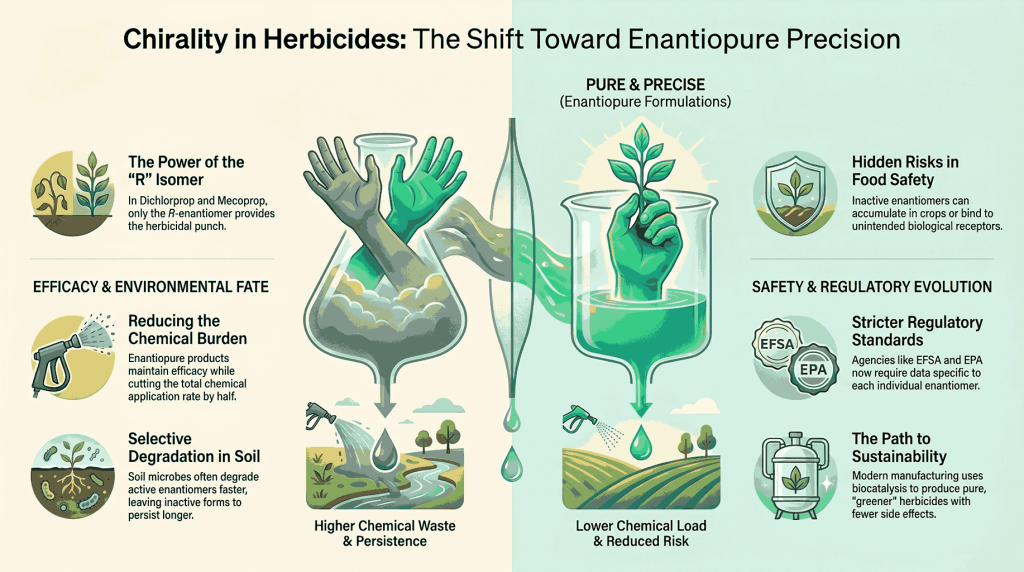
🌱 Herbicides Have Two Faces — Chirality Decides Their Impact.” 🧬
Introduction
Herbicides are among the most widely used agrochemicals worldwide. They are applied to protect crops from weed competition, ensuring higher yields and food security. A significant number of herbicides are chiral, and their enantiomers often show large differences in biological activity, environmental fate, and toxicity. The role of chirality in herbicides is particularly important because these compounds are applied across millions of hectares, making even small enantioselective differences impactful on ecosystems and food chains.
This episode examines how chirality influences herbicidal action, degradation, persistence, and regulatory concerns, using key examples to illustrate the importance of stereochemistry in sustainable crop protection.
Chirality in Phenoxy Herbicides
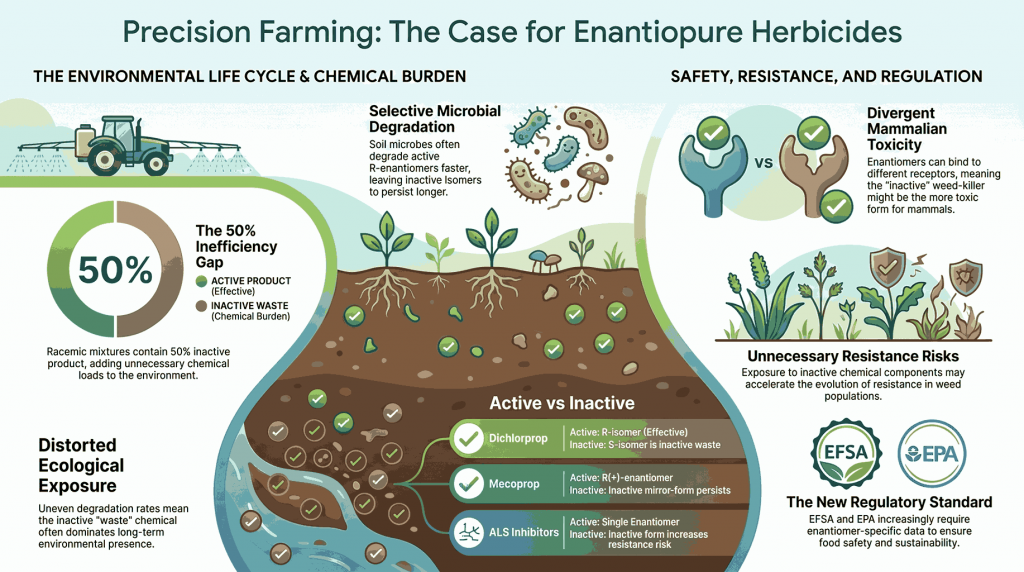
Phenoxy herbicides, such as dichlorprop and mecoprop, are classic examples where chirality determines activity. These compounds mimic plant auxins and disrupt growth processes. However, only one enantiomer is biologically active in binding to auxin receptors. Despite this, racemic formulations have been widely used, meaning half the applied chemical load does not contribute to weed control but still enters the environment.
The inefficiency of racemic mixtures increases the overall chemical burden on soil and water. This case exemplifies why developing enantiopure herbicides could reduce application rates and minimize environmental exposure while maintaining or enhancing efficacy.
Case Study 1: Dichlorprop
🌱 Dichlorprop is a herbicide with a twist: it has a single asymmetric carbon, which makes it a chiral molecule. But here’s the catch—only one “handed” form, the R‑isomer, actually works to control weeds.
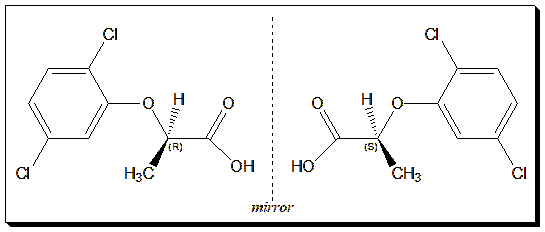
As synthetic methods improved, chemists learned how to produce the pure, active form. Today, only R‑dichlorprop (also known as dichlorprop‑p or 2,4‑DP‑p) and its derivatives are marketed in the United States, ensuring maximum effectiveness with every application.
Case Study 2: Mecoprop
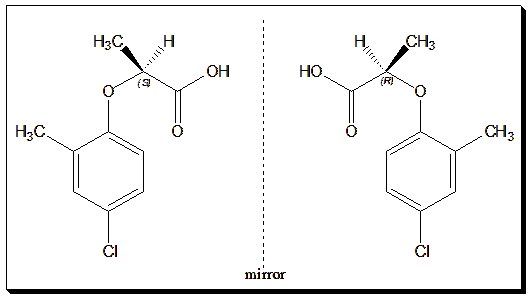
🌱 Mecoprop—also called methylchlorophenoxypropionic acid or simply MCPP—is a familiar ingredient in many household weed killers and “weed‑and‑feed” lawn products. What makes it interesting is its stereochemistry: Mecoprop exists as two mirror‑image forms (stereoisomers).
Acetolactate Synthase (ALS) Inhibitors
Many modern herbicides target acetolactate synthase (ALS), an enzyme involved in branched-chain amino acid biosynthesis. ALS itself is a chiral enzyme, and enantiomers of ALS-inhibiting herbicides often differ substantially in activity. For example, the sulfonylurea and imidazolinone classes contain stereogenic centers that govern their binding to the ALS active site. Studies have shown that only one enantiomer in these herbicides typically provides strong inhibitory activity, while the other is far less effective.
These findings have important implications for resistance management. Using racemic mixtures may increase the chance that weed populations evolve resistance mechanisms, since the inactive enantiomer unnecessarily increases exposure without providing additional control.
Glyphosate and Chiral Analogues
Glyphosate itself is achiral, but research into chiral analogues has highlighted how stereochemistry can influence herbicidal potency and selectivity. Some analogues with chiral centers demonstrate stereoselective inhibition of 5-enolpyruvylshikimate-3-phosphate synthase (EPSPS), the enzyme targeted by glyphosate. These analogues suggest that chirality could be harnessed in next-generation herbicides to fine-tune selectivity and minimize impacts on non-target plants or microbes.
Environmental Enantioselectivity
The environmental fate of chiral herbicides is strongly influenced by stereoselective processes. Soil microbial communities often degrade one enantiomer faster than the other. For example, R-dichlorprop degrades more rapidly than its S-enantiomer, leading to persistence of the less biologically active form in the environment. Such stereoselective persistence can shift ecological exposure patterns, increasing risks to non-target organisms and altering long-term environmental outcomes.
This enantioselectivity complicates environmental risk assessment. If only racemic formulations are evaluated, the persistence and toxicity of the inactive enantiomer may be underestimated. Enantiomer-specific data are therefore crucial for accurate modeling of environmental impacts.
Food Safety and Toxicity
Enantiomers of herbicides may differ not only in weed control efficacy but also in toxicity to humans and animals. While one enantiomer may have low toxicity and high herbicidal activity, the other may bind to unintended receptors in mammals or other organisms. Such differences have been observed in sulfonylurea herbicides, where stereochemistry affects both herbicidal action and mammalian toxicity profiles (Zhou et al., 2010).
From a food safety perspective, residues of inactive or toxic enantiomers may accumulate in edible crops. This underscores the importance of monitoring residues at the enantiomer-specific level and ensuring that maximum residue limits (MRLs) reflect real risks (EFSA, 2019).
Regulatory and Industrial Perspectives
Regulators are increasingly aware of the role of chirality in herbicide safety and efficacy. The European Food Safety Authority (EFSA) and US Environmental Protection Agency (EPA) now encourage or require enantiomer-specific data in safety dossiers for new herbicides. This trend pressures industry to adopt asymmetric synthesis or enantioselective separation methods during herbicide development.
While this adds complexity and cost, it also creates opportunities. Enantiopure herbicides can be marketed as more sustainable products that reduce chemical inputs and environmental impacts. This not only improves public perception but also aligns with integrated pest and weed management strategies that emphasize efficiency and sustainability.
Toward Sustainable Weed Management
The future of herbicide design lies in precision. By focusing on enantioselectivity, scientists can develop herbicides that are more potent, more selective, and less persistent in the environment. Biocatalysis and green chemistry approaches are increasingly being applied to produce enantiopure compounds efficiently.
Integrating enantiopure herbicides into sustainable weed management systems could help reduce chemical use, mitigate resistance, and protect biodiversity. Chirality thus provides both a scientific challenge and a practical tool for the next generation of herbicide innovation.
Conclusion
Chirality is a decisive factor in the biological activity, environmental fate, and safety of herbicides. Phenoxy herbicides, ALS inhibitors, and glyphosate analogues all highlight how stereochemistry shapes herbicidal action. While racemic mixtures remain common, the scientific and regulatory shift toward enantiopure products offers a pathway to more sustainable agriculture.
In the next episode, we will explore fungicides, examining how chirality influences their activity against plant pathogens and their impact on ecosystems.
References
S. Wendeborn, E. Godineau, R. Mondière, T. Smejkal, H. Smits. Chirality in Agrochemicals in Comprehensive Chirality Volume 1, 2012, Pages 120-166. https://doi.org/10.1016/B978-0-08-095167-6.00102-6
Cobb, A.H. and Reade, J.P.H. (2010) Herbicides and Plant Physiology. 2nd Edition, Wiley-Blackwell, Hoboken, 1-296.
http://dx.doi.org/10.1002/9781444327793
Jeschke P. (2025). The continuing significance of chiral agrochemicals. Pest Manag Sci. Apr;81(4):1697-1716. doi: 10.1002/ps.8655.
Peter Jeschke. (2024). New Active Ingredients for Sustainable Modern Chemical Crop Protection in Agriculture, 2024. https://doi.org/10.1002/cssc.202401042,
Vashistha VK, Sethi S, Mittal A, Das DK, Pullabhotla RVSR, Bala R, Yadav S. (2024). Stereoselective analysis of chiral pesticides: a review. Environ Monit Assess. Jan 16;196(2):153. doi:10.1007/s10661-024-12310-0.
García-Cansino L, Marina ML, García MÁ. Chiral Analysis of Pesticides and Emerging Contaminants by Capillary Electrophoresis-Application to Toxicity Evaluation. Toxics. 2024 Feb 28;12(3):185. doi: 10.3390/toxics12030185
Peter Jeschke (2018) Current status of chirality in agrochemicals. https://doi.org/10.1002/ps.5052
Garrison, A. W. (2011). An introduction to pesticide chirality and the consequences of stereoselectivity. In H. Ohkawa, H. Miyagawa, & P. W. Lee (Eds.), Chiral pesticides: Stereoselectivity and its consequences (ACS Symposium Series, Vol. 1085, pp. 1–7). American Chemical Society. https://doi.org/10.1021/bk-2011-1085.ch001
Williams, A. (1996), Opportunities for chiral agrochemicals. Pestic. Sci., 46: 3-9. https://doi.org/10.1002/(SICI)1096-9063(199601)46:1<3::AID-PS337>3.0.CO;2-J
Ariëns E.J. (1984). Stereochemistry, a basis for sophisticated nonsense in pharmacokinetics and clinical pharmacology. Eur J Clin Pharmacol. 26(6): 663–668.
Buser H.R., Müller M.D., Rappe C. (1992). Enantioselective determination of chiral phenoxy herbicides and their environmental behavior. Anal Chem. 64(13): 1461–1467.
Donald G. Crosby (1973). The Fate of Pesticides in the Environment, Annual Review of Plant Physiology 24(1):467-492. DOI:10.1146/annurev.pp.24.060173.002343
Crosby D.G. (1995). Environmental fate of pesticides: stereochemistry as a factor in transformation and degradation. Pure Appl Chem. 67(3): 407–412.
EFSA (European Food Safety Authority). (2019). Guidance on the assessment of the safety of pesticides with stereoisomers. EFSA Journal. 17(6): e05760.
Liu W, Gan J, Schlenk D, Jury WA. (2005). Enantioselectivity in environmental safety of current chiral insecticides. Proc Natl Acad Sci U S A. 18;102(3):701-6. doi: 10.1073/pnas.0408847102.
Garrison A.W., Avants J.K., Jones W.J. (1996). Enantiomeric selectivity in the environmental degradation of pesticides. Environ Sci Technol. 30(8): 2449–2455.
Yamamoto H., Miyake T., Ohkawa H. (1987). Enantioselective activity of metalaxyl enantiomers against plant pathogens. Pestic Biochem Physiol. 28(2): 163–171.
European Food Safety Authority (EFSA); Bura L, Friel A, Magrans JO, Parra-Morte JM, Szentes C. (2019). Guidance of EFSA on risk assessments for active substances of plant protection products that have stereoisomers as components or impurities and for transformation products of active substances that may have stereoisomers. EFSA J. 26;17(8):e05804. doi: 10.2903/j.efsa.2019.5804.
Zhang Y, Liu D, Diao J, He Z, Zhou Z, Wang P, Li X. (2010). Enantioselective environmental behavior of the chiral herbicide fenoxaprop-ethyl and its chiral metabolite fenoxaprop in soil. J Agric Food Chem. 22;58(24):12878-84. doi: 10.1021/jf103537a.
Liu W, Gan J, Schlenk D, Jury WA. (2005). Enantioselectivity in environmental safety of current chiral insecticides. Proc Natl Acad Sci U S A. 18;102(3):701-6. doi: 10.1073/pnas.0408847102.
Ye J, Zhao M, Niu L, Liu W. (2015). Enantioselective environmental toxicology of chiral pesticides. Chem Res Toxicol. 16;28(3):325-38. doi: 10.1021/tx500481n.
Yandi Fu, Francesc Borrull, Rosa Maria Marcé, Núria Fontanals. (2021). Enantiomeric fraction determination of chiral drugs in environmental samples using chiral liquid chromatography and mass spectrometry, Trends in Environmental Analytical Chemistry.
https://doi.org/10.1016/j.teac.2021.e00115.
Qu H, Wang P, Ma RX, Qiu XX, Xu P, Zhou ZQ, Liu DH. (2014). Enantioselective toxicity, bioaccumulation and degradation of the chiral insecticide fipronil in earthworms (Eisenia feotida). Sci Total Environ. 485-486:415-420. doi: 10.1016/j.scitotenv.2014.03.054.
Overmyer JP, Rouse DR, Avants JK, Garrison AW, Delorenzo ME, Chung KW, Key PB, Wilson WA, Black MC. (2007). Toxicity of fipronil and its enantiomers to marine and freshwater non-targets. J Environ Sci Health B. 42(5):471-80. doi: 10.1080/03601230701391823.
Further Reading


An excellent and well-articulated article highlighting the significance of chirality in herbicides with impressive scientific depth and practical relevance. Truly appreciable how such a complex stereochemical topic has been presented in an engaging, clear, and reader-friendly manner.