🧬🌱 “When Mirror Images Decide Between Protection and Toxicity.”
Introduction
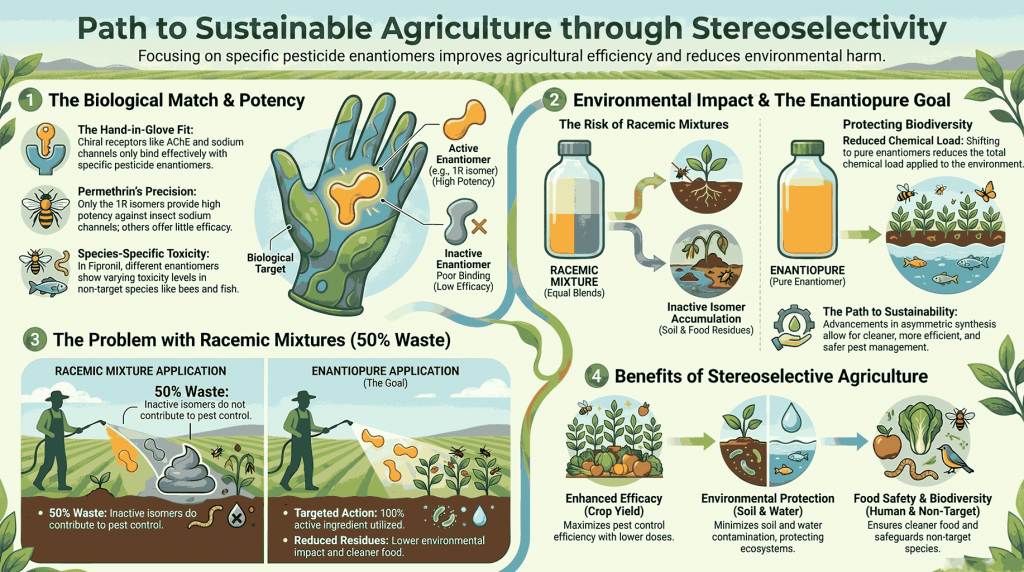
Pesticides are essential tools in modern agriculture, protecting crops from insects, weeds, and pathogens. Many of these compounds are chiral, meaning they exist as two or more non-superimposable mirror-image forms called enantiomers. Enantiomers often exhibit very different biological activities, toxicities, and environmental behaviors. Understanding these stereochemical differences is critical to designing pesticides that are both effective and safe.
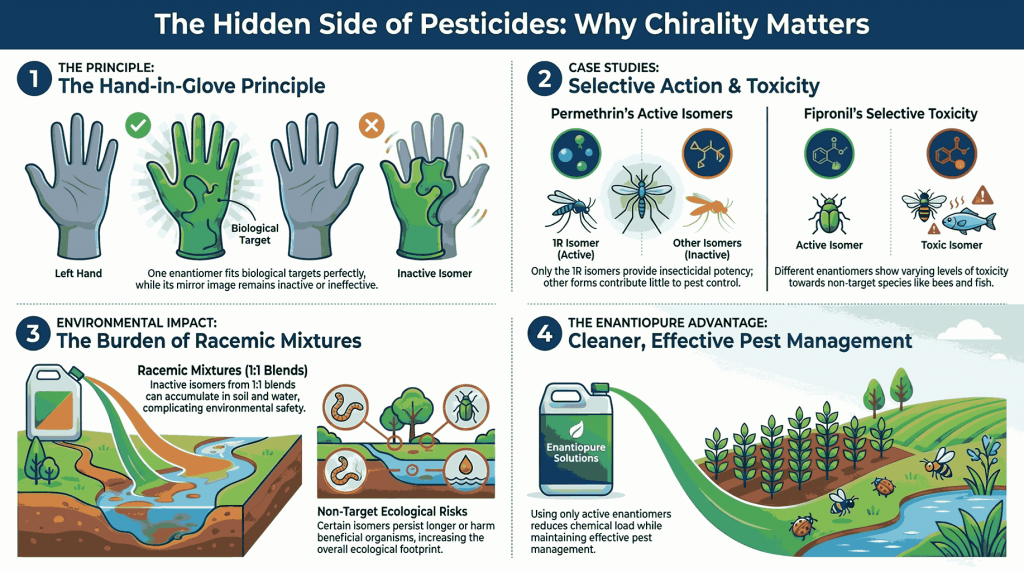
Enantioselectivity in pesticides arises because the molecular targets of these chemicals, such as insect neurotransmitter receptors or enzymes, are themselves chiral. Just as one hand fits into a glove better than the other, one enantiomer often interacts strongly with its biological target, while the mirror image shows little or no activity. This stereoselective interaction is at the core of the efficacy of many chiral pesticides.
This blog explores how stereochemistry governs pesticide efficacy, toxicity, and environmental behavior, highlighting why chirality matters in modern agrochemical science.
Chirality in Insecticides
Stereochemistry plays a crucial role in determining the toxicological profile of many chiral xenobiotics
. One of the most important classes of chiral insecticides is the pyrethroids, which are synthetic analogs of natural pyrethrins derived from chrysanthemum flowers. Pyrethroids such as permethrin, cypermethrin, and deltamethrin possess multiple stereogenic centers, giving rise to several stereoisomers. Among these, only certain stereoisomers contribute significantly to insecticidal activity.
Case Study 1: Permethrin
Permethrin, is a synthetic pyrethroid insecticide, exist in four stereoisomers (two enantiomeric pairs), arising from the two stereocenters in the cyclopropane ring. (1R,3S)-trans and (1R,3R)-cis enantiomers are responsible for the insecticidal properties of permethrin.
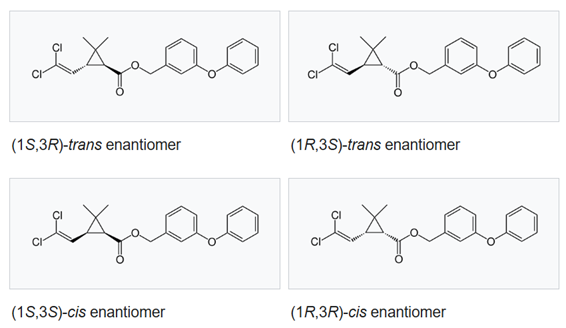
In permethrin, the cis isomers are generally more active than the trans isomers, and within these, the 1R configuration shows the highest potency against insect sodium channels (Soderlund et al., 2002). The other stereoisomers contribute little to efficacy but may persist in the environment or affect non-target species.
Case Study 1: Fipronil
Another example is, Fipronil, a broad-spectrum insecticide that belongs to the phenylpyrazole insecticide class which is used widely against crop pests and termites.
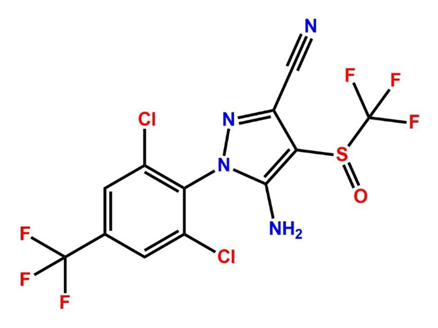
Fipronil exists as two enantiomers that differ in both insecticidal potency and toxicity to non-target organisms such as bees and fish. The stereoselective toxicity of fipronil highlights the importance of studying each enantiomer separately in environmental risk assessments.
Stereoselectivity in Mode of Action
The mechanism of pesticide action often involves binding to specific proteins or receptors in target pests. Because these binding sites are chiral, even small differences in stereochemistry can lead to large differences in biological response.
Organophosphate and carbamate insecticides, for example, inhibit acetylcholinesterase (AChE), an enzyme critical for nerve function. Enantiomers of these compounds vary in their ability to inhibit AChE, with one enantiomer often being orders of magnitude more potent than the other. This stereoselectivity translates directly into differences in insecticidal activity and mammalian toxicity.
Neonicotinoids such as imidacloprid and thiacloprid also demonstrate stereoselectivity in binding to insect nicotinic acetylcholine receptors. Subtle changes in stereochemistry alter binding affinities, influencing both pest control efficacy and toxicity to beneficial insects.
Environmental and Toxicological Implications
The use of racemic pesticide mixtures, where both enantiomers are present in equal amounts, introduces inefficiencies and risks. The inactive enantiomer may accumulate in soil and water, degrade at a different rate, or exert unintended toxic effects on non-target organisms.
For instance, enantioselective degradation has been documented in pyrethroids, with certain stereoisomers persisting longer in the environment than others. These differences can alter exposure levels, increase ecological risk, and complicate resistance management strategies in target pests.
From a food safety perspective, residues of inactive or toxic enantiomers on crops present an added layer of concern. Regulatory authorities are increasingly recognizing the need for enantiomer-specific data to ensure accurate risk assessments.
Toward Enantiopure Insecticides
The development of enantiopure insecticides represents an opportunity to enhance efficacy while reducing chemical load. By using only the active enantiomer, farmers can apply smaller amounts of pesticide with the same or greater pest control effect. This reduces environmental exposure, improves safety for non-target organisms, and aligns with sustainable agriculture practices (Williams, 1996).
Advances in asymmetric synthesis and chiral separation technologies are making it more feasible to produce enantiopure pesticides at industrial scale. Such approaches are likely to become increasingly important as regulators and consumers demand safer and more sustainable crop protection solutions.
Conclusion
Chirality profoundly influences the biological activity of pesticides. Insecticides such as pyrethroids, fipronil, organophosphates, and neonicotinoids demonstrate clear enantioselective differences in efficacy, toxicity, and environmental fate. While racemic mixtures still dominate agricultural practice, the shift toward enantiopure insecticides offers a pathway to more efficient and sustainable pest management.
As this series continues, we will explore the role of chirality in herbicides and fungicides, building a comprehensive picture of how stereochemistry shapes modern agrochemistry.
References
Ariëns E.J. (1984). Stereochemistry, a basis for sophisticated nonsense in pharmacokinetics and clinical pharmacology. Eur J Clin Pharmacol. 26(6): 663–668.
Ye J, Zhao M, Niu L, Liu W. (2015). Enantioselective environmental toxicology of chiral pesticides. Chem Res Toxicol. 16;28(3):325-38. doi: 10.1021/tx500481n.
Li C, Wang L, Dai Q, Chong Y, Utsunomiya S, Wang H, Zhang Y, Han J. (2025). Chiral pesticide permethrin promotes the antibiotic resistance genes dissemination by transformation: Different chiral isomers engage in distinct regulatory pathways. J Hazard Mater. 488:137416. doi: 10.1016/j.jhazmat.2025.137416.
Dornetshuber J, Bicker W, Lämmerhofer M, Lindner W, Karwan A, Bursch W (14 November 2007). “Impact of stereochemistry on biological effects of permethrin: induction of apoptosis in human hepatoma cells (HCC-1.2) and primary rat hepatocyte cultures”. BMC Pharmacology. 7 (Supplement 2) A65. doi:10.1186/1471-2210-7-S2-A65. ISSN 1471-2210.
Soderlund DM, Clark JM, Sheets LP, Mullin LS, Piccirillo VJ, Sargent D, Stevens JT, Weiner ML. (2002) Mechanisms of pyrethroid neurotoxicity: implications for cumulative risk assessment. Toxicology. 171(1):3-59. doi: 10.1016/s0300-483x(01)00569-8.
https://www.acs.org/molecule-of-the-week/archive/f/fipronil.html
Overmyer JP, Rouse DR, Avants JK, Garrison AW, Delorenzo ME, Chung KW, Key PB, Wilson WA, Black MC. Toxicity of fipronil and its enantiomers to marine and freshwater non-targets. J Environ Sci Health B. 2007 Jun-Jul;42(5):471-80. doi: 10.1080/03601230701391823.
Ou Y, Yan Z, Shi G, Yu Z, Cai Y, Ma R. Enantioselective toxicity, degradation and transformation of the chiral insecticide fipronil in two algae culture. Ecotoxicol Environ Saf. 2022 Apr 15;235:113424. doi: 10.1016/j.ecoenv.2022.113424.
Buser H.R., Müller M.D., Rappe C. (1992). Enantioselective determination of chiral phenoxy herbicides and their environmental behavior. Anal Chem. 64(13): 1461–1467.
European Food Safety Authority (EFSA); Bura L, Friel A, Magrans JO, Parra-Morte JM, Szentes C. (2019). Guidance of EFSA on risk assessments for active substances of plant protection products that have stereoisomers as components or impurities and for transformation products of active substances that may have stereoisomers. EFSA J. 26;17(8):e05804. doi: 10.2903/j.efsa.2019.5804.
Hollingworth R.M., Dong K. (2008). The biochemical and molecular genetic basis of resistance to pesticides. In: Global Pesticide Resistance in Arthropods. CABI Publishing, Wallingford, pp. 40–89.
Tomizawa M, Casida JE. (2005). Neonicotinoid insecticide toxicology: mechanisms of selective action. Annu Rev Pharmacol Toxicol. 45:247-68. doi: 10.1146/annurev.pharmtox.45.120403.095930.
Xiaoqun Yang, Shichun Jiang, Zhichao Jin, Tingting Li. (2024). Application of Asymmetric Catalysis in Chiral Pesticide Active Molecule Synthesis. J. Agric. Food Chem. 72, 31, 17153–17165. https://doi.org/10.1021/acs.jafc.4c02343
Jeschke P. (2025). The continuing significance of chiral agrochemicals. Pest Manag Sci. Apr;81(4):1697-1716. doi: 10.1002/ps.8655.
Peter Jeschke. (2024). New Active Ingredients for Sustainable Modern Chemical Crop Protection in Agriculture, 2024. https://doi.org/10.1002/cssc.202401042,
Vashistha VK, Sethi S, Mittal A, Das DK, Pullabhotla RVSR, Bala R, Yadav S. (2024). Stereoselective analysis of chiral pesticides: a review. Environ Monit Assess. Jan 16;196(2):153. doi:10.1007/s10661-024-12310-0.
García-Cansino L, Marina ML, García MÁ. Chiral Analysis of Pesticides and Emerging Contaminants by Capillary Electrophoresis-Application to Toxicity Evaluation. Toxics. 2024 Feb 28;12(3):185. doi: 10.3390/toxics12030185
Peter Jeschke (2018) Current status of chirality in agrochemicals. https://doi.org/10.1002/ps.5052
Garrison, A. W. (2011). An introduction to pesticide chirality and the consequences of stereoselectivity. In H. Ohkawa, H. Miyagawa, & P. W. Lee (Eds.), Chiral pesticides: Stereoselectivity and its consequences (ACS Symposium Series, Vol. 1085, pp. 1–7). American Chemical Society. https://doi.org/10.1021/bk-2011-1085.ch001
Williams, A. (1996), Opportunities for chiral agrochemicals. Pestic. Sci., 46: 3-9. https://doi.org/10.1002/(SICI)1096-9063(199601)46:1<3::AID-PS337>3.0.CO;2-J
Donald G. Crosby (1973). The Fate of Pesticides in the Environment, Annual Review of Plant Physiology 24(1):467-492. DOI:10.1146/annurev.pp.24.060173.002343
Crosby D.G. (1995). Environmental fate of pesticides: stereochemistry as a factor in transformation and degradation. Pure Appl Chem. 67(3): 407–412.
Liu W, Gan J, Schlenk D, Jury WA. (2005). Enantioselectivity in environmental safety of current chiral insecticides. Proc Natl Acad Sci U S A. 18;102(3):701-6. doi: 10.1073/pnas.0408847102.
Garrison A.W., Avants J.K., Jones W.J. (1996). Enantiomeric selectivity in the environmental degradation of pesticides. Environ Sci Technol. 30(8): 2449–2455.
Yamamoto H., Miyake T., Ohkawa H. (1987). Enantioselective activity of metalaxyl enantiomers against plant pathogens. Pestic Biochem Physiol. 28(2): 163–171.
European Food Safety Authority (EFSA); Bura L, Friel A, Magrans JO, Parra-Morte JM, Szentes C. (2019). Guidance of EFSA on risk assessments for active substances of plant protection products that have stereoisomers as components or impurities and for transformation products of active substances that may have stereoisomers. EFSA J. 26;17(8):e05804. doi: 10.2903/j.efsa.2019.5804.
Zhang Y, Liu D, Diao J, He Z, Zhou Z, Wang P, Li X. (2010). Enantioselective environmental behavior of the chiral herbicide fenoxaprop-ethyl and its chiral metabolite fenoxaprop in soil. J Agric Food Chem. 22;58(24):12878-84. doi: 10.1021/jf103537a.
Liu W, Gan J, Schlenk D, Jury WA. (2005). Enantioselectivity in environmental safety of current chiral insecticides. Proc Natl Acad Sci U S A. 18;102(3):701-6. doi: 10.1073/pnas.0408847102.
Yandi Fu, Francesc Borrull, Rosa Maria Marcé, Núria Fontanals. (2021). Enantiomeric fraction determination of chiral drugs in environmental samples using chiral liquid chromatography and mass spectrometry, Trends in Environmental Analytical Chemistry.
https://doi.org/10.1016/j.teac.2021.e00115.
Qu H, Wang P, Ma RX, Qiu XX, Xu P, Zhou ZQ, Liu DH. (2014). Enantioselective toxicity, bioaccumulation and degradation of the chiral insecticide fipronil in earthworms (Eisenia feotida). Sci Total Environ. 485-486:415-420. doi: 10.1016/j.scitotenv.2014.03.054.
Overmyer JP, Rouse DR, Avants JK, Garrison AW, Delorenzo ME, Chung KW, Key PB, Wilson WA, Black MC. (2007). Toxicity of fipronil and its enantiomers to marine and freshwater non-targets. J Environ Sci Health B. 42(5):471-80. doi: 10.1080/03601230701391823.
Further Reading