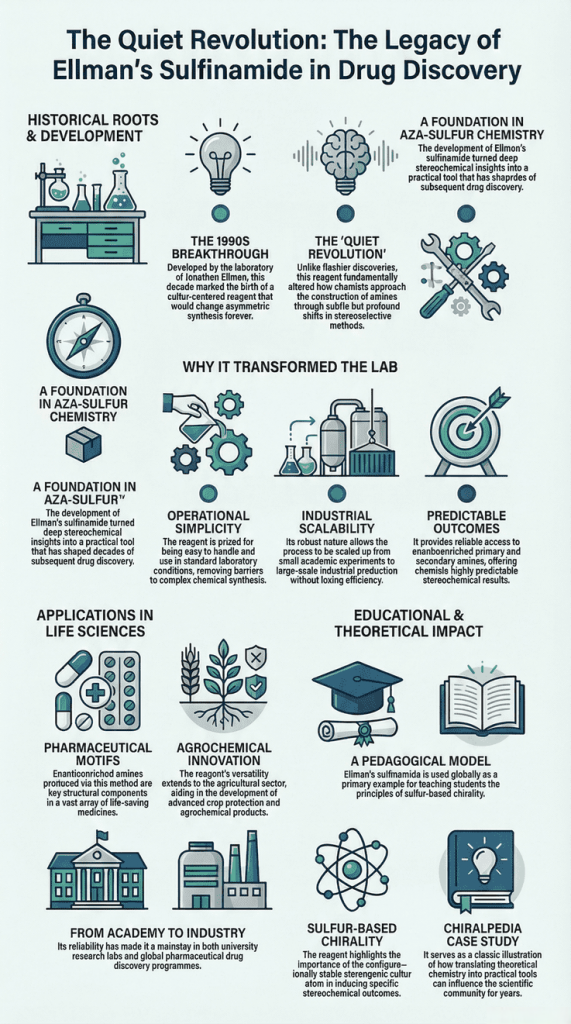
A Quiet Revolution in Asymmetric Synthesis
tert-Butanesulfinamide, widely known as Ellman’s sulfinamide, is one of the most influential chiral auxiliaries in modern asymmetric synthesis. Developed in the 1990s by the laboratory of Jonathan Ellman, this sulfur-centered chiral reagent revolutionized the stereoselective construction of amines—key structural motifs in pharmaceuticals and agrochemicals. Its configurationally stable stereogenic sulfur atom enables the formation of N-sulfinyl imines that undergo highly diastereoselective nucleophilic additions, providing reliable access to enantioenriched primary and secondary amines. The reagent’s operational simplicity, scalability, and predictable stereochemical outcomes have made it a mainstay in both academic and industrial drug discovery programs.
Beyond its synthetic utility, tert-butanesulfinamide serves as a pedagogical model for sulfur-based chirality and stereochemical induction. This blog explores its origin, stereochemical principles, mechanistic features, and broad impact on medicinal chemistry, highlighting how a foundational advance in aza-sulfur chemistry continues to shape life-saving therapeutic innovation. Futher, through the Chiralpedia lens, this case study illustrates how deep stereochemical insight, when translated into practical synthetic tools, can shape decades of drug discovery.
1. Background: The Stereochemical Bottleneck
By the late 20th century, medicinal chemistry had clearly established one fact – Chiral amines are everywhere in drug molecules. They appear in treatments for:
- CNS disorders
- Cardiovascular diseases
- Infectious diseases
- Oncology
Yet synthesizing them in high enantiomeric purity was often difficult, expensive, or unreliable at scale. The core challenge:
- How do we build stereochemically defined amines efficiently?
- Can stereocontrol be predictable and scalable?
- Can asymmetric induction be operationally simple?
This was not just a synthetic question. It was a pharmaceutical one.
2. The Founder: Jonathan Ellman and the Birth of a Platform
At this pivotal moment in asymmetric synthesis, the work of Jonathan Ellman began to reshape the field.
In the 1990s, Ellman’s laboratory sought practical solutions to a pressing problem: how to construct enantioenriched amines reliably and predictably. Rather than focusing exclusively on catalytic systems, his group explored the strategic use of sulfur-based auxiliaries. The breakthrough was conceptual. Ellman recognized that a stereogenic sulfur atom could serve as a temporary but powerful controller of three-dimensional architecture during C–N bond formation. By converting carbonyl compounds into N-sulfinyl imines, the sulfur center imposed stereochemical order on subsequent transformations.
What emerged was not simply a new reagent, but a generalizable synthetic strategy — one adaptable to diverse substrates and reaction types. Over time, this methodology influenced medicinal chemistry programs worldwide, contributing to clinical candidates and multiple FDA-approved drugs and agrochemicals.
This was the birth of a platform: a methodological advance that outlived its original publication and became embedded in the practice of drug synthesis.
3. The Innovation: Sulfur as a Stereochemical Architect
The breakthrough came from revisiting an underappreciated idea:
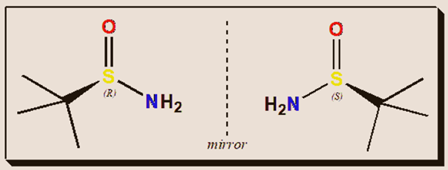
Chirality does not belong only to carbon. tert-Butanesulfinamide features a stereogenic sulfur atom bonded to: A tert-butyl group, An NH₂ group, One S=O bond, A lone pair. That gives sulfur a tetrahedral geometry with four different substituents.
Because these four groups are different, sulfur becomes a stereogenic center.This tetrahedral arrangement allows for stable R and S configurations at sulfur. Ellman’s key insight was to use this sulfur-centered chirality as a temporary stereochemical director.
The Strategy
- Form an N-sulfinyl imine
- Perform diastereoselective nucleophilic addition
- Remove the sulfinyl auxiliary
The result: highly enantioenriched amines. This approach transformed sulfur from a passive heteroatom into a stereochemical architect.
4. Why It Worked: Mechanistic Foundations of Its Success
The widespread adoption of tert-butanesulfinamide can be traced to clear mechanistic advantages
Predictable Stereochemical Induction – – The bulky tert-butyl group creates strong steric bias, guiding nucleophilic approach. The steric and electronic properties of the sulfinyl group guide nucleophilic approach to the imine, favoring formation of one diastereomer over the other.
Configurational Stability – The S=O bond provides both electronic activation and structural rigidity, enhancing selectivity during addition reactions. The sulfur center resists inversion under reaction conditions.
Operational Simplicity – – Reactions proceed under mild, reproducible conditions.
Clean Auxiliary Removal – -After stereochemical induction, the sulfinyl group can be cleaved under controlled conditions, revealing the free amine without erosion of enantiopurity.
Scalability – The method translated effectively into industrial settings.
In short, the success of this reagent was not accidental. It rested on well-understood stereochemical and electronic principles that translated into reproducible synthetic outcomes.
5. Impact: From Reagent to Real Medicines
Over time, the influence of Ellman’s chemistry expanded dramatically. Research emerging from his laboratory contributed to:
- Numerous clinical candidates
- At least 10 FDA-approved drugs and agrochemicals
While tert-butanesulfinamide is not itself a drug, it enabled the construction of complex amine-containing scaffolds that became therapeutic agents. This is a classic enabling-technology story. Drug discovery is rarely a straight line. It is a network of foundational innovations, each one enabling the next. tert-Butanesulfinamide became one of those foundational nodes.
6. Educational Insight: Lessons for Stereochemical Literacy
Through the Chiralpedia perspective, this case study highlights critical teaching points:
1️⃣ Chirality Beyond Carbon: Students often equate stereochemistry with carbon centers. This reagent expands that worldview.
2️⃣ Auxiliary vs. Catalysis: Chiral auxiliaries remain highly relevant, even in the age of asymmetric catalysis.
3️⃣ Structure–Function Thinking: Stereochemical control is not decorative—it determines biological interaction.
4️⃣ Synthetic Foresight: Today’s methodological advance may become tomorrow’s life-saving therapy.
In an era increasingly shaped by AI-driven molecular design, the ability to construct enantioenriched molecules remains indispensable. Models may predict. Chemists must build.
7. Broader Scientific Ripple Effects
The success of tert-butanesulfinamide stimulated broader exploration in:
- Aza-sulfur chemistry
- Sulfur-based stereogenic systems
- Chiral auxiliary design
- Industrial asymmetric synthesis
It also trained a generation of chemists who continued advancing synthetic methodology in academia and industry. Innovation, in chemistry, compounds.
8. Through the Chiralpedia Lens: The Deeper Reflection
At Chiralpedia, we often emphasize a simple but powerful idea: Stereochemistry is infrastructure. It is not an optional refinement. It is the structural grammar of biological interaction. tert-Butanesulfinamide teaches us that:
- A single stereogenic sulfur atom can control molecular destiny.
- Method development is not separate from medicine—it precedes it.
- Precision in 3D molecular construction shapes global health outcomes.
The reagent began as a solution to a synthetic problem. It evolved into a platform technology. It ultimately contributed to therapeutic innovation. That is the arc of meaningful chemistry.
9. Lessons for Future Innovators
For researchers, educators, and students, this case study offers enduring guidance:
- Invest in fundamental understanding.
- Explore underutilized stereogenic elements.
- Design reagents with both mechanistic clarity and practical scalability.
- Teach stereochemistry as a living, evolving discipline.
The next transformative tool in drug synthesis may already be emerging in a laboratory today. It may look small. It may seem technical. It may appear niche. But as tert-butanesulfinamide shows, precision in molecular design can echo across decades.
Closing Reflection
tert-Butanesulfinamide stands as more than a chiral auxiliary. It represents:
- The power of sulfur-centered chirality
- The importance of synthetic methodology
- The long-term impact of fundamental research
Through the Chiralpedia lens, this case study reminds us:
When we refine stereochemical language, we refine the molecules that interact with life itself. And sometimes, that refinement becomes medicine.
Reference
Charlyn Paradis. From dark days of HIV-AIDS, advances in aza-sulfur chemistry enable breakthrough treatment—and other chemical innovations. 2026. https://chem.yale.edu/posts/2026-01-26-from-dark-days-of-hiv-aids-advances-in-aza-sulfur-chemistry-enable-breakthrough
Ellman JA, Owens TD, Tang TP. N-tert-butanesulfinyl imines: versatile intermediates for the asymmetric synthesis of amines. Acc Chem Res. 2002 Nov;35(11):984-95. https://doi.org/10.1021/ar020066u
Davis, F. A., Yang, B., Deng, J., Wu, Y., Zhang, Y., Rao, A., … Anilkumar, G. (2005). Asymmetric Synthesis Using Sulfinimines (N-Sulfinyl Imines). Phosphorus, Sulfur, and Silicon and the Related Elements, 180(5–6), 1109–1117. https://doi.org/10.1080/10426500590910648
MaryAnn T. Robak, Melissa A. Herbage, Jonathan A. Ellman. Synthesis and Applications of tert-Butanesulfinamide. Chem. Rev. 2010, 110, 6, 3600–3740. https://doi.org/10.1021/cr900382t
Guo-Qiang Lin, Ming-Hua XU, Yu-Wu Zhong., and Xing-Wen Sun. An Advance on Exploring N–tert-Butanesulfinyl Imines in Asymmetric Synthesis of Chiral Amines. Acc. Chem. Res. 2008, 41, 7, 831–840. https://doi.org/10.1021/ar7002623
Futher Reading

A wonderful and insightful write-up!
My sincere appreciation to Dr. Valliappan for elegantly highlighting the noble and impactful research of Prof. Jonathan Ellman. The contribution of tert-butanesulfinamide has truly transformed asymmetric synthesis and drug development.
A fitting tribute to both the science and the scientist!
Thank you for your kind words. It was a privilege to highlight Prof. Ellman’s remarkable contributions—truly a legacy that continues to shape modern chemistry. I’m glad you found it meaningful.