
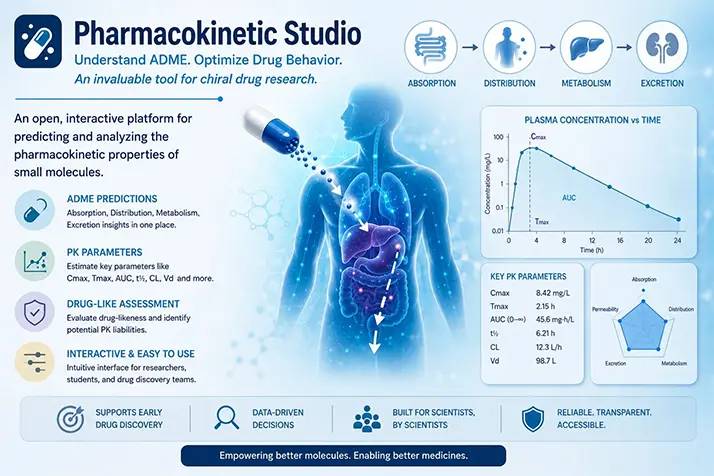
Understanding Drug Disposition Through Data & Modeling
Pharmacokinetics (PK) describes what the body does to a drug—how it is absorbed, distributed, metabolized, and excreted (ADME). Pharmacokinetic analysis transforms concentration–time data into quantitative measures of drug exposure and disposition, providing essential insights for drug discovery, development, dosing, bioavailability, bioequivalence, and therapeutic optimization.
Within Chiral ToolBox, this section brings together curated pharmacokinetic software and computational resources that support the analysis, visualization, modeling, and interpretation of PK data. These tools can assist with noncompartmental analysis, pharmacokinetic parameter estimation, compartmental modeling, bioequivalence assessment, and other data-driven PK workflows.
For chiral drug research, pharmacokinetic analysis has an additional dimension. Different enantiomers of the same drug can exhibit markedly different absorption, distribution, metabolism, and elimination, resulting in stereoselective exposure and disposition. Enantiomer-specific PK analysis can therefore help reveal differences in parameters such as Cmax, Tmax, AUC, clearance, volume of distribution, and elimination half-life, providing important insights into the behavior of chiral medicines.
Explore the curated resources within this section to discover how pharmacokinetic analysis can support research, development, and understanding of chiral drugs.