Enantioenriched

Paired Concept:
Enantiopure (Enantiomerically pure)
Definition: A chiral substance that contains one enantiomer in greater proportion than the other but is not necessarily enantiopure. An enantioenriched sample exhibits a non-zero enantiomeric excess (ee), indicating an excess of one enantiomer over its mirror-image counterpart.
Context: Many asymmetric syntheses, biocatalytic transformations, and chiral resolution processes produce enantioenriched rather than fully enantiopure products. The degree of enrichment is commonly expressed as enantiomeric excess (% ee). Enantioenriched compounds are important in pharmaceuticals, agrochemicals, and fine chemicals because biological activity often depends on the relative proportions of the two enantiomers. Higher enantiomeric enrichment generally leads to greater selectivity and more predictable biological effects.
Example: A sample of naproxen containing 95% S-naproxen and 5% R-naproxen is enantioenriched (90% ee) but not enantiopure. Similarly, an asymmetric catalytic reaction yielding a product with 80% ee produces an enantioenriched compound.
Related Terms: Enantiopure, Enantiomer, Racemate, Enantiomeric Excess (ee), Chiral Purity, Asymmetric Synthesis, Chiral Resolution.
Reference: Eliel, E. L., Wilen, S. H., & Doyle, M. P. (1994). Basic Organic Stereochemistry. New York: John Wiley & Sons. ISBN: 978-0471374993; Jacques, J., Collet, A., & Wilen, S. H. (1994). Enantiomers, Racemates, and Resolutions. Krieger Publishing Company, Malabar, Florida. ISBN: 978-0894648282; Carey, F. A., & Sundberg, R. J. (2007). Advanced Organic Chemistry, Part A: Structure and Mechanisms (5th ed.). Springer. ISBN: 978-0387448979; International Union of Pure and Applied Chemistry. Compendium of Chemical Terminology (Gold Book). Definition of "Enantiomeric Excess" and related stereochemical terminology.
Key Distinction: Enantiopure: Contains essentially only one enantiomer (≈100% ee).
Enantioenriched: Contains one enantiomer in excess over the other (>0% ee but < 100% ee).
Racemate: Contains equal amounts of both enantiomers (0% ee).
Enantiomeric Excess (ee): A quantitative measure of the excess of one enantiomer over the other in a mixture, calculated as:
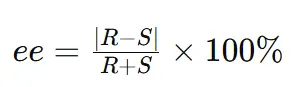
where R and S represent the amounts (or percentages) of the two enantiomers.