A
Anti-(Stereochemical Descriptor)

Associated Concept:
Syn (Stereochemical Descriptor)
Definition: Describes two substituents or groups positioned on opposite sides of a reference plane or dihedral angle (180° apart).
Context: Used to describe relative configuration in alkenes, aldols, and conformational analysis.
Example: Anti-periplanar geometry in E2 eliminations or anti-diol configurations.
Related Terms: Syn; Antiperiplanar; Synclinal.
Reference: IUPAC. Compendium of Chemical Terminology (IUPAC Gold Book), 2nd Edition, 1997 (updated 2019).
E
Enantioconvergent Synthesis
Definition: Both enantiomers of a racemic starting material are transformed into one enantiomeric product.
Context: Maximizes material economy in process chemistry.
Example: Ni-catalyzed cross-couplings with stereoretention.
Related Terms: DYKAT, Stereoretentive Coupling.
Reference: Fu, Acc. Chem. Res. (2017).
Enantioenriched
Associated Concept:
Enantiopure (Enantiomerically pure)
Definition: A chiral substance that contains one enantiomer in greater proportion than the other but is not necessarily enantiopure. An enantioenriched sample exhibits a non-zero enantiomeric excess (ee), indicating an excess of one enantiomer over its mirror-image counterpart.
Context: Many asymmetric syntheses, biocatalytic transformations, and chiral resolution processes produce enantioenriched rather than fully enantiopure products. The degree of enrichment is commonly expressed as enantiomeric excess (% ee). Enantioenriched compounds are important in pharmaceuticals, agrochemicals, and fine chemicals because biological activity often depends on the relative proportions of the two enantiomers. Higher enantiomeric enrichment generally leads to greater selectivity and more predictable biological effects.
Example: A sample of naproxen containing 95% S-naproxen and 5% R-naproxen is enantioenriched (90% ee) but not enantiopure. Similarly, an asymmetric catalytic reaction yielding a product with 80% ee produces an enantioenriched compound.
Related Terms: Enantiopure, Enantiomer, Racemate, Enantiomeric Excess (ee), Chiral Purity, Asymmetric Synthesis, Chiral Resolution.
Reference: Eliel, E. L., Wilen, S. H., & Doyle, M. P. (1994). Basic Organic Stereochemistry. New York: John Wiley & Sons. ISBN: 978-0471374993; Jacques, J., Collet, A., & Wilen, S. H. (1994). Enantiomers, Racemates, and Resolutions. Krieger Publishing Company, Malabar, Florida. ISBN: 978-0894648282; Carey, F. A., & Sundberg, R. J. (2007). Advanced Organic Chemistry, Part A: Structure and Mechanisms (5th ed.). Springer. ISBN: 978-0387448979; International Union of Pure and Applied Chemistry. Compendium of Chemical Terminology (Gold Book). Definition of "Enantiomeric Excess" and related stereochemical terminology.
Key Distinction: Enantiopure: Contains essentially only one enantiomer (≈100% ee).
Enantioenriched: Contains one enantiomer in excess over the other (>0% ee but < 100% ee).
Racemate: Contains equal amounts of both enantiomers (0% ee).
Enantiomeric Excess (ee): A quantitative measure of the excess of one enantiomer over the other in a mixture, calculated as:
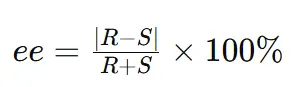
where R and S represent the amounts (or percentages) of the two enantiomers.
Enantiomer Associated Concept:
Diastereomer Definition: One of a pair of non-superimposable mirror-image stereoisomers.
Context: Enantiomers may differ in PK/PD and toxicity; single-enantiomer drugs are often preferred.
Example: S-ibuprofen (eutomer) vs R-ibuprofen (distomer).
Related Terms: Racemate, Eutomer, Distomer.
Reference: Morrison & Boyd, Organic Chemistry.
Enantiomeric Excess (ee)
Definition: The absolute difference in enantiomer fractions (|%R − %S|).
Context: Standard QC metric for chiral purity in pharma.
Example: 70% R, 30% S → 40% ee.
Related Terms: Enantiomeric Ratio, Optical Purity.
Reference: IUPAC Gold Book.
Enantiomeric Ratio (er)
Definition: The ratio of enantiomers, typically expressed as R:S.
Context: Preferred over ee for statistical modeling and kinetics.
Example: 98:2 e.r. for a product.
Related Terms: Enantiomeric Excess, dr.
Reference: IUPAC Gold Book.
Enantiomerization
Definition: Interconversion between enantiomers via bond rotation or reversible processes.
Context: Defines shelf-life and handling conditions for atropisomeric drugs.
Example: Biaryl axis rotation over barrier ΔG‡.
Related Terms: Racemization, Barrier to Rotation.
Reference: IUPAC Gold Book.
Enantiopure (Enantiomerically pure)
Associated Concept:
Scalemic Mixture |
Racemic Mixture
Definition: A chiral substance that contains only one enantiomer, with an enantiomeric excess (ee) of essentially 100%. In an
enantiopure sample, the opposite enantiomer is absent or present only in negligible trace amounts.
Context: Enantiopure compounds are highly valued in pharmaceutical, agrochemical, and fine chemical industries because the two
enantiomers of a chiral molecule can exhibit markedly different biological, pharmacological, toxicological, or
environmental behaviors. Advances in asymmetric synthesis, chiral resolution, and chiral chromatography have enabled the
production of enantiopure substances on both laboratory and industrial scales. Regulatory agencies often require
separate evaluation of individual enantiomers when stereochemistry significantly influences efficacy or safety.
Example: The proton-pump inhibitor Esomeprazole consists exclusively of the S-enantiomer of omeprazole and is therefore an
enantiopure drug. Similarly, Levofloxacin is the enantiopure S-enantiomer of ofloxacin.
Related Terms: Enantiomer, Enantioenriched, Racemate, Chiral Purity, Enantiomeric Excess (ee), Asymmetric Synthesis, Chiral Resolution.
Reference: Eliel, E. L., Wilen, S. H., & Doyle, M. P. (1994). Basic Organic Stereochemistry. New York: John Wiley & Sons. ISBN:
978-0471374993; Jacques, J., Collet, A., & Wilen, S. H. (1994). Enantiomers, Racemates, and Resolutions. Krieger
Publishing Company, Malabar, Florida. ISBN: 978-0894648282; Carey, F. A., & Sundberg, R. J. (2007). Advanced Organic
Chemistry, Part A: Structure and Mechanisms (5th ed.). Springer. ISBN: 978-0387448979; IUPAC Compendium of Chemical
Terminology (Gold Book). Definition of "Enantiomerically Pure" and related stereochemical terminology. Published by the
International Union of Pure and Applied Chemistry.
Enantioselective Metabolism
Definition: Metabolic pathways that preferentially process one enantiomer.
Context: Causes distinct clearance and exposure for enantiomers.
Example: CYP-mediated oxidation of one enantiomer faster than the other.
Related Terms: Stereopharmacology, Chiral Inversion.
Reference: Testa & Krämer, Drug Metabolism (2008).
Enantioselectivity
Definition: Preference for formation of one enantiomer over the other (quantified as ee or er).
Context: Primary performance metric in asymmetric synthesis and catalysis.
Example: 98:2 e.r. in asymmetric hydrogenation.
Related Terms: Stereoselectivity, Enantiospecificity.
Reference: Noyori, Nobel Lecture (2001).
Enantiospecificity
Definition: A reaction in which the enantiomeric identity of the product is determined by that of the starting material.
Context: Key in stereoretentive cross-couplings and biosynthetic steps.
Example: Stereoretentive substitution maintaining configuration.
Related Terms: Stereospecificity, Enantioselectivity.
Reference: IUPAC Gold Book.
Enantiotopic
Associated Concept:
Diastereotopic
Definition: A term describing two identical atoms, groups, or faces within the same achiral molecule that are related by mirror symmetry and whose replacement or reaction leads to a pair of enantiomers.
Context: Enantiotopic groups are chemically equivalent in an achiral environment and therefore usually exhibit identical physical and spectroscopic properties (e.g., a single NMR signal). However, they become distinguishable in a chiral environment, such as in the presence of a chiral reagent, catalyst, enzyme, solvent, or receptor. The concept of enantiotopicity is fundamental to prochirality, asymmetric synthesis, and enzyme stereospecificity.
Example: The two hydrogen atoms of the CH?OH group in ethanol are enantiotopic. Replacing one hydrogen with deuterium produces one enantiomer, whereas replacing the other produces its mirror image.
Related Terms: Diastereotopic, Homotopic, Prochirality, Pro-R, Pro-S, Re/Si Face, Stereotopicity, Enantiomer.
Reference: Eliel, E. L., Wilen, S. H., & Doyle, M. P. (1994). Basic Organic Stereochemistry. New York: John Wiley & Sons. ISBN: 978-0471374993; Clayden, J., Greeves, N., & Warren, S. (2012). Organic Chemistry (2nd ed.). Oxford University Press. ISBN: 978-0199270294; Anslyn, E. V., & Dougherty, D. A. (2006). Modern Physical Organic Chemistry. University Science Books. ISBN: 978-1891389314.
International Union of Pure and Applied Chemistry. Compendium of Chemical Terminology (Gold Book) - Entries on enantiotopicity, prochirality, and stereotopicity.
Key Distinction
Homotopic Groups: Replacement of either group produces identical molecules; chemically and spectroscopically equivalent.
Enantiotopic Groups: Replacement of either group produces enantiomers; equivalent in achiral environments but distinguishable in chiral environments.
Diastereotopic Groups: Replacement of either group produces diastereomers; chemically and spectroscopically non-equivalent even in achiral environments.
Pro-R / Pro-S: Labels assigned to enantiotopic atoms or faces according to the configuration that would result if one were preferentially substituted.
Key Insight:
Enantiotopicity is a manifestation of prochirality. Although enantiotopic groups are indistinguishable in ordinary (achiral) chemical environments, biological systems and asymmetric catalysts can differentiate between them, enabling stereoselective reactions and the formation of a single enantiomer. This principle underlies many enzymatic transformations and asymmetric syntheses.